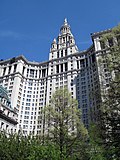
| Jacob K. Javits Federal Building | |
|---|---|
| Jacob K. Javits Federal Building | |
Interactive map of Jacob K. Javits Federal Building | |
| General information | |
| Location | 26 Federal Plaza New York, NY, United States |
| Coordinates | 40°42′54″N74°0′13″W / 40.71500°N 74.00361°W |
| Named for | Jacob K. Javits |
| Groundbreaking | 1963 |
| Opened | 1969 |
| Renovated | 1975–77 |
| Client | Multiple, including United States Department of Homeland Security |
| Owner | General Services Administration |
| Height | 587 ft (179 m) |
| Technical details | |
| Floor count | 41 |
| Design and construction | |
| Architecture firm | Alfred Easton Poor Kahn & Jacobs [1] |
| Part of a series on |
| Immigration policy of the second Trump administration |
|---|
The Jacob K. Javits Federal Office Building is a U.S. governmental office building at 26 Federal Plaza (sometimes referred to simply as 26 Federal Plaza [2] ) on Foley Square in the Civic Center neighborhood of Manhattan in New York City. At 41 stories, it is the tallest federal building in the United States. It was built in 1963–69 and was designed by Alfred Easton Poor and Kahn & Jacobs, with Eggers & Higgins as associate architects. A western addition, first announced on "inadvertently acquired land" in 1965, [3] was built in 1975–77 and was designed by Kahn & Jacobs, The Eggers Partnership and Poor & Swanke. [1] The building is named for Jacob K. Javits, who served as a United States Senator from New York for 24 years, from 1957 to 1981.
The building is assigned its own ZIP Code, 10278; it was one of 41 buildings in Manhattan that had their own ZIP Codes as of 2019 [update] . [4] The building falls under the jurisdiction of the United States Federal Protective Service for any and all law enforcement and protection issues. To the east of the main building is the James L. Watson Court of International Trade Building.
A Gothic style Masonic hall was located at this site between Reade and Pearl Streets from 1826 to 1856, directly across from the original site of the New York Hospital. [5] This served as the home of the Grand Lodge of New York until its demolition.
Agencies located in the building include the Department of Homeland Security, the Department of Health and Human Services, the Social Security Administration, the Department of Housing and Urban Development, and the Federal Executive Board. The U.S. Citizenship and Immigration Services' New York field office is on the 7th floor, the Brooklyn field office is on the 8th floor and the Queens field office is on the 9th floor. [6] The Federal Bureau of Investigation's New York field office is on the 23rd floor. [7] The 12th floor is the site of an immigration court with hallways open to the public. [8]
Former President Richard Nixon rented a federal office in the building from 1980 to 1988. [9]
A controversy developed over the artwork by Richard Serra commissioned for the plaza in front of the building, Tilted Arc . Commissioned in 1979 and built in 1981, it was criticized both for its aesthetic values and for security reasons. [10] It was removed in 1989, which resulted in a lawsuit and a trial. The piece remains in storage, as the artwork was site-specific, and the artist does not want it displayed in any other location. The removal and trial led to the creation of the Visual Artists Rights Act of 1990. [10]
After the removal of Tilted Arc, landscape artist Martha Schwartz re-designed the plaza. [10] Other artworks connected with building include A Study in Five Planes/Peace (1965) by Alexander Calder and the Manhattan Sentinels (1996) by Beverly Pepper. In the James L. Watson Court of International Trade can be found Metropolis (1967) by Seymour Fogel and Eagle/Justice Above All Else (1970) by Theodore Roszak. [10]
In relation to the second administration of Donald Trump's mass deportation campaign, the 10th floor is used as a detention center, where people are held in crowded and unsanitary conditions. [11] [12] [13] In September 2025, access to the building was barred to elected officials, who were arrested when they attempted to inspect the 10th-floor holding cells. [14]
Protesters have repeatedly assembled in Foley Square to protest the building's use for immigration enforcement in NYC during the second Trump administration. [15]
On 30 September 2025, journalists were in a hallway outside the immigration court and immigrant holding facility 26 Federal Plaza, where ICE agents grabbed and shoved journalists. [16]
One journalist, Dean Moses of amNewYork , was pushed off a public elevator while trying to take a photograph of a woman from Peru [17] being arrested who had just left the immigration court. [16] One agent wearing a mask and bulletproof vest labeled "police" grabbed Moses and told him "get the fuck off the elevator." [17] Moses later claimed "I walked into the elevator behind them, and they started screaming at me... Then they pushed me, grabbed me by my arms, and started pulling me out of the elevator. I tried to hold on, but I got shoved out." [16] Moses also alleged it seemed like the agents "didn't want to be seen taking this person." [18]
A freelance journalist who had previously done work for the Associated Press, Olga Fedorova, was shoved to the floor during the struggle between police and Moses. Fedorova claimed no limits were announced on where journalists could go and that there was no warning issued to press not to go on the elevator. [16]
A third journalist, L. Vural Elibol of Turkish news agency Anadolu, sustained injuries after hitting his head against the floor due to being pushed by an ICE agent. Paramedics put him in a neck brace and escorted him out of the building on a stretcher. [16]
A later statement by Homeland Security Assistant Secretary Tricia McLaughlin claimed officers were "swarmed by agitators and members of the press," [18] whom she claimed they warned to move back and get off the elevator [16] citing "concerns with our officers' safety." [17] Democrat politicians denounced the incident, including Kathy Hochul [16] and Hakeem Jeffries. [17] New York Mayoral candidate Zohran Mamdani said "we cannot accept or normalize what has now become routine violence at 26 Federal Plaza." [16] Murad Awawdeh, president of the New York Immigration Coalition also criticized the conflict as indicative of violence becoming the norm in places where due process is upheld. [18]
The incident was later condemned by the Society of Professional Journalists. [19]
{{cite news}}: CS1 maint: url-status (link)