Prairie Grove is a city in Washington County, Arkansas, United States. The population was 7,045 at the 2020 Census. It is part of the Northwest Arkansas region, and home to Prairie Grove Battlefield State Park.
This is a list of properties and historic districts in Arkansas that are listed on the National Register of Historic Places. There are more than 2,600 listings in the state, including at least 8 listings in each of Arkansas's 75 counties.

The President William Jefferson Clinton Birthplace Home National Historic Site is located in Hope, Arkansas. Built in 1917 by H. S. Garrett, in this house the 42nd president of the United States, Bill Clinton, spent the first four years of his life, having been born on August 19, 1946, at Julia Chester Hospital in Hope, Arkansas. The house was owned by Clinton's maternal grandparents, Edith Grisham and James Eldridge Cassidy, and they cared for him when his mother, Virginia, was away working as an anesthetist in New Orleans.

Marianna Missouri Pacific Depot is a historic railroad station at Carolina and Jarrett Streets in Marianna, Arkansas. It is a long rectangular brick building, with a tile roof. A projection on the track side for the telegrapher's booth is matched by a projection on the opposite side. The depot was built in 1915 by the Missouri Pacific Railroad during a major expansion campaign throughout the state, to provide passenger and freight services to the city.

This is a list of the National Register of Historic Places listings in Jefferson County, Arkansas.

This is a list of the National Register of Historic Places listings in Monroe County, Arkansas.
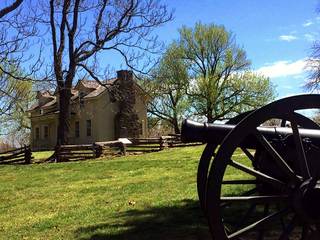
The Prairie Grove Battlefield State Park is a state park located in Prairie Grove, Arkansas. It memorializes the Battle of Prairie Grove, fought on December 7, 1862, during the American Civil War. The battle secured U.S. Army control of northwestern Arkansas.
Booth House may refer to:

This is a list of the National Register of Historic Places listings in Kerr County, Texas.

The Riverside International Speedway is an automobile racing facility at 151 Legion Road in West Memphis, Arkansas. Its facilities consist of a 0.25-mile (0.40 km) Gumbo clay oval with banked corners, bleacher seating on both straightaways. Amenities include a concession stand. The track was built in 1950 and opened June 10 of that year at an estimated cost of $150,000 by C L Montgomery, originally to showcase midget car racing. It has held a World of Outlaws race. The track is nicknamed "The Ditch".

The Green Booth House is a historic house at South Pecan Street and West Center Avenue in Searcy, Arkansas. It is a single-story brick structure, with a broad gabled roof, and a wraparound front porch that extends to a carport on the left. A gabled dormer projects from the center of the front roof slope, and the porch is supported by tapered columns set on brick piers. Built c. 1925, the house is a fine example of the area's second phase of Craftsman architecture.

The Booth-Weir House is a historic house on West First Street in McRae, Arkansas. It is a single-story wood-frame structure, with an irregular cross-gable configuration and a projecting gable-roof porch. It is finished in composition shingles and rests on brick piers. Built in 1911 for a railroad fireman, it is one of a few houses in McRae to survive the pre-World War I period, and is typical of vernacular construction of that period.

The Prairie Grove Airlight Outdoor Telephone Booth is a telephone booth installed at the southwest corner of East Douglas and Parker Streets in Prairie Grove, Arkansas, United States. It is an early example of the Airlight, the first American mass-produced weather-resistant metal telephone booth, which made possible widespread installation of outdoor payphones. In 2015, it became the first phone booth on the National Register of Historic Places.

The former Rock Island Depot is a historic railroad station at the junction of Front and Center Streets in downtown Lonoke, Arkansas. It is a long, rectangular brick building, topped by a steeply-pitched gabled tile roof. Its gable ends are partially stepped and raised above the roof pitch in the Jacobethan style. It stands south of the area where the Rock Island Line railroad tracks ran, and has a three-sided telegrapher's booth projecting from its north side. It was built in 1912, and served as a passenger and freight station for many years, and now houses the local chamber of commerce.
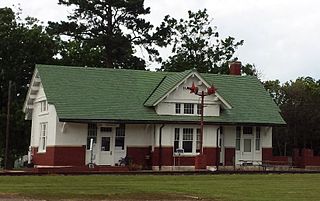
The Rock Island Depot is a historic railroad station at 157 North Front Street, Hazen, Arkansas. It is a single story stuccoed brick building with Mediterranean style, built in 1915 by the Chicago, Rock Island and Pacific Railroad. Its main facade is oriented south, toward the former railroad tracks, with a projecting telegrapher's booth. It is topped by a tile roof with broad eaves supported by large brackets.

The Missouri-Pacific Depot-Clarksville is a historic railroad station between Cherry and Main Streets in Clarksville, Arkansas. It is a single-story masonry structure, built in 1910 by the Missouri-Pacific Railroad in the Mediterranean style. It is basically rectangular, with a projecting cross-gabled telegrapher's booth on the track side, which is topped by a distinctive parapeted gable. The roof has extended eaves supported by large Italianate brackets.

Farm No. 266—Johnny Cash Boyhood Home was the home of singer-songwriter Johnny Cash from 1935 to 1950. Cash moved with his family to a rural community in Mississippi County, Arkansas. The farm house was built in 1934 in a government project to help boost the economy. The Cash family joined the community in March 1935. Ray and Carrie Cash moved to Arkansas when they took an offer to farm government land for poor and impoverished farmers. The Cash family went through many hardships while living in the farm house by floods and losing one of their children, Jack Cash. Growing up picking cotton and working on the farm influenced some of Johnny Cash's songs in the future, one of them being "Pickin' Time." In 2018, the home was listed on the National Register of Historic Places.