
Silphium is a genus of North American plants in the tribe Heliantheae within the family Asteraceae.
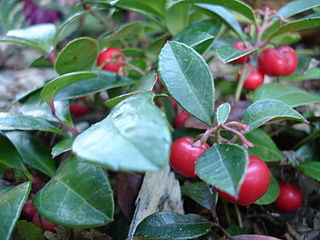
Gaultheria procumbens, also called the eastern teaberry, the checkerberry, the boxberry, or the American wintergreen, is a species of Gaultheria native to northeastern North America from Newfoundland west to southeastern Manitoba, and south to Alabama. It is a member of the Ericaceae.

Sanvitalia ), the creeping zinnias, is a genus of flowering plants belonging to the family Asteraceae. They are native to mostly to Mexico, with a few species in Central America, South America, and the Southwestern United States.

Ageratina altissima, also known as white snakeroot, richweed, or white sanicle, is a poisonous perennial herb in the family Asteraceae, native to eastern and central North America. An older binomial name for this species is Eupatorium rugosum, but the genus Eupatorium has undergone taxonomic revision by botanists, and a number of the species that were once included in it have been moved to other genera.

Anthemis cotula, also known as stinking chamomile, is a flowering annual plant with a noticeable and strong odor. The odor is often considered unpleasant, and it is from this that it gains the common epithet "stinking". In pre-colonial times, its distribution was limited to the Old Continent and Africa; though it was established in most of Europe, it was not present in Finland, Ireland, or the northernmost reaches of Scotland, in spite of the fact that these countries feature climatic regions favorable to this plant and are in proximity to countries where the species is native, such as Russia, Estonia, Lithuania and England. It has successfully migrated to the New Europes where it can be found growing in meadows, alongside roads, and in fields.

Eurybia macrophylla, commonly known as the bigleaf aster, large-leaved aster, largeleaf aster or bigleaf wood aster, is an herbaceous perennial in the family Asteraceae that was formerly treated in the genus Aster. It is native to eastern North America, with a range extending from eastern and central Canada through the northeastern deciduous and mixed forests of New England and the Great Lakes region and south along the Appalachians as far as the northeastern corner of Georgia, and west as far as Minnesota, Missouri and Arkansas. The flowers appear in the late summer to early fall and show ray florets that are usually either a deep lavender or violet, but sometimes white, and disc florets that are cream-coloured or light yellow, becoming purple as they mature. It is one of the parent species of the hybrid Eurybia × herveyi.

Anthemis arvensis, also known as corn chamomile, mayweed, scentless chamomile, or field chamomile is a species of flowering plant in the genus Anthemis, in the aster family. It is used as an ornamental plant.

Heliopsis is a genus of herbaceous flowering plants in the family Asteraceae, native to dry prairies in North and South America. The sunflower-like composite flowerheads are usually yellow, up to 8 cm (3 in) in diameter, and are borne in summer. Species are commonly called ox-eye or oxeye.

Anaphalis margaritacea, commonly known as the western pearly everlasting or pearly everlasting, is an Asian and North American species of flowering perennial plant in the family Asteraceae.
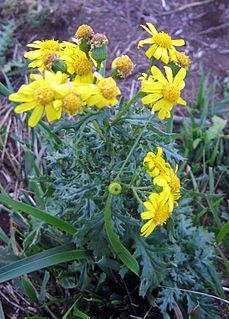
Senecio squalidus, known as Oxford ragwort, is a flowering plant in the daisy family Asteraceae. It is a yellow-flowered herbaceous plant, native to mountainous, rocky or volcanic areas, that has managed to find other homes on man-made and natural piles of rocks, war-ruined neighborhoods and even on stone walls. These habitats resemble its well drained natural rocky homeland. The plants have spread via the wind, rail and the activities of botanists. The travels of this short-lived perennial, biennial, or winter annual make it a good subject for studies of the evolution and ecology of flowering plants.

Viguiera is a genus of flowering plants in the family Asteraceae. The name honours French physician L. G. Alexandre Viguier (1790–1867). It contains around 150 species, which are commonly known as goldeneyes and are native to the New World. These are herbs to bushy shrubs that bear yellow or orange daisy-like flowers.

Sisyrinchium montanum, the blue-eyed-grass, American blue-eyed-grass, or strict blue-eyed grass, is a grass-like species of plant from the genus Sisyrinchium, native to northern North America from Newfoundland west to easternmost Alaska, and south to Pennsylvania in the east, and to New Mexico in the Rocky Mountains. It has also been introduced to parts of France, likely during the First World War.

Galinsoga quadriradiata is a species of flowering plant in the family Asteraceae which is known by several common names, including shaggy soldier, Peruvian daisy, hairy galinsoga. Its native home is apparently central Mexico, although it has become naturalized in many other places.
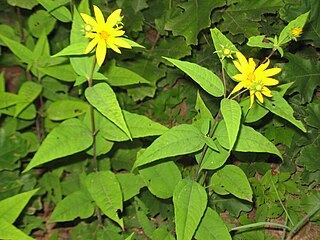
Helianthus divaricatus, commonly known as the rough sunflower, woodland sunflower, or rough woodland sunflower, is a North American species perennial herb in the family Asteraceae. It is native to central and eastern North America, from Ontario and Quebec in the north, south to Florida and Louisiana and west to Oklahoma and Iowa.

Ribes aureum, known by the common names golden currant, clove currant, pruterberry and buffalo currant, is a species of flowering plant in the genus Ribes. It is native to Canada, most of the United States and northern Mexico. The variety Ribes aureum var. villosum is sometimes considered a full species, Ribes odoratum.

Melanthera, squarestem, is a genus of flowering plants in the family Asteraceae, native to North and South America, as well as Africa, Asia and Oceania, including Hawaiʻi.

Sagina procumbens is a species of flowering plant. in the family Caryophyllaceae known by the common names procumbent pearlwort, birdeye pearlwort and matted pearlwort. It can be found throughout the Northern Hemisphere and parts of South America. It is a common weed of many environments. It can be found in wild and disturbed habitat, especially moist areas. It can sometimes be seen growing in lawns or in cracks in the sidewalk. This is a perennial herb forming clumps or mats of hairless green herbage, sometimes vaguely resembling a patch of moss. The leaves are linear and up to 1 or 2 centimeters long. The inflorescence is a solitary flower with four or five sepals and four or five small white petals, but the petals are sometimes absent.

Luzula multiflora, the common woodrush or heath wood-rush, is a species of flowering plant in the rush family.

Rhododendron minus var. minus, the Carolina azalea or Carolina rhododendron, is a rhododendron species native to the mountains of North Carolina, South Carolina, Tennessee, and Northeast Georgia. It is commonly known as Rhododendron carolinianum in the horticultural trade.

Jaltomata procumbens, the creeping false holly, is a plant species native to Arizona, USA, Mexico, Central America, Colombia, Ecuador, and Venezuela. It grows as a weed in agricultural fields and other disturbed locations, but in many places the people protect it because of the edible fruits it produces.


