Birds, also known as Aves, are a group of endothermic vertebrates, characterised by feathers, toothless beaked jaws, the laying of hard-shelled eggs, a high metabolic rate, a four-chambered heart, and a strong yet lightweight skeleton. Birds live worldwide and range in size from the 5 cm (2 in) bee hummingbird to the 2.75 m (9 ft) ostrich. They rank as the world's most numerically-successful class of tetrapods, with approximately ten thousand living species, more than half of these being passerines, sometimes known as perching birds. Birds have wings which are more or less developed depending on the species; the only known groups without wings are the extinct moa and elephant birds. Wings, which evolved from forelimbs, gave birds the ability to fly, although further evolution has led to the loss of flight in flightless birds, including ratites, penguins, and diverse endemic island species of birds. The digestive and respiratory systems of birds are also uniquely adapted for flight. Some bird species of aquatic environments, particularly seabirds and some waterbirds, have further evolved for swimming.
Charles Gald Sibley was an American ornithologist and molecular biologist. He had an immense influence on the scientific classification of birds, and the work that Sibley initiated has substantially altered our understanding of the evolutionary history of modern birds.
Burt Leavelle Monroe, Jr was an American ornithologist, a member of the American Ornithologists' Union beginning in 1953, who served as the Union's Director of the Commission of classification and nomenclature (1981-1994) and as its president from 1990 to 1992.
The Sibley-Monroe assignment of individual species to families, and of families to orders remains controversial however. Critics[who?] maintain that while it marks a great leap forward so far as the evidence from DNA-DNA hybridisation goes, it pays insufficient attention to other forms of evidence, both molecular and on a larger scale. There is no true consensus, but the broad middle-ground position is that the Sibley-Monroe classification, overall, is "about 80% correct".[citation needed] Research and debate concerning bird classification continue.
There are 9,994 species on the checklist, which is begun below and continues in several parts.
The greater rhea is a species of flightless bird native to eastern South America. Other names for the greater rhea include the grey, common, or American rhea; ñandú ; or ema (Portuguese). One of two species in the genus Rhea, in the family Rheidae, the greater rhea is native to Argentina, Bolivia, Brazil, Paraguay and Uruguay. It inhabits a variety of open areas, such as grasslands, savanna or grassy wetlands. Weighing 20–27 kilograms (44–60 lb), the greater rhea is the largest bird in South America. In the wild, the greater rhea has a life expectancy of 10.5 years. It is also notable for its reproductive habits, and for the fact that a population has established itself in Germany in recent years. The species is listed as Near Threatened by the IUCN.
The southern cassowary, also known as double-wattled cassowary, Australian cassowary or two-wattled cassowary, is a large flightless black bird. It is a ratite and therefore related to emu, ostrich, and the Rhea and Kiwi genera.
The dwarf cassowary also known as the Bennett's cassowary, little cassowary, mountain cassowary, or mooruk, is the smallest of the three species of cassowaries.
The northern cassowary also known as the one-wattled cassowary, single-wattled cassowary, or golden-necked cassowary, is a large, stocky flightless bird of northern New Guinea. They are members of the superorder Paleognathae.
The little spotted kiwi, or little gray kiwi, Apteryx owenii, is a small flightless bird in the kiwi family Apterygidae. It is the smallest species of kiwi, at about 0.9 to 1.9 kg (2.0–4.2 lb), about the size of a bantam. It is endemic to New Zealand, and in pre-European times occurred in both main islands, but is now restricted to a number of small offshore islands and mainland reserves protected by pest-exclusion fences.
The great spotted kiwi, great grey kiwi or roroa is a species of kiwi endemic to the South Island of New Zealand. The great spotted kiwi, as a member of the ratites, is flightless. It is the largest of the kiwi. The rugged topography and harsh climate of the high altitude, alpine, part of its habitat render it inhospitable to a number of introduced mammalian predators, which include dogs, ferrets, cats and stoats. Because of this, populations of this species have been less seriously affected by the predations of these invasive species compared to other kiwi. Nonetheless, there has been a 43% decline in population in the past 45 years, due to these predators and habitat destruction. This has led it to be classified as vulnerable. There are less than 16,000 great spotted kiwis in total, almost all in the more mountainous parts of northwest Nelson, the northwest coast, and the Southern Alps. A minority live on island reserves.
This page is based on this Wikipedia article Text is available under the CC BY-SA 4.0 license; additional terms may apply. Images, videos and audio are available under their respective licenses.
Related Research Articles
Galliformes is an order of heavy-bodied ground-feeding birds that includes turkey, grouse, chicken, New World quail and Old World quail, ptarmigan, partridge, pheasant, francolin, junglefowl and the Cracidae. The name derives from "gallus", Latin for "cock" or "rooster". Common names are gamefowl or gamebirds, landfowl, gallinaceous birds, or galliforms. "Wildfowl" or just "fowl" are also often used for the Galliformes, but usually these terms also refer to waterfowl (Anseriformes), and occasionally to other commonly hunted birds. This group has about 290 species, one or more of which are found in essentially every part of the world's continents. They are rarer on islands, and in contrast to the closely related waterfowl, are essentially absent from oceanic islands—unless introduced there by humans. Several species have been domesticated during their long and extensive relationships with humans.
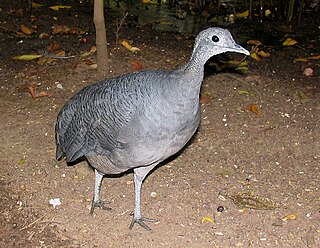
Tinamous form an order of birds (Tinamiformes), comprising a single family (Tinamidae) with two distinct subfamilies, containing 47 species found in Mexico, Central America, and South America. The word "tinamou" comes from the Galibi term for these birds, tinamu. Tinamous have traditionally been regarded as the sister group of the flightless ratites, but recent work places them well within the ratite radiation, implying basal ratites could fly. Tinamous first appear in the fossil record in the Miocene epoch. They are generally sedentary, ground-dwelling and, though not flightless, when possible avoid flight in favour of hiding or running away from danger. They are found in a variety of habitats, ranging from semi-arid alpine grasslands to tropical rainforests. The two subfamilies are broadly divided by habitat, with the Nothurinae referred to as steppe or open country tinamous, and the Tinaminae known as forest tinamous.
The Phasianidae are a family of heavy, ground-living birds, which includes pheasants, partridges, junglefowl, chickens, turkeys, Old World quail, and peafowl. The family includes many of the most popular gamebirds. The family is a large one, and is occasionally broken up into two subfamilies, the Phasianinae, and the Perdicinae. Sometimes, additional families and birds are treated as part of this family. For example, the American Ornithologists' Union includes the Tetraonidae (grouse), Numididae (guineafowl), and Meleagrididae (turkeys) as subfamilies in Phasianidae.
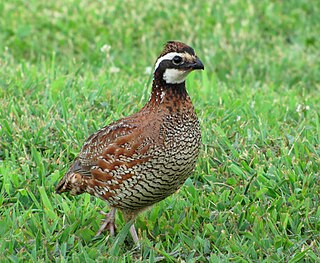
The New World quails or Odontophoridae are small birds only distantly related to the Old World quail, but named for their similar appearance and habits. The American species are in their own family Odontophoridae, whereas Old World quail are in the pheasant family Phasianidae. The family ranges from Canada through to southern Brazil, and two species, the California quail and the bobwhite quail, have been successfully introduced to New Zealand. The stone partridge and Nahan's partridge, both found in Africa, seem to belong to the family. Species are found across a variety of habitats from tropical rainforest to deserts, although few species are capable of surviving at very low temperatures. Thirty-four species are placed in ten genera.
The chachalacas, guans and curassows are birds in the family Cracidae. These are species of tropical and subtropical Central and South America. The range of one species, the plain chachalaca, just reaches southernmost parts of Texas in the United States. Two species, the Trinidad piping guan and the rufous-vented chachalaca occur on the islands of Trinidad and Tobago respectively.
Jurong Bird Park is an aviary and tourist attraction in Jurong, Singapore. The bird park, managed by Wildlife Reserves Singapore, covers an area of 0.2 square kilometres on the western slope of Jurong Hill, the highest point in the Jurong region.
Perdicinae is a subfamily of birds in the pheasant family, Phasianidae, regrouping the partridges, Old World quails, and francolins. Although this subfamily was considered monophyletic and separated from the pheasants, tragopans, junglefowls, and peafowls (Phasianinae) till the early 1990s, molecular phylogenies have shown that these two subfamilies actually constitute only one lineage. For example, some partridges are more closely affiliated to pheasants, whereas Old World quails and partridges from the Alectoris genus are closer to junglefowls.
The Western Ecuador moist forests (NT0178) is an ecoregion in the plains and western foothills of the Andes of southern Colombia and Ecuador.
At one time this region contained dense forests with highly diverse flora and fauna, and many endemic species.
Most of the original habitat has now been destroyed, and the ecoregion is one of the most threatened in the world.