Sibley-Monroe checklist 4

Last updated

The Sibley-Monroe checklist was a landmark document in the study of birds. It drew on extensive DNA-DNA hybridisation studies to reassess the relationships between modern birds.

Bird Warm-blooded, egg-laying vertebrates with wings, feathers and beaks

Birds, also known as Aves, are a group of endothermic vertebrates, characterised by feathers, toothless beaked jaws, the laying of hard-shelled eggs, a high metabolic rate, a four-chambered heart, and a strong yet lightweight skeleton. Birds live worldwide and range in size from the 5 cm (2 in) bee hummingbird to the 2.75 m (9 ft) ostrich. They rank as the world's most numerically-successful class of tetrapods, with approximately ten thousand living species, more than half of these being passerines, sometimes known as perching birds. Birds have wings which are more or less developed depending on the species; the only known groups without wings are the extinct moa and elephant birds. Wings, which evolved from forelimbs, gave birds the ability to fly, although further evolution has led to the loss of flight in flightless birds, including ratites, penguins, and diverse endemic island species of birds. The digestive and respiratory systems of birds are also uniquely adapted for flight. Some bird species of aquatic environments, particularly seabirds and some waterbirds, have further evolved for swimming.

Contents

Coraciiformes (continued)

Alcedinidae

Blyths kingfisher species of bird

Blyth's kingfisher is the largest kingfisher in the genus Alcedo. Named for Edward Blyth, the species has also been known as Alcedo grandis and as the great blue kingfisher. Between 22 and 23 centimetres long, the kingfisher has deep rufous underparts with a blackish blue breast patch, and brilliant cobalt blue or azure upperparts, tinged with purple. The wings are a dark blackish green, with blue speckles and tips to some of the feathers. The bill of the male is entirely black, while the female has a dark red lower mandible. The species is distinguished from the similar blue-eared kingfisher and common kingfisher by its greater size, heavy black bill, and dark lores.

Common kingfisher species of bird

The common kingfisher also known as the Eurasian kingfisher, and river kingfisher, is a small kingfisher with seven subspecies recognized within its wide distribution across Eurasia and North Africa. It is resident in much of its range, but migrates from areas where rivers freeze in winter.

Half-collared kingfisher species of bird

The half-collared kingfisher is a kingfisher in the subfamily Alcedininae that is found in southern and eastern Africa. It feeds almost exclusively on fish and frequents streams, rivers and larger bodies of water.

Halcyonidae

Banded kingfisher species of bird

The banded kingfisher is a tree kingfisher found in lowland tropical forests of southeast Asia. It is the only member of the genus Lacedo. Male and female adults are very different in plumage. The male has a bright blue crown with black and blue banding on the back. The female has rufous and black banding on the head and upperparts.

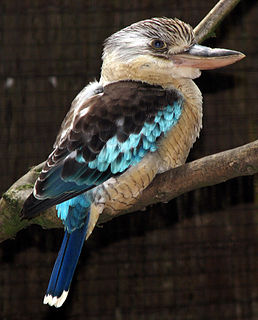
Laughing kookaburra species of carnivorous bird

The laughing kookaburra is a bird in the kingfisher subfamily Halcyoninae. It is a large robust kingfisher with a whitish head and a dark eye-stripe. The upperparts are mostly dark brown but there is a mottled light-blue patch on the wing coverts. The underparts are white and the tail is barred with rufous and black. The plumage of the male and female birds is similar. The territorial call is a distinctive laugh that is often delivered by several birds at the same time, and is widely used as a stock sound effect in situations that involve a jungle setting.

Blue-winged kookaburra species of bird

The blue-winged kookaburra is a large species of kingfisher native to northern Australia and southern New Guinea.

Cerylidae

Giant kingfisher species of kingfisher in Africa

The giant kingfisher is the largest kingfisher in Africa, where it is a resident breeding bird over most of the continent south of the Sahara Desert other than the arid southwest.

Crested kingfisher species of bird

The crested kingfisher is a very large kingfisher that is native to parts of southern Asia, stretching eastwards from the Indian Subcontinent towards Japan. It forms a species complex with the other three Megaceryle species.

Belted kingfisher species of bird

The belted kingfisher is a large, conspicuous water kingfisher, the only member of that group commonly found in the northern United States and Canada. It is depicted on the 1986 series Canadian $5 note. All kingfishers were formerly placed in one family, Alcedinidae, but recent research suggests that this should be divided into three subfamilies.

Meropidae

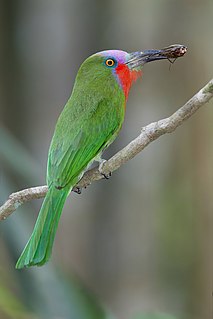
Red-bearded bee-eater species of bird

The red-bearded bee-eater is a large species of bee-eater found in the Indo-Malayan subregion of South-east Asia. This species is found in openings in patches of dense forest.

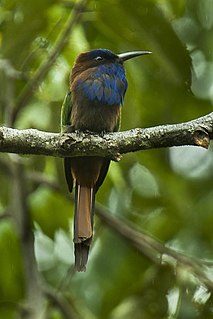
Blue-bearded bee-eater species of bird

The blue-bearded bee-eater is a species of bee-eater found in much of the Indian subcontinent and parts of Southeast Asia. This bee-eater is found in forest clearings. It is found mainly in the Malayan region but extends west into peninsular India. The blue feathers of its throat are elongated and often fluffed giving it its name. They have a loud call but are not as gregarious or active as the smaller bee-eaters, and their square ended tail lacks the typical "wires" made up of the shafts of the longer central tail feathers in many species.

Purple-bearded bee-eater species of bird

The purple-bearded bee-eater or Celebes bee-eater is a near passerine bird in the bee-eater family Meropidae. It is an endemic resident on the island of Sulawesi, Indonesia. This species is often seen in clearings inside dense forest.

Coliiformes

Coliidae

Speckled mousebird species of bird

The speckled mousebird is the largest species of mousebird, as well as one of the most common.

White-headed mousebird species of bird

The white-headed mousebird is a bird belonging to the mousebird family, Coliidae. It is found only in east Africa where it occurs in southern Somalia and parts of Kenya with its range just extending into southern Ethiopia and northern Tanzania. It inhabits arid bushland up to 1,400 metres above sea-level.

Red-backed mousebird species of bird

The red-backed mousebird is a species of bird in the Coliidae family. It is found in Angola and the Democratic Republic of the Congo. The name mousebird is based on bird's soft feathers with texture similar to a mouse's fur. The red-backed mousebird got its name from the red or chestnut color patch on its back.

Cuculiformes

Cuculidae

Centropodidae

Coccyzidae

Opisthocomidae

Crotophagidae

Neomorphidae

Psittaciformes

Psittacidae

Previous page: Sibley-Monroe checklist 3

Next page: Sibley-Monroe checklist 5

Index of pages: 1, 2, 3, 4, 5, 6, 7, 8, 9, 10, 11, 12, 13, 14, 15, 16, 17, 18

Related Research Articles

Parakeet small to medium sized species of parrot

A parakeet is any one of a large number of small to medium-sized species of parrot, in multiple genera, that generally have long tail feathers. Older spellings still sometimes encountered are paroquet or paraquet.

Loriini is a tribe of small to medium-sized arboreal parrots characterized by their specialized brush-tipped tongues for feeding on nectar of various blossoms and soft fruits, preferably berries. The species form a monophyletic group within the parrot family Psittacidae. The group consist of the lories and lorikeets. Traditionally, they were considered a separate subfamily (Loriinae) from the other subfamily (Psittacinae) based on the specialized characteristics, but recent molecular and morphological studies show that the group is positioned in the middle of various other groups. They are widely distributed throughout the Australasian region, including south-eastern Asia, Polynesia, Papua New Guinea, Timor Leste and Australia, and the majority have very brightly coloured plumage.

Conure Wikimedia disambiguation page

Conures are a diverse, loosely defined group of small to medium-sized parrots. They belong to several genera within a long-tailed group of the New World parrot subfamily Arinae. The term "conure" is used primarily in bird keeping, though it has appeared in some scientific journals. The American Ornithologists' Union uses the generic term parakeet for all species elsewhere called conure, though Joseph Forshaw, a prominent Australian ornithologist, uses conure.

Loriinae subfamily of birds

Loriinae is a subfamily of psittacines birds, one of the five subfamilies that make up the Psittaculidae family. It consists of three tribes, the lories and lorikeets (Loriini), the budgerigar (Melopsittacini) and the fig parrots (Cyclopsittini), which are small birds, mostly of bright colors and inhabitants of Oceania and the islands of Southeast Asia.

Jurong Bird Park zoo in Singapore

Jurong Bird Park is an aviary and tourist attraction in Jurong, Singapore. The bird park, managed by Wildlife Reserves Singapore, covers an area of 0.2 square kilometres on the western slope of Jurong Hill, the highest point in the Jurong region.

Birds of Eden

Birds of Eden is the world's largest free flight aviary and bird sanctuary, located near Plettenberg Bay in the Western Cape, South Africa. The mesh dome of the sanctuary was built over 2.3 hectares of indigenous forest, and is up to 55 metres (180 ft) above ground level. 1.2 kilometres (0.75 mi) of walkways, about 75% of which are elevated, let visitors see the birds at all levels of the aviary.

Arini (tribe) tribe of parrots

The Arini tribe of the neotropical parrots is a monophyletic clade of macaws and parakeets characterized by colorful plumage and long, tapering tails. They occur throughout Mexico, Central America, and South America, and formerly the Caribbean and North America. One genus and several species are extinct; another genus is extinct in the wild. Two species are known only through subfossil remains. About a dozen hypothetical extinct species have been described, native to the Caribbean area. Among the Arini are some of the rarest birds in the world, such as Spix's macaw which is extinct in the wild - fewer than 100 specimens survive in captivity. It also contains the largest flighted parrot in the world, the hyacinth macaw.

References

  1. Cacatua goffini has been synonymized with Cacatua ducorpsii ; the new name for this species is Cacatua goffiniana , see Roselaar, C.S.; T.G. Prins (2000). "List of type specimens of birds in the Zoological Museum of the University of Amsterdam (ZMA), including taxa described by ZMA staff but without types in ZMA". Beaufortia. 50: 95–126. and Roselaar, C.S.; J.P. Michels (2004). "Systematic notes on Asian birds. 48. Nomenclatural chaos untangled, resulting in the naming of the formally undescribed Cacatua species from the Tanimbar Islands, Indonesia (Psittaciformes: Cacatuidae)". Zoologische Verhandelingen. 350: 183–196.
  2. David, N. & Gosselin, M. 2002. The grammatical gender of avian genera. Bulletin of the British Ornithologists’ Club, 122: 257-282