Sibley-Monroe checklist 6

Last updated

The Sibley-Monroe checklist was a landmark document in the study of birds. It drew on extensive DNA-DNA hybridisation studies to reassess the relationships between modern birds.

Bird Warm-blooded, egg-laying vertebrates with wings, feathers and beaks

Birds, also known as Aves or avian dinosaurs, are a group of endothermic vertebrates, characterised by feathers, toothless beaked jaws, the laying of hard-shelled eggs, a high metabolic rate, a four-chambered heart, and a strong yet lightweight skeleton. Birds live worldwide and range in size from the 5 cm (2 in) bee hummingbird to the 2.75 m (9 ft) ostrich. They rank as the world's most numerically-successful class of tetrapods, with approximately ten thousand living species, more than half of these being passerines, sometimes known as perching birds. Birds have wings which are more or less developed depending on the species; the only known groups without wings are the extinct moa and elephant birds. Wings, which evolved from forelimbs, gave birds the ability to fly, although further evolution has led to the loss of flight in flightless birds, including ratites, penguins, and diverse endemic island species of birds. The digestive and respiratory systems of birds are also uniquely adapted for flight. Some bird species of aquatic environments, particularly seabirds and some waterbirds, have further evolved for swimming.

Contents

Strigiformes

Tytonidae

Greater sooty owl species of bird

The greater sooty owl, is a medium to large owl found in south-eastern Australia, Montane rainforests of New Guinea and have been seen on Flinders Island in the Bass Strait. They have a finely white spotted head with scattered white spots on the wings. The females are lighter colored than the males. The females' length is 37–43 cm and weighs 750-1200 g. The male is smaller and length is 37–43 cm and weighs 500-700 g. The wing length is 30–40 cm. The large dark eyes are set in a round large facial disk. The facial disk is dark gray-silver or sooty black and has a heavy black edge. The upper part of the owl is black to dark gray and the under part is lighter. The tail is short and the legs are feathered. The feet and talons are large. Their call is a piercing shriek which can last up to two seconds.
The lesser sooty owl, is sometimes considered to be conspecific with this species, in which case they are then together referred to as sooty owls. It is substantially smaller and occurs in the wet tropics region of North Queensland, Australia.

Lesser sooty owl species of bird

The lesser sooty owl is an owl that lives in the wet tropics region of Australia. It is sometimes considered conspecific with the greater sooty owl, Tyto tenebricosa, by some authors. The birds are then together commonly referred to as sooty owl. Like other birds of prey, the female is bigger than the male. The lesser sooty owl is part of the masked group of owls: an important part of the environment because they are efficient predators that keep down rodent populations.

Minahassa masked owl species of bird

The Minahassa masked owl, also known as the Minahassa barn owl, Sulawesi owl or Sulawesi golden owl, is an endemic barn owl living on Sulawesi, Indonesia. The name is derived from the Minahassa Peninsula, where it was first described as a breeding bird; however, it is also known to live in north-central Sulawesi.

Strigidae

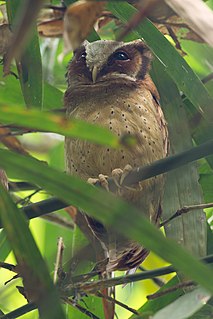
White-fronted scops owl species of bird

The white-fronted scops owl is a small Asian owl in the family Strigidae. It has a small and declining population about which little is known, and is dependent on lowland and foothill forests which are rapidly being destroyed. This species of owl is considered vulnerable and has a population of about 2,500–10,000. Its range covers 149,000 km2 (58,000 sq mi) of forest from 0–700 m (0–2,297 ft) above sea-level.

Reddish scops owl species of bird

The reddish scops owl is an owl found in southeast Asia.

Sandy scops owl species of bird

The sandy scops owl, or cinnamon scops owl, is an owl form the familay Strigidae found in Africa.

Aegothelidae

Podargidae

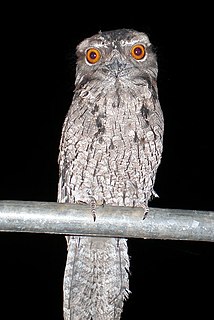
Tawny frogmouth species of bird

The tawny frogmouth is a species of frogmouth native to and found throughout the Australian mainland and Tasmania. It is a big-headed, stocky bird, often mistaken for an owl due to its nocturnal habits and similar colouring, and is sometimes incorrectly referred to as "mopoke", a common name for the Australian boobook, whose call is often confused with the tawny frogmouth's.

Papuan frogmouth species of bird

The Papuan frogmouth is a species of bird in the family Podargidae.

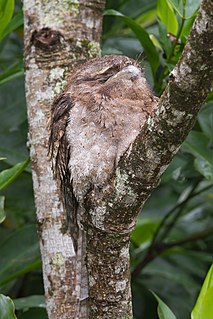
Marbled frogmouth species of bird

The marbled frogmouth is a species of bird in the family Podargidae. It is found in the Aru Islands, New Guinea and Queensland. Its natural habitats are subtropical or tropical moist lowland forest and subtropical or tropical moist montane forest.

Batrachostomidae

Large frogmouth species of bird

The large frogmouth is a species of bird in the family Podargidae. It is found in Brunei, Indonesia, Malaysia, and Thailand, in subtropical or tropical moist lowland forest. Logging of its habitat poses a risk to its survival, and the International Union for Conservation of Nature has listed it as being "near-threatened".

Dulit frogmouth species of bird

The Dulit frogmouth is a little-known species of bird in the frogmouth family, Podargidae, with a patchily recorded distribution in the mountain forests of northern and central Borneo to which it is endemic. The species is monotypic.

Philippine frogmouth species of bird

The Philippine frogmouth is a nocturnal bird that is found throughout the Philippine archipelago. It is common in lowland forests and maturing second growth. Little information is known about the bird. It feeds on grasshoppers, cicadas, crickets and beetles.

Steatornithidae

Nyctibiidae

Eurostopodidae

Caprimulgidae

Columbiformes

Raphidae

Columbidae

Previous page: Sibley-Monroe checklist 5

Next page: Sibley-Monroe checklist 7

Index of pages: 1, 2, 3, 4, 5, 6, 7, 8, 9, 10, 11, 12, 13, 14, 15, 16, 17, 18

Related Research Articles

True owl family of birds

The true owls or typical owls are one of the two generally accepted families of owls, the other being the barn owls (Tytonidae). The Sibley-Ahlquist taxonomy unites the Caprimulgiformes with the owl order; here, the typical owls are a subfamily Striginae. This is unsupported by more recent research, but the relationships of the owls in general are still unresolved. This large family comprises nearly 220 living species in 25 genera. The typical owls have a cosmopolitan distribution and are found on every continent except Antarctica.

Jurong Bird Park zoo in Singapore

Jurong Bird Park is an aviary and tourist attraction in Jurong, Singapore. The bird park, managed by Wildlife Reserves Singapore, covers an area of 0.2 square kilometres on the western slope of Jurong Hill, the highest point in the Jurong region.