This article does not cite any sources .(June 2019) (Learn how and when to remove this template message) |
The Sibley-Monroe checklist was a landmark document in the study of birds. It drew on extensive DNA-DNA hybridisation studies to reassess the relationships between modern birds.
Birds, also known as Aves or avian dinosaurs, are a group of endothermic vertebrates, characterised by feathers, toothless beaked jaws, the laying of hard-shelled eggs, a high metabolic rate, a four-chambered heart, and a strong yet lightweight skeleton. Birds live worldwide and range in size from the 5 cm (2 in) bee hummingbird to the 2.75 m (9 ft) ostrich. They rank as the world's most numerically-successful class of tetrapods, with approximately ten thousand living species, more than half of these being passerines, sometimes known as perching birds. Birds have wings which are more or less developed depending on the species; the only known groups without wings are the extinct moa and elephant birds. Wings, which evolved from forelimbs, gave birds the ability to fly, although further evolution has led to the loss of flight in flightless birds, including ratites, penguins, and diverse endemic island species of birds. The digestive and respiratory systems of birds are also uniquely adapted for flight. Some bird species of aquatic environments, particularly seabirds and some waterbirds, have further evolved for swimming.
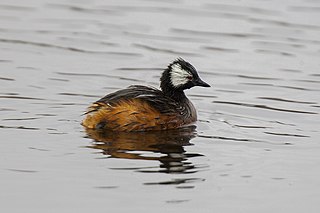
The white-tufted grebe, also known as Rolland's grebe, is a species of grebe in the family Podicipedidae. Found in the southern half of South America, its natural habitat is freshwater lakes, ponds and sluggish streams.
The little grebe, also known as dabchick, is a member of the grebe family of water birds. The genus name is from Ancient Greek takhus "fast" and bapto "to sink under". The specific ruficollis is from Latin rufus "red" and Modern Latin -collis, "-necked", itself derived from Latin collum "neck".
The Australasian grebe is a small waterbird common on fresh water lakes and rivers in greater Australia, New Zealand and on nearby Pacific islands. At 25–27 cm (9.8–10.6 in) in length, it is one of the smallest members of the grebe family, along with the least grebe and little grebe.
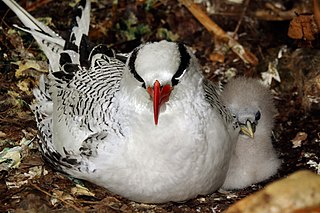
The red-billed tropicbird is a tropicbird, one of three closely related species of seabird of tropical oceans. Superficially resembling a tern in appearance, it has mostly white plumage with some black markings on the wings and back, a black mask and, as its common name suggests, a red bill. Most adults have tail streamers that are about two times their body length, with those in males being generally longer than those in females. The red-billed tropicbird itself has three subspecies recognized, including the nominate. The subspecies mesonauta is distinguished from the nominate by the rosy tinge of its fresh plumage, and the subspecies indicus can be differentiated by its smaller size, more restricted mask, and more orange bill. This species ranges across the tropical Atlantic, eastern Pacific, and Indian Oceans. The nominate is found in the southern Atlantic Ocean, the subspecies indicus in the waters off of the Middle East and in the Indian Ocean, and the subspecies mesonauta in the eastern portions of both the Atlantic and the Pacific Oceans and in the Caribbean. It was one of the many species described by Carl Linnaeus in his 1758 10th edition of Systema Naturae.
The red-tailed tropicbird(Phaethon rubricauda) is a seabird native to tropical Indian and Pacific Oceans. One of three closely related species of tropicbird, it was described by Pieter Boddaert in 1783. Superficially resembling a tern in appearance, it has almost all-white plumage with a black mask and a red bill. The sexes have similar plumage. Adults have red tail streamers that are about twice their body length, which gives rise to its common name. There are four subspecies recognised, though there is evidence there is a clinal change with smaller birds in the north and larger in the south.
The white-tailed tropicbird(Phaethon lepturus) is a tropicbird. It is the smallest of three closely related seabirds of the tropical oceans and smallest member of the order Phaethontiformes. It is found in the tropical Atlantic, western Pacific and Indian Oceans. It also breeds on some Caribbean islands, and a few pairs have started nesting recently on Little Tobago, joining the red-billed tropicbird colony. In addition to the tropical Atlantic, it nests as far north as Bermuda, where it is locally called a "longtail".
Abbott's booby is an endangered seabird of the sulid family, which includes gannets and boobies. It is a large booby, smaller than gannets, and is placed within its own monotypic genus. It was first identified from a specimen collected by William Louis Abbott, who discovered it on Assumption Island in 1892.
The northern gannet is a seabird, the largest species of the gannet family, Sulidae. It is native to the coasts of the Atlantic Ocean, breeding in Western Europe and North America. The sexes are similar in appearance. The adult northern gannet has a mainly white streamlined body with a long neck, long and slender wings. It is 87–100 cm (34–39 in) long with a 170–180 cm (67–71 in) wingspan. The head and nape have a buff tinge that is more prominent in breeding season, and the wings are edged with dark brown-black feathers. The long pointed bill is blue-grey, contrasting with black bare skin around the mouth and eyes. Juveniles are mostly grey-brown, becoming increasingly white in the five years it takes them to reach maturity.
The Cape gannet originally Sula capensis, is a large seabird of the gannet family, Sulidae.
The anhinga, sometimes called snakebird, darter, American darter, or water turkey, is a water bird of the warmer parts of the Americas. The word anhinga comes from the Brazilian Tupi language and means devil bird or snake bird. The origin of the name snakebird is apparent when swimming: only the colored neck appears above water so the bird looks like a snake ready to strike. They do not have external nares (nostrils) and breathe solely through their epiglottis.
The African darter (Anhinga rufa), sometimes called the snakebird, is a water bird of sub-Saharan Africa and Iraq.
The Oriental darter or Indian darter is a water bird of tropical South Asia and Southeast Asia. It has a long and slender neck with a straight, pointed bill and, like the cormorant, it hunts for fish while its body is submerged in water. It spears a fish underwater, bringing it above the surface, tossing and juggling it before swallowing the fish head first. The body remains submerged as it swims, and the slender neck alone is visible above the water, which accounts for the colloquial name of snakebird. Like the cormorants, it has wettable feathers and it is often found perched on a rock or branch with its wings held open to dry.
The crowned cormorant is a small cormorant that is endemic to the waters of the cold Benguela Current of southern Africa. It is an exclusively coastal species and is not found more than 10 km (6 mi) away from land. This species is related to the reed cormorant, and was formerly considered to the same species.
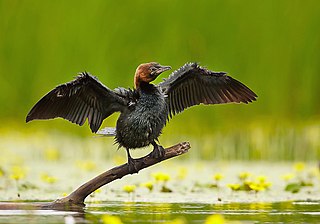
The pygmy cormorant is a member of the Phalacrocoracidae (cormorant) family of seabirds. It breeds in south-eastern Europe and south-western Asia. It is partially migratory, with northern populations wintering further south, mostly within its breeding range. It is a rare migrant to western Europe.
The little cormorant is a member of the cormorant family of seabirds. Slightly smaller than the Indian cormorant it lacks a peaked head and has a shorter beak. It is widely distributed across the Indian Subcontinent and extends east to Java, where it is sometimes called the Javanese cormorant. It forages singly or sometimes in loose groups in lowland freshwater bodies, including small ponds, large lakes, streams and sometimes coastal estuaries. Like other cormorants, it is often found perched on a waterside rock with its wings spread out after coming out of the water. The entire body is black in the breeding season but the plumage is brownish, and the throat has a small whitish patch in the non-breeding season. These birds breed gregariously in trees, often joining other waterbirds at heronries.
Previous page: Sibley-Monroe checklist 8
Next page: Sibley-Monroe checklist 10
Index of pages: 1, 2, 3, 4, 5, 6, 7, 8, 9, 10, 11, 12, 13, 14, 15, 16, 17, 18
The Birds of Macquarie Island are, unsurprisingly for an isolated oceanic island, predominantly seabirds. By far the majority of the breeding species are penguins, petrels and albatrosses. However, the bird list includes many vagrants, including passerines, from New Zealand and Australia.
The Diep River Fynbos Corridor is a nature reserve located in Cape Town, South Africa. It forms part of the larger Table Bay Nature Reserve, which was established in June 2012.