Sibley-Monroe checklist 12

Last updated

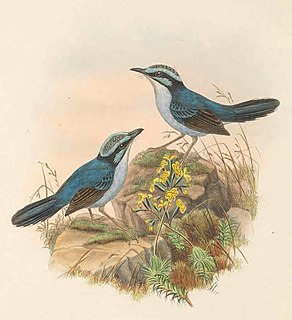
The Sibley-Monroe checklist was a landmark document in the study of birds. It drew on extensive DNA-DNA hybridisation studies to reassess the relationships between modern birds.

Bird Warm-blooded, egg-laying vertebrates with wings, feathers and beaks

Birds, also known as Aves, are a group of endothermic vertebrates, characterised by feathers, toothless beaked jaws, the laying of hard-shelled eggs, a high metabolic rate, a four-chambered heart, and a strong yet lightweight skeleton. Birds live worldwide and range in size from the 5 cm (2 in) bee hummingbird to the 2.75 m (9 ft) ostrich. They rank as the world's most numerically-successful class of tetrapods, with approximately ten thousand living species, more than half of these being passerines, sometimes known as perching birds. Birds have wings which are more or less developed depending on the species; the only known groups without wings are the extinct moa and elephant birds. Wings, which evolved from forelimbs, gave birds the ability to fly, although further evolution has led to the loss of flight in flightless birds, including ratites, penguins, and diverse endemic island species of birds. The digestive and respiratory systems of birds are also uniquely adapted for flight. Some bird species of aquatic environments, particularly seabirds and some waterbirds, have further evolved for swimming.

Contents

Passeriformes (continued)

Climacteridae

Papuan treecreeper species of bird

The Papuan treecreeper is a species of bird in the family Climacteridae. It was previously considered a subspecies of the white-throated treecreeper.

White-throated treecreeper species of bird

The white-throated treecreeper is an Australian treecreeper found in the forests of eastern Australia. It is unrelated to the northern hemisphere treecreepers. It is a small passerine bird with predominantly brown and white plumage and measuring some 15 cm (6 in) long on average. It is insectivorous, eating mainly ants. Unlike treecreepers of the genus Climacteris, the white-throated treecreeper does not engage in cooperative breeding, and wherever it overlaps with species of that genus, it feeds upon much looser bark besides typically using different trees.

White-browed treecreeper species of bird

The White-browed Treecreeper is the smallest of the Australo-papuan Treecreepers and sole family member adapted to arid environments. The species foraging strategy involves climbing the trunks of trees in search of invertebrate prey on and under bark. Although some populations within the species range have declined, the species IUCN conservation status is of Least Concern.

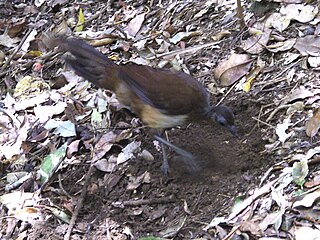
Alberts lyrebird species of bird

Albert's lyrebird is a timid, pheasant-sized songbird which is endemic to subtropical rainforests of Australia, in a small area on the state border between New South Wales and Queensland. The rarer of the two species of lyrebirds, Albert's lyrebird is named after Prince Albert, the prince consort of Queen Victoria, queen of the United Kingdom. It lacks the elegant lyre-shaped tail feathers of the superb lyrebird and is found in a much more restricted range.

Superb lyrebird species of bird

The superb lyrebird is an Australian songbird, one of two species from the family Menuridae. It is one of the world's largest songbirds, and is noted for its elaborate tail and excellent mimicry. The species is endemic to the south east of the country, and has been introduced to Tasmania. According to David Attenborough the species displays the most sophisticated voice skills within the animal kingdom.

Ptilonorhynchidae

White-eared catbird species of bird

The white-eared catbird is a species of bird in the family Ptilonorhynchidae found on New Guinea and the West Papuan Islands. Its natural habitats are subtropical or tropical dry forest and subtropical or tropical moist lowland forest.

Spotted catbird species of reptile

The spotted catbird is a species of bowerbird (Ptilonorhynchidae) which can be found in north Queensland, the eastern Moluccas and New Guinea. Although it is a member of the bowerbird family it does not build a bower.

Green catbird species of bird

The green catbird is a species of bowerbird found in subtropical forests along the east coast of Australia, from southeastern Queensland to southern New South Wales. It is named for its distinctive call which sounds like a cat meowing, although it has also been mistaken for a crying child. The green catbird resembles the spotted catbird, which is only found in an isolated population in Far North Queensland.

Maluridae

Orange-crowned fairywren species of bird

The orange-crowned fairywren is a species of passerine bird in the Australasian wren family, Maluridae. It is monotypic within the genus Clytomyias. It is found on New Guinea in its natural habitat of subtropical or tropical moist montane forests.

Wallaces fairywren species of bird

Wallace's fairywren is a species of bird in the Australasian wren family, Maluridae. It is monotypic within the genus Sipodotus. It is found in New Guinea and the Aru Islands, where its natural habitat is subtropical or tropical moist lowland forests.

Broad-billed fairywren species of bird

The broad-billed fairywren is a species of bird in the Australasian wren family, Maluridae. It is found in northern and north-western New Guinea. Its natural habitat is subtropical or tropical moist lowland forests.

Meliphagidae

Drab myzomela species of bird

The drab myzomela or Seram myzomela is a species of bird in the family Meliphagidae. It is endemic to the islands of Seram, Boano and Ambon in Indonesia. Its natural habitats are subtropical or tropical moist lowland forests and subtropical or tropical moist montane forests.

The white-chinned myzomela is a species of bird in the family Meliphagidae. It is endemic to Papua New Guinea.

Dusky myzomela species of bird

The dusky myzomela or dusky honeyeater is a small, brown bird that is a common resident of the Aru Islands, southern New Guinea and northern and eastern Australia, where there are two separated populations, one in the Top End, another from Cape York Peninsula along the east coast as far south as the New South Wales border, though the species is rare south of Rockhampton.

Pardalotidae

Petroicidae

Irenidae

Orthonychidae

Pomatostomidae

Laniidae

Vireonidae

Previous page: Sibley-Monroe checklist 11

Next page: Sibley-Monroe checklist 13

Index of pages: 1, 2, 3, 4, 5, 6, 7, 8, 9, 10, 11, 12, 13, 14, 15, 16, 17, 18

Related Research Articles

Macquarie Pass National Park Protected area in New South Wales, Australia

Macquarie Pass National Park is a national park in New South Wales, Australia, 90 km southwest of Sydney. It is located around the pass of the same name, which is on the Illawarra Highway and part of the Illawarra escarpment.

Vireo family of birds

The vireos make up a family, Vireonidae, of small to medium-sized passerine birds found in the New World and Southeast Asia, "Vireo" is a Latin word referring to a green migratory bird, perhaps the female golden oriole, possibly the European greenfinch.

Lockerbie Scrub

Lockerbie Scrub is a 230 km2 area of closed forest and woodland, surrounded by open tropical savanna woodland, at the northern tip of the Cape York Peninsula in Far North Queensland, Australia.

The Moorooduc Quarry Flora and Fauna Reserve is located in Mount Eliza, Victoria, Australia and occupies approximately 27 hectares of land. There are entrances to the reserve located on Allison Road, Canadian Bay Road, Two Bays Road and Station Street near the Moorooduc Railway Station.

Wooroonooran Important Bird Area Important Bird Area in Queensland, Australia

The Wooroonooran Important Bird Area comprises some 5125 km2 of mainly forested land in the Wet Tropics of Queensland World Heritage Site, of Far North Queensland, Australia.
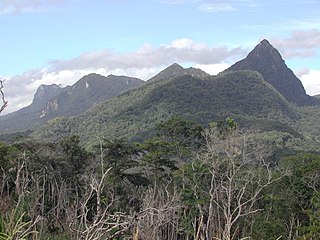
Paitchau

Paitchau is a mountain in the Tutuala subdistrict, Lautém District of East Timor. Situated within Nino Konis Santana National Park, it is south of Lake Ira Lalaro. Though part of a mountain chain, Paitchau is an isolated mountain in the southern Sucos Mehara. It ranges in altitude from 0–960 metres (0–3,150 ft). BirdLife International has classified the mountain and its surrounding region of 55,797 hectares as an Important Bird Area of East Timor. The area contained within the Paitchau Range and Ira Lalaro is sparsely populated and contains several unique faunal and floral species.

The Federation Walk Coastal Reserve is a reserve comprising the eastern part of The Spit on the Gold Coast, Queensland, Australia. The reserve was opened on the 22 June 2003, and is approximately 93 hectares in size. The area supports a subtle mix of habitats including littoral rainforest, native grasslands, and pockets of wetlands. The Federation Walk track goes throughout the reserve.

<i>Forgotten Songs</i> (artwork) public artwork in Sydney

Forgotten Songs is a public artwork by Michael Thomas Hill located in Angel Place, Sydney. The installation was part of the 2009 Sydney Laneway Temporary art scheme, afterwards, due to the popularity of the installation, in 2011, the project was turned into a part of the 9 million dollar permanent laneway installations.