This article does not cite any sources .(June 2019) (Learn how and when to remove this template message) |
The Sibley-Monroe checklist was a landmark document in the study of birds. It drew on extensive DNA-DNA hybridisation studies to reassess the relationships between modern birds.
Birds, also known as Aves or avian dinosaurs, are a group of endothermic vertebrates, characterised by feathers, toothless beaked jaws, the laying of hard-shelled eggs, a high metabolic rate, a four-chambered heart, and a strong yet lightweight skeleton. Birds live worldwide and range in size from the 5 cm (2 in) bee hummingbird to the 2.75 m (9 ft) ostrich. They rank as the world's most numerically-successful class of tetrapods, with approximately ten thousand living species, more than half of these being passerines, sometimes known as perching birds. Birds have wings which are more or less developed depending on the species; the only known groups without wings are the extinct moa and elephant birds. Wings, which evolved from forelimbs, gave birds the ability to fly, although further evolution has led to the loss of flight in flightless birds, including ratites, penguins, and diverse endemic island species of birds. The digestive and respiratory systems of birds are also uniquely adapted for flight. Some bird species of aquatic environments, particularly seabirds and some waterbirds, have further evolved for swimming.
The chestnut-collared swift is a resident breeding bird from Mexico and Trinidad south to Peru and Bolivia. It was one of the species of Cypseloides controversially moved to Streptoprocne by the AOU.
The tepui swift is a species of swift in the family Apodidae. It is found in Brazil, Guyana, and Venezuela.
The white-chested swift is a species of swift in the family Apodidae. It is found in Colombia, Ecuador, and Peru. Its natural habitat is heavily degraded former forest.
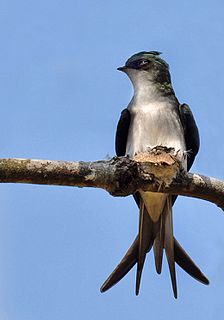
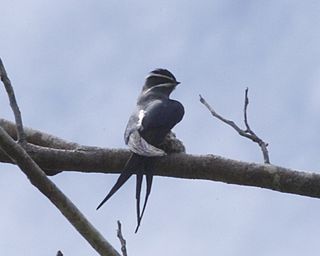
The crested treeswift is a kind of tree swift. The tree swifts are aerial near passerine birds, closely related to, but distinct from the true swifts by their sexual dimorphism, a frontal crest, and toes that allow perching on branches. They are restricted to southeast Asia and Australasia. It was for sometime considered conspecific with its eastern relative, the grey-rumped treeswift, but they do not interbreed where their ranges overlap. They are distinct in flight with long bowed wings and a deeply forked tail that usually appears narrow and pointed. When perched the long
The grey-rumped treeswift is a species of bird in the Hemiprocnidae family. There are currently four extant species in the family. Like the other members of Hemiprocnidae, this species is closely related to true swifts as well. However, unlike true swifts, the treeswifts are arboreal in nature, often seen perched on trees, high tension power transmission lines and on pylons. When perched, the wing tips cross over the tail. This species is commonly found in peninsular Malaysia but has an extremely large range with limited information about the population trend,.
The moustached treeswift is a species of bird in the family Hemiprocnidae. It is found in the northern Moluccas, New Guinea, Bismarck and the Solomon Islands archipelagos. Its natural habitats are subtropical or tropical moist lowland forests, subtropical or tropical mangrove forests, and subtropical or tropical moist montane forests.
The bronzy hermit is a species of hummingbird in the family Trochilidae. It is found in forests and thickets from eastern Honduras south to western Panama, and in the Chocó of western Colombia and north-western Ecuador. It closely resembles the larger rufous-breasted hermit.
The rufous-breasted hermit or hairy hermit is a hummingbird that breeds from Panama south to Bolivia, and on Trinidad, Tobago and Grenada. It is a widespread and generally common species, though local populations may change in numbers and disappear altogether in marginal habitat
The sooty barbthroat is a hummingbird species in the family Trochilidae.
The Guinea turaco, also known as the green turaco or green lourie, is a species of turaco, a group of otidimorphae birds belonging to the family Musophagidae. It was formerly included in the Livingstone's, Schalow's, Knysna, black-billed and Fischer's turacos as subspecies.
The black-billed turaco is a medium-sized turaco, an endemic family to sub-Saharan Africa. It is a resident breeder in the forests of central Africa, found in the Democratic Republic of Congo, Uganda, West Kenya, Burundi, Rwanda and South Sudan.
The Schalow's turaco is a frugivorous bird in the Musophagidae family. This bird's common name and Latin binomial commemorate the German banker and amateur ornithologist Hermann Schalow.
Previous page: Sibley-Monroe checklist 4
Next page: Sibley-Monroe checklist 6
Index of pages: 1, 2, 3, 4, 5, 6, 7, 8, 9, 10, 11, 12, 13, 14, 15, 16, 17, 18
The Sibley-Monroe checklist was a study of birds conducted by Charles Sibley and Burt Monroe. It drew on extensive DNA-DNA hybridisation studies to reassess the relationships between modern birds.
The Sibley-Monroe checklist was a landmark document in the study of birds. It drew on extensive DNA-DNA hybridisation studies to reassess the relationships between modern birds.
The violet sabrewing is a very large hummingbird native to southern Mexico and Central America as far south as Costa Rica and western Panama.
The hermits are tropical and subtropical hummingbirds in the subfamily Phaethornithinae, comprising 30–40 species in six genera. They occur from southern Mexico, through Central America, to South America as far south as northern Argentina.
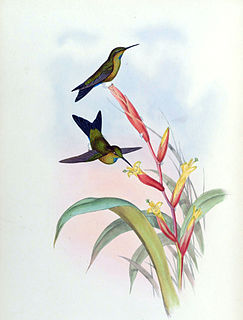
The turquoise-throated puffleg, also known as Godin's puffleg, is a species of hummingbird from Ecuador. It is mostly green with blue undertail coverts and white powder-puffs of downy feathers on the legs, and the male has a bluish-purple throat patch. It is only known from a few specimens taken in the nineteenth century and its taxonomic position is unclear. The type of habitat in which the type species was recovered has largely disappeared, and recent surveys trying to find this bird have failed. The International Union for Conservation of Nature believes it may be extinct, but there is a possibility that some individuals remain, so the bird has been rated as "critically endangered".
Not to be confused with the Club Penguin Puffles.
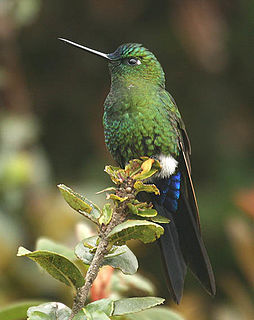
Eriocnemis is a genus of hummingbirds, which - together with the species in the genus Haplophaedia - are known as pufflegs. They occur in humid forest, woodland and shrub at altitudes of 1000 to 4800 m. asl in the Andes of Argentina, Bolivia, Peru, Ecuador, Colombia, and Venezuela. The males have a colourful green, coppery or blue plumage, and the females are generally somewhat duller. The most striking feature of both sexes in the genus Eriocnemis are their dense snow-white leg-puffs which consist of feather tufts that resemble woolly panties. One species, the black-thighed puffleg - is characterized by black coloured leg-puffs. Most have a contrasting blue, purple or coppery-red vent, but this is green in the black-thighed and emerald-bellied puffleg. Further common features of all species are the straight black bill and the slightly to deeply forked tail. The genus name was coined by the German naturalist Ludwig Reichenbach who called them Snowy panties.
Amazilia is a hummingbird genus in the subfamily Trochilinae. It occurs in tropical Central and South America.
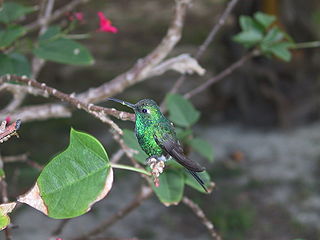
Chlorostilbon is a genus of hummingbird in the family Trochilidae, known as emeralds. A single species, the blue-chinned sapphire is variously placed in the monotypic genus Chlorestes or in Chlorostilbon. The taxonomy of the C. mellisugus superspecies is highly complex and, depending on view, includes 1-8 species. All species in this genus have straight black or black-and-red bills. The males are overall iridescent green, golden-green or bluish-green, and in some species the tail and/or throat is blue. The females have whitish-grey underparts, tail-corners and post-ocular streak.

The fauna of Colombia is characterized by a high biodiversity, with the highest rate of species by area unit worldwide.
The Apodinae are a subfamily of swifts and contain the following species: