This article does not cite any sources .(June 2019) (Learn how and when to remove this template message) |
The Sibley-Monroe checklist was a landmark document in the study of birds. It drew on extensive DNA-DNA hybridisation studies to reassess the relationships between modern birds.
Birds, also known as Aves or avian dinosaurs, are a group of endothermic vertebrates, characterised by feathers, toothless beaked jaws, the laying of hard-shelled eggs, a high metabolic rate, a four-chambered heart, and a strong yet lightweight skeleton. Birds live worldwide and range in size from the 5 cm (2 in) bee hummingbird to the 2.75 m (9 ft) ostrich. They rank as the world's most numerically-successful class of tetrapods, with approximately ten thousand living species, more than half of these being passerines, sometimes known as perching birds. Birds have wings which are more or less developed depending on the species; the only known groups without wings are the extinct moa and elephant birds. Wings, which evolved from forelimbs, gave birds the ability to fly, although further evolution has led to the loss of flight in flightless birds, including ratites, penguins, and diverse endemic island species of birds. The digestive and respiratory systems of birds are also uniquely adapted for flight. Some bird species of aquatic environments, particularly seabirds and some waterbirds, have further evolved for swimming.
The horned screamer is a member of a small family of birds, the Anhimidae, which occurs in wetlands of tropical South America. There are three screamer species, the other two being the southern screamer and the northern screamer in the genus Chauna. They are related to the ducks, geese and swans, which are in the family Anatidae, but have bills looking more like those of game birds.
The northern screamer, also known as the black-necked screamer, is a large species of bird in the small family Anhimidae, the screamers. It is a resident breeder in northern Colombia, in Chocó, Antioquia, Córdoba, Sucre, Bolívar, Magdalena, Santander, and Cesar Departments and northwestern Venezuela, in Zulia, Mérida, and Trujillo States. On average, they are 88.9 cm (35 in) long and weigh about 3.9 kg (8.6 lb).
The southern screamer, also known as the crested screamer, belongs to the order Anseriformes. It is found in southeastern Peru, northern Bolivia, Paraguay, southern Brazil, Uruguay and northern Argentina. Its diet consists of plants stems, seeds, leaves, and, rarely, small animals.
The spotted whistling duck is a member of the duck family Anatidae.
The plumed whistling duck, also called the grass whistling duck, is a whistling duck that breeds in Australia. It is a predominantly brown-coloured duck with a long neck and characteristic plumes arising from its flanks. The sexes are similar in appearance.
The fulvous whistling duck or fulvous tree duck is a species of whistling duck that breeds across the world's tropical regions in much of Mexico and South America, the West Indies, the Southern United States, sub-Saharan Africa and the Indian subcontinent. It has plumage that is mainly reddish brown, long legs and a long grey bill, and shows a distinctive white band across its black tail in flight. Like other members of its ancient lineage, it has a whistling call which is given in flight or on the ground. Its preferred habitat consists of wetlands with plentiful vegetation, including shallow lakes and paddy fields. The nest, built from plant material and unlined, is placed among dense vegetation or in a tree hole. The typical clutch is around ten whitish eggs. The breeding adults, which pair for life, take turns to incubate, and the eggs hatch in 24–29 days. The downy grey ducklings leave the nest within a day or so of hatching, but the parents continue to protect them until they fledge around nine weeks later.
The masked duck is a tiny stiff-tailed duck ranging through the tropical Americas. They are found from Mexico to South America and also in the Caribbean. Primarily not migratory, masked ducks are reported as very uncommon vagrants in the southernmost United States, along the Mexican border and in Florida. As of 2000, the conservation status for masked ducks in Texas is 3,800 birds. On April 1, 1962, it was recorded from Lowndes County, Georgia, where it was photographed by Alexander Wetmore.
The ruddy duck is a duck from North America and one of the stiff-tailed ducks. The genus name is derived from Ancient Greek oxus, "sharp", and oura, "tail", and jamaicensis is "from Jamaica". The Andean duck was considered a subspecies. In fact, some taxonomists, including the American Ornithological Society, still consider it conspecific. Subspecies: jamaicensis - North America including West Indies. andina - central Colombia. ferruginea - southern Colombia south to Chile.
The Andean duck is a duck from the Andes Mountains of South America, one of the stiff-tailed ducks. It was considered a subspecies of the ruddy duck. In fact, some taxonomic authorities still consider it conspecific, including the American Ornithological Society.
The red-backed buttonquail is a species of bird in the family Turnicidae. It is found in Australia, Indonesia, Papua New Guinea, the Philippines and the Solomon Islands. Other names by which it is known in different parts of its range include black-backed, black-spotted and orange-breasted buttonquail. There are fourteen recognised subspecies.
The black-rumped buttonquail is a small species of bird in the buttonquail genus.
The Hottentot buttonquail is a bird in the family Turnicidae formerly considered conspecific with the black-rumped buttonquail.
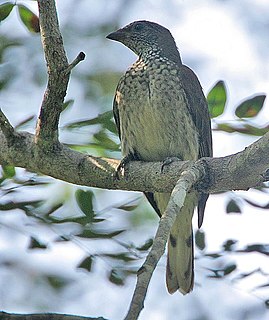
The spotted honeyguide is a species of bird in the family Indicatoridae. It is found in Angola, Benin, Cameroon, Central African Republic, Republic of the Congo, Democratic Republic of the Congo, Ivory Coast, Equatorial Guinea, Gabon, Gambia, Ghana, Guinea, Guinea-Bissau, Liberia, Mali, Nigeria, Senegal, Sierra Leone, South Sudan, Togo, and Uganda.
The scaly-throated honeyguide is a species of bird in the family Indicatoridae.
The greater honeyguide is a bird in the family Indicatoridae, paleotropical near passerine birds related to the woodpeckers. Its English and scientific names refer to its habit of guiding people to bee colonies. Claims that it also guides non-human animals are disputed.
Previous page: Sibley-Monroe checklist 1
Next page: Sibley-Monroe checklist 3
Index of pages: 1, 2, 3, 4, 5, 6, 7, 8, 9, 10, 11, 12, 13, 14, 15, 16, 17, 18
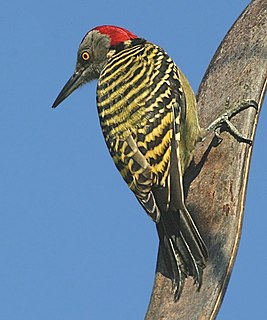
Woodpeckers are near passerine birds of the order Piciformes. They are one subfamily in the family Picidae, which also includes the piculets and wrynecks. They are found worldwide.
Woodpeckers are part of the family Picidae, a group of near-passerine birds that also consist of piculets, wrynecks, and sapsuckers. Members of this family are found worldwide, except for Australia, New Guinea, New Zealand, Madagascar, and the extreme polar regions. Most species live in forests or woodland habitats, although a few species are known that live in treeless areas, such as rocky hillsides and deserts, and the Gila woodpecker specialises in exploiting cacti.
Under South Korean law, the hunting and capturing of a large number of species of wild animals is prohibited. These include 64 species of mammals, 396 species of birds, 16 species of reptiles, and 10 species of amphibians. Most of these species are not actually endangered species, but are protected for other reasons. No freshwater fish are included on the list, although some are endangered.
This is a list of the fauna of Finland. Finland borders Sweden to the west, Russia to the east, and Norway to the north, while Estonia lies to its south across the Gulf of Finland, allowing an ecological mix. Finland contains many species of mammals, birds, and fish, but only a few reptiles and amphibians. This article discusses all the vertebrate animals which can be found on Finland itself, not the oceans.
Tyzzeria is a genus of parasitic alveolates that with one exception infect the cells of the small intestine.