Sibley-Monroe checklist 11

Last updated

The Sibley-Monroe checklist was a landmark document in the study of birds. It drew on extensive DNA-DNA hybridisation studies to reassess the relationships between modern birds.

Bird Warm-blooded, egg-laying vertebrates with wings, feathers and beaks

Birds, also known as Aves, are a group of endothermic vertebrates, characterised by feathers, toothless beaked jaws, the laying of hard-shelled eggs, a high metabolic rate, a four-chambered heart, and a strong yet lightweight skeleton. Birds live worldwide and range in size from the 5 cm (2 in) bee hummingbird to the 2.75 m (9 ft) ostrich. They rank as the world's most numerically-successful class of tetrapods, with approximately ten thousand living species, more than half of these being passerines, sometimes known as perching birds. Birds have wings which are more or less developed depending on the species; the only known groups without wings are the extinct moa and elephant birds. Wings, which evolved from forelimbs, gave birds the ability to fly, although further evolution has led to the loss of flight in flightless birds, including ratites, penguins, and diverse endemic island species of birds. The digestive and respiratory systems of birds are also uniquely adapted for flight. Some bird species of aquatic environments, particularly seabirds and some waterbirds, have further evolved for swimming.

Contents

Passeriformes (continued)

Thamnophilidae

Fasciated antshrike species of bird

The fasciated antshrike is a species of bird in the antbird family Thamnophilidae. The species is found in Central and Southern America.

Bamboo antshrike species of bird

The bamboo antshrike is a species of bird in the family Thamnophilidae. It is found in Bolivia, Brazil, and Peru. Its natural habitat is subtropical or tropical moist lowland forests.

Spot-backed antshrike species of bird

The spot-backed antshrike is a species of bird in the family Thamnophilidae. It is the only member of the genus Hypoedaleus. It is found in southeastern Brazil, eastern Paraguay and far northeastern Argentina. Its natural habitat is subtropical or tropical moist lowland forest.

Furnariidae

Campo miner species of bird

The campo miner is a species of bird in the family Furnariidae.

Common miner species of bird

The common miner is a passerine bird of South America, belonging to the ovenbird family. It is a ground-dwelling bird which feeds on insects and seeds. It has about 9 different subspecies, some of which may be better treated as separate species.

Greyish miner species of bird

The greyish miner is a species of bird in the family Furnariidae. It is found in Chile and Peru. Its natural habitat is subtropical or tropical dry shrubland.

Formicariidae

Rufous-capped antthrush species of bird

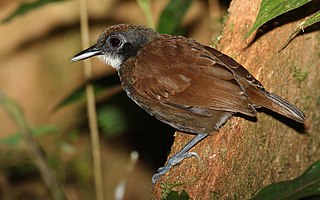
The rufous-capped antthrush is a species of bird in the family Formicariidae. It is found in Bolivia, Brazil, Colombia, Ecuador, French Guiana, Guyana, Peru, Suriname, and Venezuela. Its natural habitat is subtropical or tropical moist lowland forest.

Black-faced antthrush species of bird

The black-faced antthrush, is a passerine bird.

The rufous-fronted antthrush is a species of bird in the family Formicariidae. It is found very locally in humid forest in southeastern Peru, northwestern Bolivia (Pando), and far southwestern Brazil (Acre). It is threatened by habitat loss.

Conopophagidae

Rufous gnateater species of bird

The rufous gnateater is a passerine bird of the gnateater family, Conopophagidae. It is found in forest understory and bushes in eastern Brazil from Rio Grande do Sul north to central Brazil. Its range also extends into eastern Paraguay and north-eastern Argentina and it has recently been recorded in Uruguay. It is often elusive and hard to see, but is commoner and less shy than other gnateaters.

Chestnut-belted gnateater species of bird

The chestnut-belted gnateater is a species of bird in the Conopophagidae family, the gnateaters. It is found in the Amazon Basin of northern Brazil, southern Colombia and eastern Peru and Ecuador; also the Guianan countries of Guyana, Suriname and eastern French Guiana. Its natural habitat is tropical moist lowland forests.

Hooded gnateater species of bird

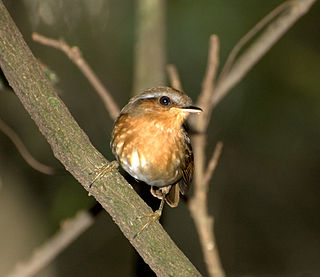
The hooded gnateater is a species of bird in the Conopophagidae family. It is endemic to northern Brazil.

Rhinocryptidae

Moustached turca species of bird

The moustached turca is a passerine bird which is endemic to Chile. It belongs to the tapaculo group and is a member of the genus Pteroptochos, along with the two species of huet-huet.

White-throated tapaculo species of bird

The white-throated tapaculo is a species of bird in the Rhinocryptidae family. It is endemic to northern Chile.

Chucao tapaculo species of bird

The chucao tapaculo is a species of bird in the Rhinocryptidae family. It is found in central Chile and adjacent Argentina; it has also been spotted in the Magallanes Province. Its natural habitat is temperate forests. The diet of the chucao tapaculo is dominated by invertebrates and fruits. This bird show a pattern of aggressiveness and territoriality towards the other species of tapaculos in the forest of southern Chile. The chucao tapaculo seems vulnerable to the fragmentation of its habitat.

Previous page: Sibley-Monroe checklist 10

Next page: Sibley-Monroe checklist 12

Index of pages: 1, 2, 3, 4, 5, 6, 7, 8, 9, 10, 11, 12, 13, 14, 15, 16, 17, 18

Related Research Articles

Antbird A large passerine bird family, found across subtropical and tropical Central and South America, from Mexico to Argentina.

The antbirds are a large passerine bird family, Thamnophilidae, found across subtropical and tropical Central and South America, from Mexico to Argentina. There are more than 230 species, known variously as antshrikes, antwrens, antvireos, fire-eyes, bare-eyes and bushbirds. They are related to the antthrushes and antpittas, the tapaculos, the gnateaters and the ovenbirds. Despite some species' common names, this family is not closely related to the wrens, vireos or shrikes.

Ovenbird (family) family of birds

Ovenbirds or furnariids are a large family of small suboscine passerine birds found from Mexico and Central to southern South America. They form the family Furnariidae. The ovenbird, which breeds in North America, is not a furnariid – rather it is a distantly related bird of the wood warbler family, Parulidae.

Niels Krabbe Danish ornithologist

Niels Kaare Krabbe is an ornithologist and bird conservationist for many years based at the Vertebrate Department of the Zoological Museum, University of Copenhagen and tutored by Jon Fjeldså. His research interests include various aspects of ornithology, especially bioacoustics, conservation, and systematics and altitudinal replacements of Scytalopus tapaculos. He has worked extensively in the Andes, especially Ecuador, and wrote the passerine section of Birds of the High Andes (1990) and the accounts of most Andean species in Threatened Birds of the Americas (1992). He has helped build up a large tissue collection in the Zoological Museum and has authored or coauthored several bioacoustic publications and peer-reviewed papers in scientific journals.

<i>Synallaxis</i> genus of birds

Synallaxis is a genus of birds in the ovenbird family, Furnariidae.