The Sibley-Monroe checklist was a landmark document in the study of birds. It drew on extensive DNA-DNA hybridisation studies to reassess the relationships between modern birds.
Birds, also known as Aves, are a group of endothermic vertebrates, characterised by feathers, toothless beaked jaws, the laying of hard-shelled eggs, a high metabolic rate, a four-chambered heart, and a strong yet lightweight skeleton. Birds live worldwide and range in size from the 5 cm (2 in) bee hummingbird to the 2.75 m (9 ft) ostrich. They rank as the world's most numerically-successful class of tetrapods, with approximately ten thousand living species, more than half of these being passerines, sometimes known as perching birds. Birds have wings which are more or less developed depending on the species; the only known groups without wings are the extinct moa and elephant birds. Wings, which evolved from forelimbs, gave birds the ability to fly, although further evolution has led to the loss of flight in flightless birds, including ratites, penguins, and diverse endemic island species of birds. The digestive and respiratory systems of birds are also uniquely adapted for flight. Some bird species of aquatic environments, particularly seabirds and some waterbirds, have further evolved for swimming.
The monotonous lark is a species of lark in the family Alaudidae found in southern Africa.
The white-tailed lark is a species of lark in the family Alaudidae found in Africa.
Kordofan lark is a species of lark in the family Alaudidae found in Africa.
The Gurney's sugarbird is a species of bird in the family Promeropidae.
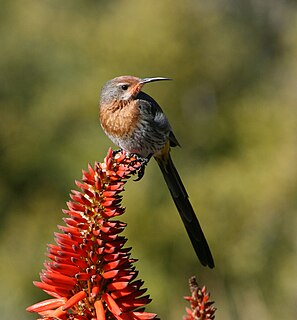
The Cape sugarbird is one of the six bird species endemic to the Fynbos biome of the Western Cape and Eastern Cape provinces of South Africa.
The olive-backed flowerpecker is a species of bird in the Dicaeidae family. It is endemic to the Philippines.
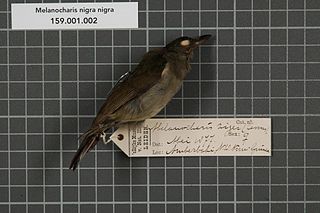
The obscure berrypecker is a small passerine bird from the berrypecker family Melanocharitidae. It was described by the German ornithologist Friedrich Finsch based on a specimen collected on the island of New Guinea ; collected in 1867 in the Arfak Mountains. Another specimen was collected in 1933 in the mountains northwest of Port Moresby in Papua New Guinea, these two specimens are the only confirmed records of the species. Unconfirmed sight records have been made in regions of New Guinea; these suggest that the species is not rare, and is a resident of disturbed forest, able to cope with human modification of its habitat. All these sightings were all made in the mountains, which is consistent with the range of the rest of the berrypeckers, only the black berrypecker has a lowland range.
The black berrypecker is a species of bird in the Melanocharitidae family. It is found in Indonesia and Papua New Guinea. Its natural habitat is subtropical or tropical moist lowland forests.
The fan-tailed berrypecker is a species of bird in the Melanocharitidae family. It is found in New Guinea. Its natural habitat is subtropical or tropical moist montane forests.
The tit berrypecker is a species of bird in the family Paramythiidae. First described by Christian Erich Hermann von Meyer in 1875, it is monotypic within the genus Oreocharis. It is found in the New Guinea Highlands and more scarcely in northern parts of the island, in subtropical or tropical moist montane forests.
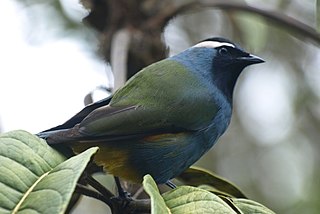
The crested berrypecker is a species of bird in the family Paramythiidae. It is found in New Guinea. Its natural habitat is subtropical or tropical moist montane forests.
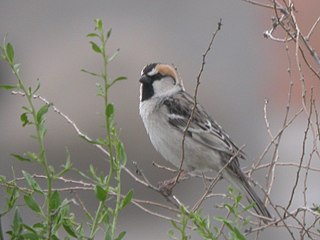
The saxaul sparrow is a passerine bird of the sparrow family Passeridae, found in parts of Central Asia. At 14–16 centimetres (5.5–6.3 in) and 25–32 grams (0.88–1.13 oz), it is among the larger sparrows. Both sexes have plumage ranging from dull grey to sandy brown, and pale brown legs. Females have less boldly coloured plumage and bills, lacking the pattern of black stripes on the male's head. The head markings of both sexes make the saxaul sparrow distinctive, and unlikely to be confused with any other bird. Vocalisations include a comparatively soft and musical chirping call, a song, and a flight call.
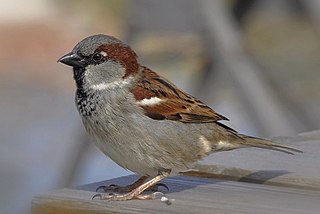
The house sparrow is a bird of the sparrow family Passeridae, found in most parts of the world. A small bird, it has a typical length of 16 cm (6.3 in) and a mass of 24–39.5 g (0.85–1.39 oz). Females and young birds are coloured pale brown and grey, and males have brighter black, white, and brown markings. One of about 25 species in the genus Passer, the house sparrow is native to most of Europe, the Mediterranean Basin, and much of Asia. Its intentional or accidental introductions to many regions, including parts of Australasia, Africa, and the Americas, make it the most widely distributed wild bird.
The Spanish sparrow or willow sparrow is a passerine bird of the sparrow family Passeridae. It is found in the Mediterranean region and south-west and central Asia. It is very similar to the closely related house sparrow, and the two species show their close relation in a "biological mix-up" of hybridisation in the Mediterranean region, which complicates the taxonomy of this species.
Previous page: Sibley-Monroe checklist 16
Next page: Sibley-Monroe checklist 18
Index of pages: 1, 2, 3, 4, 5, 6, 7, 8, 9, 10, 11, 12, 13, 14, 15, 16, 17, 18
Estrildidae, or estrildid finch, is a family of small passerine birds of the Old World tropics and Australasia. They can be classified as the family Estrildidae, comprising species commonly known as munias, mannakins, firefinches, parrotfinches and waxbills, or as a subfamily within the family Passeridae, which strictly defined comprises the Old World sparrows. Despite the word "finch" being included in the common names of many of the species, they are not closely related to birds with this name in other families, such as the Fringillidae, Emberizidae or Passerellidae.