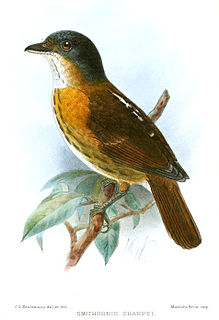
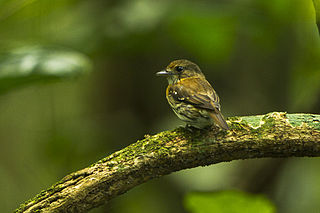
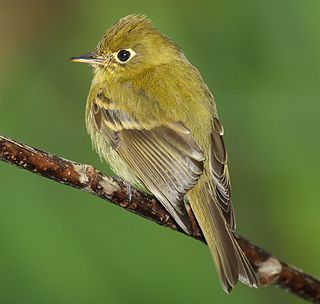
The Sibley-Monroe checklist was a landmark document in the study of birds. It drew on extensive DNA-DNA hybridisation studies to reassess the relationships between modern birds.
Birds, also known as Aves, are a group of endothermic vertebrates, characterised by feathers, toothless beaked jaws, the laying of hard-shelled eggs, a high metabolic rate, a four-chambered heart, and a strong yet lightweight skeleton. Birds live worldwide and range in size from the 5 cm (2 in) bee hummingbird to the 2.75 m (9 ft) ostrich. They rank as the world's most numerically-successful class of tetrapods, with approximately ten thousand living species, more than half of these being passerines, sometimes known as perching birds. Birds have wings which are more or less developed depending on the species; the only known groups without wings are the extinct moa and elephant birds. Wings, which evolved from forelimbs, gave birds the ability to fly, although further evolution has led to the loss of flight in flightless birds, including ratites, penguins, and diverse endemic island species of birds. The digestive and respiratory systems of birds are also uniquely adapted for flight. Some bird species of aquatic environments, particularly seabirds and some waterbirds, have further evolved for swimming.
The rifleman is a small insectivorous passerine bird that is endemic to New Zealand. It belongs to the family Acanthisittidae, also known as the New Zealand wrens, of which it is one of only two surviving species. The rifleman resembles a wren in form, but is not related to the family of true wrens, Troglodytidae, nor the fairy-wrens of Australia.
The eared pitta is a species of bird in the pitta family, Pittidae, and is found in Southeast Asia.
The blue-naped pitta is a species of bird in the family Pittidae.
The blue-rumped pitta is a species of bird in the Pittidae family. It is found in Cambodia, China, Laos, Thailand, and Vietnam. Its natural habitats are subtropical or tropical moist lowland forests and subtropical or tropical moist montane forests.
The African broadbill, also known as the Black-capped Broadbill or Delacour's broadbill is a species of bird in the sub-oscine family Eurylaimidae.
The grey-headed broadbill is a species of bird in the Eurylaimidae family. It is found in Cameroon, Central African Republic, Republic of the Congo, Democratic Republic of the Congo, Equatorial Guinea, Gabon, and Nigeria. Its natural habitat is subtropical or tropical moist lowland forests.
The rufous-sided broadbill is a species of bird in the Eurylaimidae family. It is found in Angola, Benin, Cameroon, Central African Republic, Republic of the Congo, Democratic Republic of the Congo, Ivory Coast, Equatorial Guinea, Gabon, Ghana, Liberia, Nigeria, Rwanda, Sierra Leone, South Sudan, Togo, and Uganda. Its natural habitat is subtropical or tropical moist lowland forests.
The velvet asity is a species of bird in the Philepittidae family. It is endemic to Madagascar.
Schlegel's asity is a species of bird in the family Eurylaimidae. It is endemic to Madagascar. Its natural habitats are subtropical or tropical dry forest and subtropical or tropical moist lowland forest. It is threatened by habitat loss.
The streak-necked flycatcher is a species of bird in the family Tyrannidae.
The olive-striped flycatcher is a species of bird in the family Tyrannidae.
The ochre-bellied flycatcher is a small bird of the tyrant flycatcher family. It breeds from southern Mexico through Central America, and South America east of the Andes as far as southern Brazil, and on Trinidad and Tobago.
Previous page: Sibley-Monroe checklist 9
Next page: Sibley-Monroe checklist 11
Index of pages: 1, 2, 3, 4, 5, 6, 7, 8, 9, 10, 11, 12, 13, 14, 15, 16, 17, 18
The tyrant flycatchers (Tyrannidae) are a family of passerine birds which occur throughout North and South America. They are considered the largest family of birds, with more than 400 species. They are the most diverse avian family in every country in the Americas, except for the United States and Canada. As could be expected from a family this large, the members vary greatly in shape, patterns, size and colors. Some tyrant flycatchers superficially resemble the Old World flycatchers which they are named after but are not related to. They are members of suborder Tyranni (suboscines), which do not have the sophisticated vocal capabilities of most other songbirds.
Tityridae is family of suboscine passerine birds found in forest and woodland in the Neotropics. The 45 species in this family were formerly spread over the families Tyrannidae, Pipridae and Cotingidae. As yet, no widely accepted common name exists for the family, although tityras and allies and tityras, mourners and allies have been used. They are small to medium-sized birds. Under current classification, the family ranges in size from the buff-throated purpletuft, at 9.5 cm (3.7 in) and 10 grams, to the masked tityra, at up to 24 cm (9.5 in) and 88 grams. Most have relatively short tails and large heads.
Aracuri-Esmeralda Ecological Station is an ecological station in the state of Rio Grande do Sul, Brazil. It is in the Atlantic Forest biome.