This article does not cite any sources .(June 2019) (Learn how and when to remove this template message) |
The Sibley-Monroe checklist was a landmark document in the study of birds. It drew on extensive DNA-DNA hybridisation studies to reassess the relationships between modern birds.
Birds, also known as Aves or avian dinosaurs, are a group of endothermic vertebrates, characterised by feathers, toothless beaked jaws, the laying of hard-shelled eggs, a high metabolic rate, a four-chambered heart, and a strong yet lightweight skeleton. Birds live worldwide and range in size from the 5 cm (2 in) bee hummingbird to the 2.75 m (9 ft) ostrich. They rank as the world's most numerically-successful class of tetrapods, with approximately ten thousand living species, more than half of these being passerines, sometimes known as perching birds. Birds have wings which are more or less developed depending on the species; the only known groups without wings are the extinct moa and elephant birds. Wings, which evolved from forelimbs, gave birds the ability to fly, although further evolution has led to the loss of flight in flightless birds, including ratites, penguins, and diverse endemic island species of birds. The digestive and respiratory systems of birds are also uniquely adapted for flight. Some bird species of aquatic environments, particularly seabirds and some waterbirds, have further evolved for swimming.
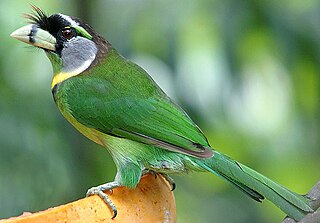
The fire-tufted barbet is a species of bird in the Asian barbet family Megalaimidae. It is native to Peninsular Malaysia and Sumatra, where it inhabits tropical moist lowland and montane forests. It has been listed as Least Concern on the IUCN Red List since 2004. Its scientific name was proposed by Salomon Müller in 1836, who described a barbet from Sumatra.
The great barbet is an Asian barbet native to the Indian sub-continent and Southeast Asia, where it inhabits foremost forests up to 3,000 m (9,800 ft) altitude. It has been listed as Least Concern on the IUCN Red List since 2004 because of its wide distribution.
The red-vented barbet is a species of bird in the family Megalaimidae. It is found in Cambodia, Laos and Vietnam. Its natural habitats are subtropical or tropical moist lowland forest and subtropical or tropical moist montane forest.
The naked-faced barbet is a bird species in the family Lybiidae. It used to be placed in the family Bucconidae (puffbirds), which has been split up; alternatively, it may be included in a vastly expanded Ramphastidae (toucans).
The bristle-nosed barbet is a bird species in the family Lybiidae. It used to be placed in the family Bucconidae (puffbirds), which has been split up; alternatively, it may be included in a vastly expanded Ramphastidae (toucans).
The Sladen's barbet is a species of bird in the Lybiidae family . It is found in the Central African Republic and the Democratic Republic of the Congo.
The scarlet-crowned barbet is a species of bird in the Capitonidae family.
The spot-crowned barbet is a species of bird in the family Capitonidae. It is found in Colombia and Panama. Its natural habitats are subtropical or tropical moist lowland forest and heavily degraded former forest.
The orange-fronted barbet is a species of bird in the Capitonidae family. It is found in forests in western Ecuador and extreme southwestern Colombia. It is threatened by habitat loss. Both male and female orange-fronted barbets are mostly black and white, and have a red forecrown. The chest of the male bird is very pale yellowish and the throat is white, while these sections are black in the female bird. Unlike the male, the female also has whitish edging to the mantle and wing-coverts.
The white-eared jacamar is a species of bird in the family Galbulidae.
The dusky-backed jacamar is a species of bird in the family Galbulidae.
The pale-headed jacamar is a species of bird in the family Galbulidae.
The white-necked puffbird is a species of puffbird in the family Bucconidae.
The black-breasted puffbird is a species of puffbird in the family Bucconidae. It is found in Colombia, Ecuador, and Panama.
The brown-banded puffbird is a species of bird in the family Bucconidae, the puffbirds. It is one of six species in the genus Notharchus.
Previous page: Sibley-Monroe checklist 2
Next page: Sibley-Monroe checklist 4
Index of pages: 1, 2, 3, 4, 5, 6, 7, 8, 9, 10, 11, 12, 13, 14, 15, 16, 17, 18

Jurong Bird Park is an aviary and tourist attraction in Jurong, Singapore. The bird park, managed by Wildlife Reserves Singapore, covers an area of 0.2 square kilometres on the western slope of Jurong Hill, the highest point in the Jurong region.
The emerald toucanet or northern emerald toucanet is a species of near-passerine bird in the Ramphastidae family occurring in mountainous regions of Mexico and Central America. Several taxa formerly included within this species have now been re-classified into separate species of their own.
The collared aracari or collared araçari is a toucan, a near-passerine bird. It breeds from southern Mexico to Panama; also Ecuador, Colombia, Venezuela and Costa Rica.
Ramphastos is a genus of toucans, tropical and subtropical near passerine birds from Mexico, and Central and South America, which are brightly marked and have enormous, often colourful, bills.
An aracari or araçari is any of the medium-sized toucans that, together with the saffron toucanet, make up the genus Pteroglossus.
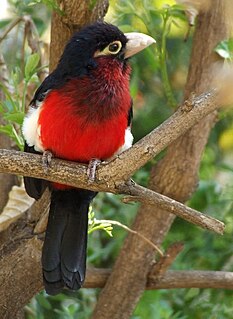
The African barbets are birds in the family Lybiidae. They were usually united with their New World and Asian relatives in the Capitonidae for quite some time, but this has been confirmed to be limited to the main New World lineage. There are 42 species ranging from the type genus Lybius of forest interior to the tinkerbirds (Pogoniulus) of forest and scrubland. They are found throughout sub-Saharan Africa, with the exception of the far south-west of South Africa.
The green aracari, or green araçari, is a toucan, a near-passerine bird. It is found in the lowland forests of northeastern South America, in the northeast Amazon Basin, the Guianas and the eastern Orinoco River drainage of Venezuela. At 30–40 cm. (12–16 in) long and weighing 110–160 grams, it is the smallest aracari in its range, and among the smallest members of the toucan family.
The red-necked aracari, or red-necked araçari, is a species of bird in the Ramphastidae family, the toucans, toucanets, aracaris, etc.

The fauna of Colombia is characterized by a high biodiversity, with the highest rate of species by area unit worldwide.
Soberanía National Park is a national park in Panama near the banks of the Panama Canal in the provinces of Panamá and Colón, some 25 kilometres (16 mi) from Panama City. The Chagres River runs through the park. Established as a national park in 1980, the park covers 55,000 acres (220 km2).
Toucans are members of the Neotropical near passerine bird family Ramphastidae. The Ramphastidae are most closely related to the American barbets. They are brightly marked and have large, often-colorful bills. The family includes five genera and over forty different species.
The citron-throated toucan is a species of bird in the family Ramphastidae found in northern Colombia and north-western Venezuela.
The black-throated toucanet is a near-passerine bird found in central Ecuador to western Bolivia.
Galbuli is one of the two suborders of the order Piciformes and includes two families Bucconidae (puffbirds) and Galbulidae (jacamars). The other suborder Pici is a global group of piciforms, puffbirds and jacamars are only found in the Neotropics.
Wagler's toucanet is a species of bird in the family Ramphastidae found in the Sierra Madre del Sur of Guerrero and Oaxaca in south-western Mexico. Its natural habitat is subtropical or tropical moist lowlands and montane forests. It is also resident in shrublands, wetlands, farmlands and gardens.
The white-throated toucanet is a near-passerine bird found in the Andes from western Venezuela, through Colombia to northern Ecuador.