The Sibley-Monroe checklist was a landmark document in the study of birds. It drew on extensive DNA-DNA hybridisation studies to reassess the relationships between modern birds.
Birds, also known as Aves, are a group of endothermic vertebrates, characterised by feathers, toothless beaked jaws, the laying of hard-shelled eggs, a high metabolic rate, a four-chambered heart, and a strong yet lightweight skeleton. Birds live worldwide and range in size from the 5 cm (2 in) bee hummingbird to the 2.75 m (9 ft) ostrich. They rank as the world's most numerically-successful class of tetrapods, with approximately ten thousand living species, more than half of these being passerines, sometimes known as perching birds. Birds have wings which are more or less developed depending on the species; the only known groups without wings are the extinct moa and elephant birds. Wings, which evolved from forelimbs, gave birds the ability to fly, although further evolution has led to the loss of flight in flightless birds, including ratites, penguins, and diverse endemic island species of birds. The digestive and respiratory systems of birds are also uniquely adapted for flight. Some bird species of aquatic environments, particularly seabirds and some waterbirds, have further evolved for swimming.
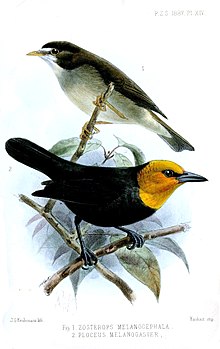
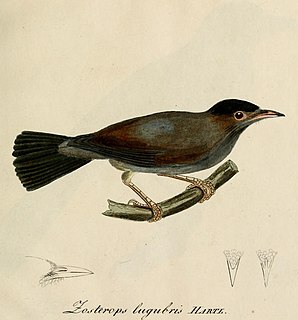
The black-capped speirops is a species of bird in the family Zosteropidae. It was previously placed in the genus Speirops. It is endemic to São Tomé and Príncipe.
The Fernando Po speirops, also known as the Bioko speirops, is a species of bird in the family Zosteropidae. It is endemic to Bioko Island in Equatorial Guinea.
The chestnut-headed tesia is a songbird species formerly of the "Old World warbler" family but nowadays placed in the bush warbler family (Cettiidae).
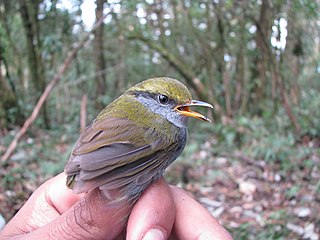
The slaty-bellied tesia is a species of warbler in the family Cettiidae.
The grey-bellied tesia is a species of warbler in the Cettiidae family.
Previous page: Sibley-Monroe checklist 15
Next page: Sibley-Monroe checklist 17
Index of pages: 1, 2, 3, 4, 5, 6, 7, 8, 9, 10, 11, 12, 13, 14, 15, 16, 17, 18
The Sibley-Monroe checklist was a study of birds conducted by Charles Sibley and Burt Monroe. It drew on extensive DNA-DNA hybridisation studies to reassess the relationships between modern birds.
The Sibley-Monroe checklist was a landmark document in the study of birds. It drew on extensive DNA-DNA hybridisation studies to reassess the relationships between modern birds.
Old World warblers are a large group of birds formerly grouped together in the bird family Sylviidae. The family held over 400 species in over 70 genera, and were the source of much taxonomic confusion. Two families were split out initially, the cisticolas into Cisticolidae and the kinglets into Regulidae. In the past ten years they have been the subject of much research and many species are now placed into other families, including the Acrocephalidae, Cettiidae, Phylloscopidae, and Megaluridae. In addition some species have been moved into existing families or have not yet had their placement fully resolved. A smaller family of warblers, together with some babblers formerly placed in the family Timaliidae and the parrotbills, are retained in a much smaller family Sylviidae.
The common cuckoo is a member of the cuckoo order of birds, Cuculiformes, which includes the roadrunners, the anis and the coucals.
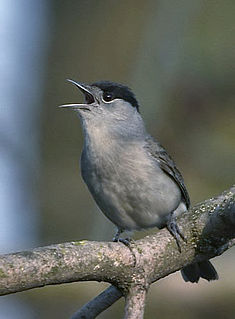
Sylviidae is a family of passerine birds that includes the typical warblers, parrotbills, the wrentit, and a number of babblers formerly placed within the Old World babbler family. They are found in Eurasia, Africa, and the west coast of North America.
The parrotbills are a group of peculiar birds native to East and Southeast Asia, though feral populations exist elsewhere. They are generally small, long-tailed birds which inhabit reedbeds and similar habitat. They feed mainly on seeds, e.g. of grasses, to which their bill, as the name implies, is well-adapted. Living in tropical to southern temperate climates, they are usually non-migratory.
The jungle babblers, Pellorneidae, are mostly Old World passerine birds belonging to the superfamily Sylvioidea. They are quite diverse in size and coloration, and usually characterised by soft, fluffy plumage and a tail on average the length of their body, or longer. These birds are found in tropical zones, with the greatest biodiversity in Southeast Asia and the Indian subcontinent.