The Sibley-Monroe checklist was a landmark document in the study of birds. It drew on extensive DNA-DNA hybridisation studies to reassess the relationships between modern birds.
Birds, also known as Aves, are a group of endothermic vertebrates, characterised by feathers, toothless beaked jaws, the laying of hard-shelled eggs, a high metabolic rate, a four-chambered heart, and a strong yet lightweight skeleton. Birds live worldwide and range in size from the 5 cm (2 in) bee hummingbird to the 2.75 m (9 ft) ostrich. They rank as the world's most numerically-successful class of tetrapods, with approximately ten thousand living species, more than half of these being passerines, sometimes known as perching birds. Birds have wings which are more or less developed depending on the species; the only known groups without wings are the extinct moa and elephant birds. Wings, which evolved from forelimbs, gave birds the ability to fly, although further evolution has led to the loss of flight in flightless birds, including ratites, penguins, and diverse endemic island species of birds. The digestive and respiratory systems of birds are also uniquely adapted for flight. Some bird species of aquatic environments, particularly seabirds and some waterbirds, have further evolved for swimming.
The chestnut-vented nuthatch is a species of bird in the nuthatch family.
The Kashmir nuthatch is a species of bird in the Sittidae family. It is found in the northernmost regions of the Indian subcontinent, primarily in the mid-altitudes of the Himalayas. The species ranges across Afghanistan, India, Nepal and Pakistan. The global population size has not been quantified, but the species is described as common in eastern Afghanistan and north-western India, and fairly common in Nepal.
The chestnut-bellied nuthatch is a species of bird in the family Sittidae.
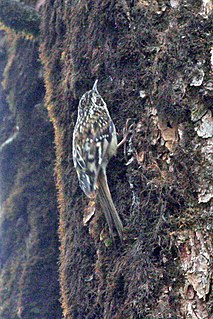
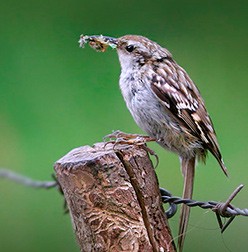
The Eurasian treecreeper or common treecreeper is a small passerine bird also known in the British Isles, where it is the only living member of its genus, simply as treecreeper. It is similar to other treecreepers, and has a curved bill, patterned brown upperparts, whitish underparts, and long stiff tail feathers which help it creep up tree trunks. It can be most easily distinguished from the similar short-toed treecreeper, which shares much of its European range, by its different song.
The Sichuan treecreeper is a rare species of bird in the treecreeper family, Certhiidae.

The short-toed treecreeper is a small passerine bird found in woodlands through much of the warmer regions of Europe and into north Africa. It has a generally more southerly distribution than the other European treecreeper species, the common treecreeper, with which it is easily confused where they both occur. The short-toed treecreeper tends to prefer deciduous trees and lower altitudes than its relative in these overlap areas. Although mainly sedentary, vagrants have occurred outside the breeding range.
The Eurasian penduline tit or European penduline tit is a passerine bird of the genus Remiz. The genus name is the Polish word for the Eurasian penduline tit, and pendulinus is Latin for "hanging down”, which refers to its nest.
The white-crowned penduline tit is a species of bird in the family Remizidae. It is found in Afghanistan, China, India, Kazakhstan, Mongolia, Pakistan, Russia, and Tajikistan.
The Chinese penduline tit is a species of bird in the family Remizidae. It is found in China, Japan, North Korea, South Korea, and Russia. Totally in the world there is 10 species of birds in the family Remizidae. They are similar to true tits, but make characteristic penduline nests. Inhibit in openfield and around wetland. They have sharp bill tips and sexes are alike.
The long-tailed tit or long-tailed bushtit, occasionally referred to as the silver-throated tit or silver-throated dasher, is a common bird found throughout Europe and Asia. The genus name Aegithalos was a term used by Aristotle for some European tits, including the long-tailed tit.
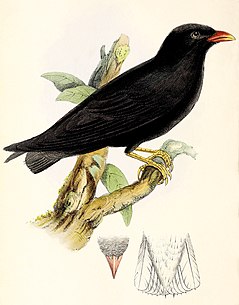
The African river martin is a passerine bird, one of two members of the river martin subfamily of the swallow family, Hirundinidae. When discovered, it was not initially recognised as a swallow, and its structural differences from most of its relatives, including its stout bill and robust legs and feet, have led to its current placement in a separate subfamily shared only with the Asian white-eyed river martin. The African river martin is a large swallow, mainly black with a blue-green gloss to the head and a greener tint to the back and wings. The under-wings are brownish, the underparts are purple-black, and the flight feathers are black. This martin has red eyes, a broad orange-red bill and a black, square tail. Young birds are similar in appearance to the adults, but have browner plumage. This species has a variety of unmusical calls, and displays both in flight and on the ground, although the purpose of the terrestrial display is unknown.
The white-eyed river martin is a passerine bird, one of only two members of the river martin subfamily of the swallows. Since it has significant differences from its closest relative, the African river martin, it is sometimes placed in its own genus, Eurochelidon. First found in 1968, it is known only from a single wintering site in Thailand, and may be extinct, since it has not been seen since 1980 despite targeted surveys in Thailand and neighbouring Cambodia. It may possibly still breed in China or Southeast Asia, but a Chinese painting initially thought to depict this species was later reassessed as showing pratincoles.
The tree swallow is a migratory bird of the family Hirundinidae. Found in the Americas, the tree swallow was first described in 1807 by French ornithologist Louis Vieillot as Hirundo bicolor. It has since been moved to its current genus, Tachycineta, where its phylogenetic placement is in debate. The tree swallow has glossy blue-green upperparts, with the exception of the blackish wings and tail, and white underparts. The bill is black, the eyes are dark brown, and the legs and feet are pale brown. The female is generally duller than the male, and the first-year female has mostly brown upperparts, with some blue feathers. Juveniles have brown upperparts, and a grey-brown-washed breast. The tree swallow breeds in the US and Canada. It winters along southern US coasts south, along the Gulf Coast, to Panama and the northwestern coast of South America, and in the West Indies.
Previous page: Sibley-Monroe checklist 14
Next page: Sibley-Monroe checklist 16
Index of pages: 1, 2, 3, 4, 5, 6, 7, 8, 9, 10, 11, 12, 13, 14, 15, 16, 17, 18