Sibley-Monroe checklist 18

Last updated

The Sibley-Monroe checklist was a landmark document in the study of birds. It drew on extensive DNA-DNA hybridisation studies to reassess the relationships between modern birds.

The Sibley-Monroe checklist was a study of birds conducted by Charles Sibley and Burt Monroe. It drew on extensive DNA-DNA hybridisation studies to reassess the relationships between modern birds.

Bird Warm-blooded, egg-laying vertebrates with wings, feathers and beaks

Birds, also known as Aves, are a group of endothermic vertebrates, characterised by feathers, toothless beaked jaws, the laying of hard-shelled eggs, a high metabolic rate, a four-chambered heart, and a strong yet lightweight skeleton. Birds live worldwide and range in size from the 5 cm (2 in) bee hummingbird to the 2.75 m (9 ft) ostrich. They rank as the world's most numerically-successful class of tetrapods, with approximately ten thousand living species, more than half of these being passerines, sometimes known as perching birds. Birds have wings which are more or less developed depending on the species; the only known groups without wings are the extinct moa and elephant birds. Wings, which evolved from forelimbs, gave birds the ability to fly, although further evolution has led to the loss of flight in flightless birds, including ratites, penguins, and diverse endemic island species of birds. The digestive and respiratory systems of birds are also uniquely adapted for flight. Some bird species of aquatic environments, particularly seabirds and some waterbirds, have further evolved for swimming.
Passeriformes (continued)

Fringillidae

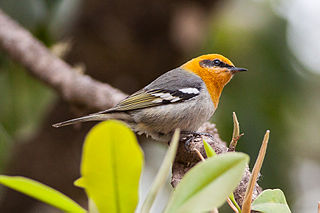
Olive warbler species of bird

The olive warbler is a small passerine bird. It is the only member of the genus Peucedramus and the family Peucedramidae.

Common chaffinch species of small passerine bird

The common chaffinch, usually known simply as the chaffinch, is a common and widespread small passerine bird in the finch family. The male is brightly coloured with a blue-grey cap and rust-red underparts. The female is much duller in colouring, but both sexes have two contrasting white wing bars and white sides to the tail. The male bird has a strong voice and sings from exposed perches to attract a mate.

Brambling species of bird

The brambling is a small passerine bird in the finch family Fringillidae. It has also been called the cock o' the north and the mountain finch. It is widespread and migratory, often seen in very large flocks.

Previous page: Sibley-Monroe checklist 17

Index of pages: 1, 2, 3, 4, 5, 6, 7, 8, 9, 10, 11, 12, 13, 14, 15, 16, 17, 18

The Sibley-Monroe checklist was a landmark document in the study of birds. It drew on extensive DNA-DNA hybridisation studies to reassess the relationships between modern birds.

The Sibley-Monroe checklist was a landmark document in the study of birds. It drew on extensive DNA-DNA hybridisation studies to reassess the relationships between modern birds.

The Sibley-Monroe checklist was a landmark document in the study of birds. It drew on extensive DNA-DNA hybridisation studies to reassess the relationships between modern birds.

Related Research Articles

Finch family of birds

The true finches are small to medium-sized passerine birds in the family Fringillidae. Finches have stout conical bills adapted for eating seeds and often have colourful plumage. They occupy a great range of habitats where they are usually resident and do not migrate. They have a worldwide distribution except for Australia and the polar regions. The family includes species known as siskins, canaries, redpolls, serins, grosbeaks and euphonias.

Tanager family of birds

The tanagers comprise the bird family Thraupidae, in the order Passeriformes. The family has an American distribution. The Thraupidae are the second-largest family of birds and represent about 4% of all avian species and 12% of the Neotropical birds.

The seedeaters are a form taxon of seed-eating passerine birds with a distinctively conical bill.