Sibley-Monroe checklist 8

Last updated

The Sibley-Monroe checklist was a landmark document in the study of birds. It drew on extensive DNA-DNA hybridisation studies to reassess the relationships between modern birds.

Bird Warm-blooded, egg-laying vertebrates with wings, feathers and beaks

Birds, also known as Aves or avian dinosaurs, are a group of endothermic vertebrates, characterised by feathers, toothless beaked jaws, the laying of hard-shelled eggs, a high metabolic rate, a four-chambered heart, and a strong yet lightweight skeleton. Birds live worldwide and range in size from the 5 cm (2 in) bee hummingbird to the 2.75 m (9 ft) ostrich. They rank as the world's most numerically-successful class of tetrapods, with approximately ten thousand living species, more than half of these being passerines, sometimes known as perching birds. Birds have wings which are more or less developed depending on the species; the only known groups without wings are the extinct moa and elephant birds. Wings, which evolved from forelimbs, gave birds the ability to fly, although further evolution has led to the loss of flight in flightless birds, including ratites, penguins, and diverse endemic island species of birds. The digestive and respiratory systems of birds are also uniquely adapted for flight. Some bird species of aquatic environments, particularly seabirds and some waterbirds, have further evolved for swimming.

Contents

Ciconiiformes (continued)

Chionididae

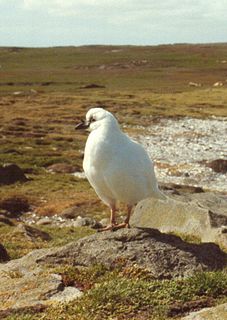
Snowy sheathbill species of bird

The snowy sheathbill, also known as the greater sheathbill, pale-faced sheathbill, and paddy, is one of two species of sheathbill. It is usually found on the ground. It is the only land bird native to the Antarctic continent.

Black-faced sheathbill species of bird

The black-faced sheathbill, also known as the lesser sheathbill or paddy bird, is one of only two species of sheathbills, aberrant shorebirds which are terrestrial scavengers of subantarctic islands.

Pluvianellidae

Burhinidae

Senegal thick-knee species of bird

The Senegal thick-knee is a stone-curlew, a group of waders in the family Burhinidae.

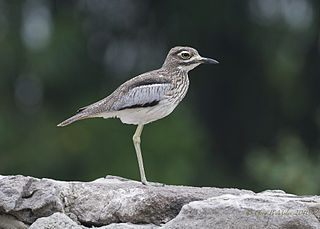
Water thick-knee species of bird

The water thick-knee, or water dikkop is a species of bird in the thick-knee family Burhinidae. The species is found across sub-Saharan Africa, usually close to water.

Spotted thick-knee species of bird

The spotted thick-knee also known as the spotted dikkop,Cape thick-knee, or Miiby bird is a wader in the family Burhinidae. It is native to tropical regions of central and southern Africa.

Charadriidae

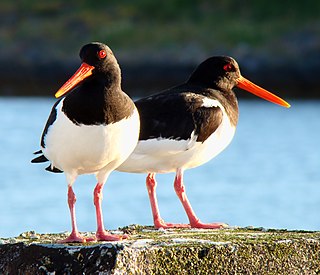
Eurasian oystercatcher species of bird

The Eurasian oystercatcher also known as the common pied oystercatcher, or palaearctic oystercatcher, or just oystercatcher, is a wader in the oystercatcher bird family Haematopodidae. It is the most widespread of the oystercatchers, with three races breeding in western Europe, central Eurasia, Kamchatka, China, and the western coast of Korea. No other oystercatcher occurs within this area.

Canary Islands oystercatcher species of bird

The Canary Islands Oystercatcher, Canarian Oystercatcher, or Canarian black Oystercatcher , was a shorebird endemic to Fuerteventura, Lanzarote, and their offshore islets in the Canary Islands, Spain. It is now considered to be extinct.

African oystercatcher A large near-threatened wading species of bird redident on the shores of South Africa

The African oystercatcher or African black oystercatcher, is a large charismatic wader resident to the mainland coasts and offshore islands of southern Africa. This near-threatened oystercatcher has a population of over 6,000 adults, which breed between November and April. The scientific name moquini commemorates the French naturalist Alfred Moquin-Tandon who discovered and named this species before Bonaparte.

Glareolidae

Egyptian plover species of bird

The Egyptian plover, also known as the crocodile bird, is a wader, the only member of the genus Pluvianus. Formerly placed in the pratincole and courser family, Glareolidae, it is now regarded as the sole member of its own monotypic family Pluvianidae.

Double-banded courser species of bird

The double-banded courser, also known as the two-banded courser, is a species of bird in the Glareolidae family.

Bronze-winged courser species of bird

The bronze-winged courser or violet-tipped courser is a species of bird in the family Glareolidae. It is found throughout Sub-Saharan Africa.

Laridae

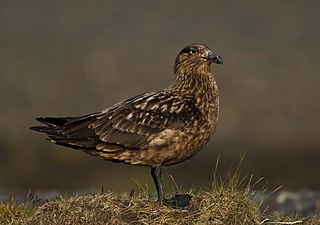
Great skua species of bird

The great skua is a large seabird in the skua family Stercorariidae. The English name and species name "skua" is believed to originate from the Faroese skúvur or skúgvur[ˈskɪkvʊər] and is the only known bird name to originate from the Faroes that has come into regular use elsewhere. In Britain, it is sometimes known by the name bonxie, a Shetland name of Norse origin. The genus name Stercorarius is Latin and means "of dung"; the food disgorged by other birds when pursued by skuas was once thought to be excrement.

Brown skua species of Antarctic and Subantarctic seabird

The brown skua, also known as the Antarctic skua, subantarctic skua, southern great skua, southern skua, or hākoakoa (Māori), is a large seabird that breeds in the subantarctic and Antarctic zones and moves further north when not breeding. Its taxonomy is highly complex and a matter of dispute, with some splitting it into two or three species: Falkland skua, Tristan skua, and subantarctic skua. To further confuse, it hybridizes with both the south polar and Chilean skuas, and the entire group has been considered to be a subspecies of the great skua, a species otherwise restricted to the Northern Hemisphere.

Chilean skua species of bird

The Chilean skua, also called the cinnamon skua, is a large predatory seabird, which breeds in Argentina and Chile, but ranges as far north as Brazil and Peru when not breeding. A relatively distinctive skua, it has a dark cap that contrasts with its cinnamon throat and lower face. Hybrids with the brown skua are known from southern Argentina.

Accipitridae

Sagittariidae

Falconidae

Previous page: Sibley-Monroe checklist 7

Next page: Sibley-Monroe checklist 9

Index of pages: 1, 2, 3, 4, 5, 6, 7, 8, 9, 10, 11, 12, 13, 14, 15, 16, 17, 18

Related Research Articles

This is a list of the fauna of Finland. Finland borders Sweden to the west, Russia to the east, and Norway to the north, while Estonia lies to its south across the Gulf of Finland, allowing an ecological mix. Finland contains many species of mammals, birds, and fish, but only a few reptiles and amphibians. This article discusses all the vertebrate animals which can be found on Finland itself, not the oceans.