Sierra Railway 3

Last updated
Sierra Railway No. 3
Sierra RR July 3 2010 042xRP - Flickr - drewj1946.jpg
Sierra Railway No. 3. hauling its first train on July 3, 2010, after its overhaul
Type and origin
Power typeSteam
Builder Rogers Locomotive and Machine Works
Serial number4493
Build dateMarch 26, 1891
Rebuild date2007–2010
Specifications
Configuration:
   Whyte 4-6-0
   UIC 2'C
Gauge 4 ft 8+12 in (1,435 mm)
Leading dia. 2 ft 2 in (0.660 m) [1]
Driver dia.4 ft 8 in (1.422 m)
Boiler pressure150 psi (1.03 MPa)
Cylinders Two, outside
Cylinder size 17 in × 24 in (432 mm × 610 mm)
Valve gear Stephenson
Valve type Piston valves
Performance figures
Tractive effort 17,470 lbf (77.7 kN) [1]
Career
OperatorsPrescott & Arizona Central Railway, Sierra Railroad
NumbersPrescott & Arizona: 3,
Sierra: 3
Official nameW.N. Kelly
Retired1932 (revenue service)
1996 (1st excursion service)
Restored1948 (1st restoration)
July 3, 2010 (2nd restoration)
Current owner Railtown 1897 State Historic Park
DispositionUndergoing FRA inspection and overhaul

Sierra Railway 3, often called the "Movie Star locomotive", is a 19th-century steam locomotive owned by the State of California and preserved at Railtown 1897 State Historic Park in Jamestown, California. Former Transportation History curator at the Smithsonian Institution William L. Withhuhn described the locomotive's historical and cultural significance:

Contents

Sierra Railway No. 3 has appeared in more motion pictures, documentaries, and television productions than any other locomotive. It is undisputedly the image of the archetypal steam locomotive that propelled the USA from the 19th century into the 20th. [2]

Built in 1891, the locomotive returned to operation in July 2010 after a fourteen-year absence from service and a three-year-long overhaul, requiring the replacement of its original boiler.

History

Sierra Railway #3 on the P&AC. Prescott and Arizona Central 3.jpg
Sierra Railway #3 on the P&AC.

No. 3 is a 4-6-0 Ten-Wheeler steam locomotive built by the Rogers Locomotive and Machine Works of Paterson, New Jersey. Construction of the locomotive was completed on March 26, 1891, and was given Rogers construction number 4493. It has 17 in × 24 in (43 cm × 61 cm) cylinders, 56-inch (140 cm) driving wheels and weighs 50 short tons (45 t) in working order. [1] It was built for the Prescott & Arizona Central Railway (P&AC) as their locomotive #3 and named W.N. Kelley after the company's treasurer.

The P&AC went bankrupt in 1893 and its chief promoter, Thomas S. Bullock, relocated much of its equipment and hardware to California, including the No. 3. He then entered into a partnership with Prince André Poniatowski and William H. Crocker, and together in 1897 they incorporated the Sierra Railway Company of California to connect Oakdale, California with the mining and timber producing regions of Tuolumne County and Calaveras County. [3]

The locomotive became Sierra No. 3 (dropping the W. N. Kelley name) and played a key role in the construction of the railroad to Jamestown, California in 1897, Sonora, California in 1899 and Tuolumne, California in 1900. It was the primary locomotive pulling freight trains on the railroad until 1906, when the Sierra Railway purchased a new Baldwin Locomotive Works 2-8-0 locomotive. It played a significant role in passenger and freight hauling operations in the Sierra foothills during the early development of Tuolumne County.

Originally built as a coal-fired locomotive, Sierra No. 3 was converted to burn oil sometime between 1900 and 1902. [1]

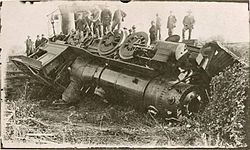
Sierra No. 3 was involved in several wrecks. In February 1898, a switch mishap killed conductor William G. Bailey. [3] In September 1899, its tender derailed while backing up on a trestle, causing it to collapse.

No. 3's 1918 derailment that destroyed the original wooden cab. Sierra Railway 3 1918 Derailment.jpg
No. 3's 1918 derailment that destroyed the original wooden cab.

The locomotive turned on its side in 1918 just above Sonora, destroying its original wooden cab, which was replaced with a new Southern Pacific steel cab in February, 1919. [3] Two years later, Sierra No. 3 made her first known Hollywood film appearance, in a silent film The Terror starring Tom Mix.

During the Great Depression, the original Sierra Railway Company of California went into bankruptcy, and was reorganized as the Sierra Railroad Company in 1937. [1] Sierra No. 3 was taken out of service in 1932, and parked on a siding in the Jamestown yard for 15 years. [2] It managed to avoid being scrapped during World War II, and again received attention from Hollywood in 1945, when David O. Selznick, the producer of Duel in the Sun being filmed on the Sierra Railroad, proposed to destroy her in a train wreck scene for the movie. The Sierra Railroad's Master Mechanic Bill Tremewan persuaded railroad management not to consider a notion so "ridiculous", and instead allowed shop crews to restore the locomotive to operation for charter and movie service. [1]

Damaged smokestack used in the locomotive explosion scene in Back to the Future Part III. Back to the Future III smokestack.jpg
Damaged smokestack used in the locomotive explosion scene in Back to the Future Part III .

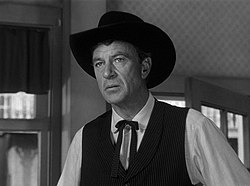
Inspection of the boiler proved it was in serviceable condition; however, the resulting work required a reduction of the Maximum Allowable Working Pressure from 160 to 150 psi (1.10 to 1.03 MPa). The rebuild was completed in 1948, and the locomotive officially returned to service heading a Pacific Coast Chapter, Railway and Locomotive Historical Society sponsored excursion train on May 30 that year. Over the next half-century, Sierra No. 3 pulled excursion trains and appeared in dozens of films, TV shows, and commercials. Among them were High Noon in 1952, for which Gary Cooper won the Academy Award for Best Actor, and Unforgiven , starring and directed by Clint Eastwood, which won the Academy Award for Best Picture for 1992.

The locomotive was often redecorated for various movie and television appearances, one of its most famous roles being the Hooterville Cannonball from the mid-1960s series Petticoat Junction . False smokestacks were also often installed to alter the appearance of the locomotive.

In 1979, Crocker and Associates announced their intention to sell the railroad to Silverfoot, Inc. based in Chicago, Illinois, but the deal did not include the historic steam era shop facilities in Jamestown. [3] The complex, including Sierra No. 3, was acquired by the State of California as a result of legislation passed in April 1981, and signed by Governor Jerry Brown. The acquisition was completed on September 15, 1982, and since then, the locomotive has been the property of the State of California. [1] In 1991, No. 3 turned 100 years old, and in May, it was moved to Sacramento to take part in "Railfair '91", an event that celebrated the tenth anniversary of the grand opening of the California State Railroad Museum. [4] [5]

In 1995, the Federal Railroad Administration issued new safety standards for steam locomotive boilers following the Gettysburg Railroad incident. In order to comply with these revised regulations, Sierra No. 3 was removed from service until a complete evaluation of the locomotive's condition could be made.

21st-century renovation

Sierra Railway No. 3's original boiler that was replaced during a rebuild, photo taken 2011 Sierra No 3 old boiler.jpg
Sierra Railway No. 3's original boiler that was replaced during a rebuild, photo taken 2011

Preliminary repairs were completed in 2000–2001 with deferred maintenance funding from the State of California. This included dismantling the locomotive. [6] The project progressed very slowly until 2007, when a major fundraising campaign began. At that time, the budget for the project was estimated at US$600,000, based on the assumption the existing boiler could be saved.

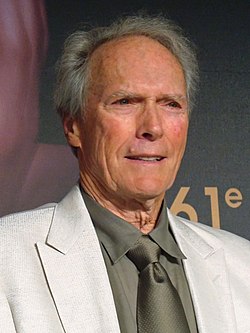
In a fundraising appeal, Clint Eastwood described Sierra No. 3 as "like a treasured old friend." [2] Eastwood had ridden the locomotive early in his career on the TV series Rawhide , and later used the locomotive in his own movie productions Pale Rider and Unforgiven . Eastwood wrote, "Sierra No. 3 resides at Railtown 1897 State Historic Park. It is housed in the original roundhouse which is still in use. Together these two assets provide a rare opportunity to experience history just as it was 109 years ago." [2] Funding for the renovation project was provided by the California Cultural and Historical Endowment, [7] the Irving J. Symons Foundation, [8] the Sonora Area Foundation, [8] the California State Parks Foundation, [9] the Teichert Foundation, DuPont and many individual donors.

The rebuild included boring out the cylinders and turning the drive wheel tires on a lathe. [10] When work on the disassembled locomotive resumed, and the boiler was inspected thoroughly by ultrasound testing, [9] it was discovered that a new boiler was necessary. Its old lap seam design made retrofitting it to modern standards too costly, [10] and the risk of the boiler losing its historical integrity was a risk Railtown staff decided not to take. Engineering drawings and other technical assistance needed to build a new boiler were provided by the Strasburg Rail Road in Lancaster County, Pennsylvania. [10] The old boiler was shipped to the Chelatchie Boiler Works of Camas, Washington to be used as a reference. Chelatchie fabricated a new welded boiler for the No. 3 at a cost of US$600,000. [10] Following the completion of the new boiler, both boilers were shipped to the historic Southern Pacific shops in Sacramento, California and fitted on the original frame. The locomotive was then moved via truck back to Jamestown, California for final assembly. [11]

The 1920s were selected as the restoration period for the locomotive to represent. The final cost of the restoration was US$1.6 million; the locomotive officially returned to service on July 3, 2010. [12] As of 2023, No. 3 is currently undergoing its Federal Railroad Administration (FRA) 1,472 day inspection and overhaul.

Movie appearances

Lobby card for 1920 Tom Mix movie The Terror shows Sierra No. 3 in the fourth panel. Tom Mix Terror.jpg
Lobby card for 1920 Tom Mix movie The Terror shows Sierra No. 3 in the fourth panel.
Gary Cooper, seen here in High Noon, appeared in four movies with Sierra No. 3. Gary Cooper in High Noon 1952.JPG
Gary Cooper, seen here in High Noon , appeared in four movies with Sierra No. 3.
Clint Eastwood, who appeared in two movies and a TV series with Sierra No. 3, wrote a letter supporting fundraising for the renovation of the locomotive. ClintEastwoodCannesMay08.jpg
Clint Eastwood, who appeared in two movies and a TV series with Sierra No. 3, wrote a letter supporting fundraising for the renovation of the locomotive.

Sierra No. 3 has appeared in many movies. [2] [6] [7] [8] [9] [12] [13] According to Movie Railroad Historian Larry Jensen, those which were filmed using Sierra No. 3 include the following:

TV appearances

Sierra No. 3 has also appeared in many television shows. [2] [6] [7] [8] [9] [12] [13] According to Railtown 1897, these include the following:

See also

Related Research Articles

<i>Bound for Glory</i> (1976 film) 1976 American film

Bound for Glory is a 1976 American biographical film directed by Hal Ashby and loosely adapted by Robert Getchell from Woody Guthrie's 1943 partly fictionalized autobiography Bound for Glory. The film stars David Carradine as folk singer Woody Guthrie, with Ronny Cox, Melinda Dillon, Gail Strickland, John Lehne, Ji-Tu Cumbuka and Randy Quaid. Much of the film is based on Guthrie's attempt to humanize the desperate Okie Dust Bowl refugees in California during the Great Depression.

<span class="mw-page-title-main">Jamestown, California</span> Census-designated place in California, United States

Jamestown is a census-designated place (CDP) in Tuolumne County, California, United States. The population was 3,433 at the 2010 census, up from 3,017 at the 2000 census. Formerly a California Gold Rush town, Jamestown is now a California Historical Landmark. Jamestown is the home of Railtown 1897 State Historic Park and the Sierra Railway, which operates steam passenger trains.

<i>Back to the Future Part III</i> 1990 film by Robert Zemeckis

Back to the Future Part III is a 1990 American science fiction Western film and the final installment of the Back to the Future trilogy. The film was directed by Robert Zemeckis, and stars Michael J. Fox, Christopher Lloyd, Mary Steenburgen, Thomas F. Wilson, and Lea Thompson. The film continues immediately following Back to the Future Part II (1989); while stranded in 1955 during his time travel adventures, Marty McFly (Fox) discovers that his friend Dr. Emmett "Doc" Brown (Lloyd), trapped in 1885, was killed by Buford "Mad Dog" Tannen (Wilson), Biff's great-grandfather. Marty travels to 1885 to rescue Doc and return once again to 1985, but matters are complicated when Doc falls in love with Clara Clayton (Steenburgen).

<span class="mw-page-title-main">Shay locomotive</span> Geared steam locomotive

The Shay locomotive is a geared steam locomotive that originated and was primarily used in North America. The locomotives were built to the patents of Ephraim Shay, who has been credited with the popularization of the concept of a geared steam locomotive. Although the design of Ephraim Shay's early locomotives differed from later ones, there is a clear line of development that joins all Shays. Shay locomotives were especially suited to logging, mining and industrial operations and could operate successfully on steep or poor quality track.

<span class="mw-page-title-main">California State Railroad Museum</span> Railroad museum in Sacramento, California

The California State Railroad Museum is a museum in the state park system of California, United States, interpreting the role of the "iron horse" in connecting California to the rest of the nation. It is located in Old Sacramento State Historic Park at 111 I Street, Sacramento.

<span class="mw-page-title-main">Tennessee Valley Railroad Museum</span> Railroad museum in Chattanooga, Tennessee

The Tennessee Valley Railroad Museum is a railroad museum and heritage railroad in Chattanooga, Tennessee.

The Hooterville Cannonball is a fictional railroad train featured in Petticoat Junction, an American situation comedy that originally aired on CBS from 1963 to 1970. The train was considered an "important character" by the show's producers, and producer Paul Henning hired railroad historian Gerald M. Best to make sure that the locomotive sounds used on the show were authentic to a train of the same type and age.

Kansas Pacific is a 1953 American Cinecolor Western film released by Allied Artists Pictures and directed by Ray Nazarro. It stars Sterling Hayden and Eve Miller. While the film was released in 1953, the title screen clearly states "Copyright MCMLII" (1952). The film offers a fictionalized account of the struggle to build the Kansas Pacific Railway in the early 1860s just prior to the American Civil War. In the film the building of the railroad in Kansas is opposed by sympathizers of the South before it forms the Confederacy.

<span class="mw-page-title-main">Roaring Camp & Big Trees Narrow Gauge Railroad</span>

The Roaring Camp & Big Trees Narrow Gauge Railroad is a 3 ft narrow-gauge tourist railroad in California that starts from the Roaring Camp depot in Felton, California and runs up steep grades through redwood forests to the top of nearby Bear Mountain, a distance of 3.25 miles.

Railtown 1897 State Historic Park, and its operating entity, the Sierra Railway, is known as "The Movie Railroad." Both entities are a heritage railway and are a unit of the California State Park System. Railtown 1897 is located in Jamestown, California. The entire park preserves the historic core of the original Sierra Railway of California. The railway's Jamestown locomotive and rolling stock maintenance facilities are remarkably intact and continue to function much as they have for over 100 years. The maintenance facilities are listed on the National Register of Historic Places as the Sierra Railway Shops Historic District.

<span class="mw-page-title-main">Sierra Railroad</span> Freight transportation company in Northern California

The Sierra Railroad Corporation is a privately owned common carrier. Its Sierra Northern Railway freight division handles all freight operations for all branches owned by the Sierra Railroad. The company's Mendocino Railway group operates the diesel- and steam-powered Sacramento RiverTrain (Woodland-Sacramento) and the Skunk Train. The company's Sierra Energy division is for energy projects.

<span class="mw-page-title-main">Yosemite Mountain Sugar Pine Railroad</span> Historic narrow gauge railroad

The Yosemite Mountain Sugar Pine Railroad (YMSPRR) is a historic 3 ft narrow gauge railroad with two operating steam train locomotives located near Fish Camp, California, in the Sierra National Forest near the southern entrance to Yosemite National Park. Rudy Stauffer organized the YMSPRR in 1961, utilizing historic railroad track, rolling stock and locomotives to construct a tourist line along the historic route of the Madera Sugar Pine Lumber Company.

<span class="mw-page-title-main">Oil burner (engine)</span> Steam engine that uses oil as fuel

An oil burner engine is a steam engine that uses oil as its fuel. The term is usually applied to a locomotive or ship engine that burns oil to heat water, to produce the steam which drives the pistons, or turbines, from which the power is derived.

<i>The Shadow Riders</i> (film) 1982 TV film

The Shadow Riders is a 1982 American Western television film directed by Andrew V. McLaglen and starring Tom Selleck, Sam Elliott, Dominique Dunne, and Katharine Ross. Based on the 1982 novel of the same name by Louis L'Amour, the film is about two brothers who meet up after fighting on opposite sides of the Civil War and return home only to find their siblings kidnapped by ruthless raiders. Together they set out on an adventure to rescue their family. The film reunites actors Selleck, Elliot, and Jeff Osterhage, who also starred in the 1979 film The Sacketts. The Shadow Riders first aired in the United States on Tuesday, September 28, 1982.

<span class="mw-page-title-main">Sierra Railway 28</span> Preserved American 2-8-0 locomotive

Sierra Railway 28 is a 2-8-0 steam locomotive owned and operated by the Sierra Railway in California.

<i>The Terror</i> (1920 film) 1920 film

The Terror is a 1920 American silent Western film starring Tom Mix, Francelia Billington, and Lester Cuneo. The film was produced by William Fox and directed and written by Jacques Jaccard, and was based on a story written by Mix.

<span class="mw-page-title-main">Southern Pacific 1744</span> Preserved SP M-6 class 2-6-0 locomotive

Southern Pacific No. 1744 is a preserved American class "M-6" 2-6-0 "Mogul" type steam locomotive built by the Baldwin Locomotive Works for the Southern Pacific Railroad in November 1901. Originally equipped with Vauclain compound cylinders, it was rebuilt with conventional cylinders in 1912. It operated for many years out of Oakland, California on the Southern Pacific's Western Division and in California's Central Valley where the locomotive and its classmates were fondly called “Valley Mallets” by their crews. The locomotive was made famous in later years by pulling some of the last steam excursions on the SP alongside other steam locomotives, including 4-8-4 4460. In 1959, No. 1744 was donated to the Sons of Utah Pioneers in Corinne, Utah where it remained on static display, until 1980. That year, it was restored by New London Railroad and Village Incorporated to operate on the Heber Valley Railroad in Heber City for the rest of the decade. In 1989, it was sold to Tarantula Corporation for a rebuild that never came to fruition, and it spent another decade in storage in Fort Worth, Texas. In 1999, it was sold again the Rio Grande Pacific Corporation, and it was restored to operate in New Orleans, Louisiana until 2001. It was eventually sold once again to Iowa Pacific Holdings for use on the Rio Grande Scenic Railroad between Alamosa and La Veta, Colorado. However, its fourth return to service only lasted less than a year, as firebox repairs needed to be done for the locomotive. The boiler was sent to several out of state facilities for repairs, until the Rio Grande Scenic ceased operations. In March 2020, the Pacific Locomotive Association purchased No. 1744 with the hopes of bringing it back to service on the Niles Canyon Railway in Sunol, California.

References

  1. 1 2 3 4 5 6 7 Wyatt, Kyle (July 23, 2009). "Detailed History of the Sierra #3". Railtown 1897 State Historic Park . Retrieved June 7, 2011.
  2. 1 2 3 4 5 6 "Sierra Railway No. 3 "The Movie Star Locomotive" Background Information". Railtown 1897 State Historic Park. Archived from the original on October 23, 2016. Retrieved July 20, 2018.
  3. 1 2 3 4 Wyatt, Kyle (February 27, 1991). "A History of Sierra Railway 4-6-0 No. 3" (Microsoft Word document). Railtown 1897 State Historic Park . Retrieved June 8, 2011.[ permanent dead link ]
  4. "Trains, August 1991". Trains. Retrieved 2023-03-05.
  5. "Trains, December 1991". Trains. Retrieved 2023-03-05.
  6. 1 2 3 Reid, Dixie (January 25, 2007). "Train needs makeover before next Hollywood close-up". Scripps News . Archived from the original on March 10, 2012. Retrieved June 5, 2011.
  7. 1 2 3 "California Cultural and Historic Endowment supports famous Sierra Train restoration". CSL Connection. California State Library. 2004. Archived from the original on March 22, 2012. Retrieved June 6, 2011.
  8. 1 2 3 4 "Chamber Supports Efforts to Restore Sierra Engine No. 3". The Union Democrat . Sonora, California. December 26, 2006. Retrieved June 5, 2011.
  9. 1 2 3 4 Ashe, Suzanne (December 11, 2006). "Locomotive fund drive on fast track". The Union Democrat . Sonora, California. Retrieved June 5, 2011.
  10. 1 2 3 4 "Restore Sierra No. 3, the "Movie Star" Steam Locomotive". California State Railroad Museum. 2009. Archived from the original on April 14, 2013. Retrieved June 7, 2011.
  11. Hecteman, Kevin W. (2010). Sacramento's Southern Pacific Shops. Arcadia Publishing. pp. 122–124. ISBN   978-0-7385-8052-4.
  12. 1 2 3 Holland, John (June 19, 2010). "Back Tracks: Historic steam engine to run again in Jamestown". Modesto Bee . Modesto, California. Archived from the original on March 20, 2012. Retrieved June 5, 2011.
  13. 1 2 "Movies". Sierra DinnerTrain. 2014-11-08. Archived from the original on 2014-11-08. Retrieved 2022-11-16.
  14. Robertson, Donald B. (1998). Encyclopedia of Western Railroad History. Vol. 4, California. Caldwell, Idaho: Caxton Printers. p. 107. ISBN   978-0-87004-385-7. OCLC   1052707014 via Central Pacific Railroad Photographic History Museum.

Further reading