| Trams or waggons for transporting coal | |
| Overview | |
|---|---|
| Locale | Irvine and Dreghorn, North Ayrshire |
| Dates of operation | 1836 (circa)–1878 |
| Successor | Abandoned |
| Technical | |
| Track gauge | 4 ft 8+1⁄2 in (1,435 mm) |
| Length | 2.25 miles (3.62 km) |
The Towerlands Tram Road was a 19th-century mineral railway or 'Bogey line' that transported coal, running from the old Towerlands Colliery and associated coal pits [1] near Bourtreehill to Irvine in one direction and to Dreghorn in the other direction. Both towns are located in North Ayrshire, Scotland. [2] [3]
The term 'Tram Road' is indicated on OS maps, [2] [4] and the course of the line mainly follows a route defined by the roads that existed at the time [5] [6] from the Towerlands or Tourlands coal pits and the later colliery in two directions, [7] one separate branch line running to Dreghorn railway station where exchange sidings existed for transport further afield via the standard gauge Glasgow and South Western Railway's Dalry to Kilmarnock line and the other branch running to the outskirts of Irvine at Townhead, the tram road ending just short of Springfield House on Mill Road, once called Slate Mill Road. [8]
The Great Reform Act Plans and Reports map of 1832 does not show the tram road [9] that first appears in the 1856 OS maps. [10] The Towerlands Colliery at Dreghorn had closed by 1878, and the OS map of 1890 only names and indicates the route of the tram road without marking the colliery or the tram road tracks. [4] Later OS maps mark the old colliery 'offices' as Towerlands Cottage. [10]
In keeping with other such tram roads the line was probably worked by gravity, manually and by horses. [11] The use of horses is also indicated by the horse trough next to the line near Fencedyke. [7] The use of steam locomotives is not consistent with the tram road's infrastructure as indicated on the OS maps, with right angle bends, gaps at road junctions, etc., [7] although the short section of line to Dreghorn was different in this respect, and a locomotive-style run-round loop is suggestive of some form of steam engine being in use here. [1]
A 'tram' in historical terms was a low box-shaped four-wheeled cart or barrow used in coal mines, [12] often without a flange on its wheels that were either wood with metal tyres or made from metal. A 'tram road' was a roadway built to permit the passage of trams or waggons and consists of parallel tracks made of metal plates or rails, carved stone blocks or wooden rails, often with metal traction surface strips attached. [13] Tramroads often run on roads that are also used by cars, pedestrians, etc.
One branch of the Towerlands Tram Road appears to have been relatively cheaply constructed to supply coal to the population of Irvine and to the Town Mill using horse drawn waggons or trams that used dedicated sections of tram road along the edge of the existing road in places, with a few diversions through fields where necessary. The horse-drawn waggons may have been able to continue and complete their journey into Irvine by road, and as noted a weighing machine was present at Townhead near the toll. [8]
The Dreghorn branch is not shown as being physically joined to the Irvine branch. The presence of a run-round loop and a siding at Towerlands Colliery may be suggestive of the use of a steam locomotive, which would require a heavier gauge of track. This section of the line was built for the export of coal via the exchange sidings located at Dreghorn railway station as shown on the 1856 OS map.
The surfacing of the early 19th century roads outside of the town that were not surfaced with cobblestones would not have been sufficient to resist the wear and tear from a regular movement of heavy coal waggons, which may explain why the tram road was built and why it stopped close to the cobbled streets of Irvine town centre.
It is not known what sort of sleepers were used; however, stone blocks were favoured on horse-worked lines, as they did not interfere with the centre of the track as do wooden sleepers that run right across the centre of the trackbed. [14]
The Ordnance Survey maps show that weighing machines existed at both the colliery [7] and at the Townhead turnpike in Irvine. [8]
The tram road gauge is not known, but the OS map depiction suggests that standard gauge of 4 ft 8.5 in. was in use on the Dreghorn section at least, as the Towerlands Colliery tram road ran on to standard gauge railway exchange sidings at Dreghorn railway station. [1]
The route was not entirely fenced, such as at the 'on road' section running past Bourtreehill down to the Irvine municipal boundary where the fencing started and then continued down to the terminus near Springfield House. [10]
The tram road is reminiscent of transport systems such as the Cambridgeshire Guided Busway where dedicated busways have gaps for roads to cross and also sections of normal road that may lead on to other sections of guided busway. The Towerlands tram road had several places where short 'gaps' existed which presumably had no rails or plates, a gap at a 'T' junction, and near Irvine the route even crossed from one side of the road to the other without any physical connection of the 'permanent way'. If the coal was transported in waggons or trams with no flanges, then such gaps would not be a real problem, just an inconvenience.
The tram road was divided into a section that ran from the Towerlands Colliery to the outskirts of Irvine and a short separate section that ran from sidings and a turn-round loop at the colliery to sidings at Dreghorn Station, running past the old Broomlands miners rows along the Station Brae Road without any 'breaks', suggesting that it was more of a standard railway than the tram road that ran to Irvine. The line joined the sidings at a right angle, indicating that a small turntable was used. [1]
The route towards Irvine ran through fields with two right-angle turns [7] until it reached the road near Towerlands House, where it ran along the side of the road with a gap or 'break' opposite the lane that divided Towerlands estate from the old Bourtreehill estate and further along a break at the 'T' junction near Fencedyke on the road that leads to Irvine via Mill Lane. [7] After the 'T' junction at Fencedyke, the tram road is shown to 'break' and cross to the other side of Mill Road at the municipal boundary. [15] In 1836 the Irvine Town Council had installed a steam engine at the Town Mill [16] and coal may have been delivered here. [15] The tram road stopped just short of the old toll at Irvine's Townhead near the site of Springfield House. [8]
Nothing survives of the colliery, associated spoil heaps and old offices. A housing estate now occupies the site. The tram road's route survives in part, and the sections running into Irvine and Dreghorn are occupied by the Broomlands Busway that joins Mill Road.
In 1862, 25-year-old Alexander Crawford from Towerlands Colliery won the first prize in Glasgow School of Mines And The Society of Arts' Examinations in mining and metallurgy for the Society of Arts' prizes and certificates. Prior to a six-month period of study he was maintaining his wife and family by hewing coals. His only previous period of formal education was twelve months at a village school. [17]
The tram road had a lot in common with the Craigie Waggonway that carried coal from the Craigie Pits to Ayr between 1855 and 1865.
Dreghorn is a village in North Ayrshire, Scotland, 3.5 kilometres (2.2 mi) to the east of Irvine town centre, on the old main road from Irvine to Kilmarnock. It is sited on a ridge between two rivers. As archaeological excavations near the village centre have found a significant neolithic settlement provisionally dated to around 3500BC, as well as medieval structures, scholars have suggested that Dreghorn could be Britain's oldest continuously inhabited village. Both Irvine and Dreghorn have grown in size and they are now separated by the Annick Valley Park, which incorporates a footpath and National Cycle Route 73 on the route of the disused Irvine to Busby railway line. It had an estimated population of 3,540 in 2016.
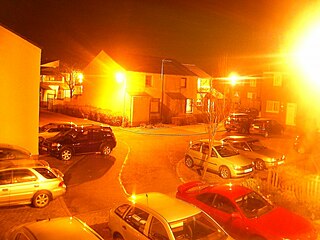
Bourtreehill is a large housing estate built by the Irvine Development Corporation (IDC) in the late 1970s which forms part of the Irvine New Town in North Ayrshire, Scotland. The estate has two main parts, known as Bourtreehill North and Bourtreehill South. Along its southern border runs the Broomlands estate. The Bourtreehill South area has suffered from anti-social behaviour. However, with more frequent police and Community Warden Patrols, this has gone down, though the area still suffers from the lack of employment opportunities in North Ayrshire.
Broomlands is district of Irvine in North Ayrshire, Scotland. Situated on a series of bends in the River Annick, Broomlands and its original features are now almost lost within the south-Bourtreehill and Broomlands housing scheme.
Lambroughton is a village in the old Barony of Kilmaurs, Scotland. This is a rural area famous for its milk and cheese production and the Ayrshire or Dunlop breed of cattle.
Cunninghamhead is a hamlet in North Ayrshire, Scotland. It was the centre of the lands of Cunninghamhead, Perceton and Annick Lodge in Cunninghame. This mainly rural area is noted for its milk and cheese production and the Ayrshire, Cunninghame or Dunlop breed of cattle.
Cunninghamhead railway station (NS369414) was a railway station serving Cunninghamhead Estate, the village of Crossroads, North Ayrshire and the town of Stewarton, East Ayrshire, Scotland. The station was originally part of the Glasgow, Paisley, Kilmarnock and Ayr Railway.
Dreghorn railway station was a railway station serving the village of Dreghorn, North Ayrshire, Scotland. The station was originally part of the Glasgow, Paisley, Kilmarnock and Ayr Railway. The line forms part of National Cycle Route 73, and the site of the station is marked by signs at the junction with Station Brae, Dreghorn.
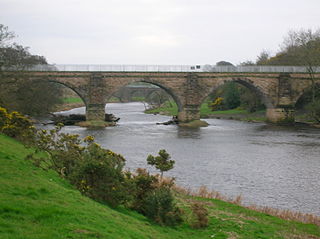
Laigh Milton Viaduct is a railway viaduct near Laigh Milton mill to the west of Gatehead in East Ayrshire, Scotland, about 5 miles (8 km) west of Kilmarnock. It is probably the world's earliest surviving railway viaduct on a public railway, and the earliest known survivor of a type of multi-span railway structure subsequently adopted universally.
The village or hamlet of Gatehead is located in East Ayrshire, Parish of Kilmaurs, Scotland. It is one and a quarter miles from Crosshouse and one and a half miles from Kilmarnock. In the 18th and 19th centuries the locality was a busy coal mining district. The settlement runs down to the River Irvine where a ford and later a bridge was located.
The village of Springside is in North Ayrshire, Parish of Dreghorn, Scotland. It is three miles from Irvine, 1 1⁄2 miles (2.4 km) west of Crosshouse and four miles from Kilmarnock. In the 18th, 19th and mid-20th centuries, the locality was a highly industrialised coal mining district. The settlement is on the Garrier Burn, which forms the boundary with East Ayrshire. Springside had a population of around 1364 in 1991. The A71 now bypasses the village, 1⁄4 mile (0.40 km) to the south.
Knockentiber is a village in East Ayrshire, Parish of Kilmaurs, Scotland. Knockentiber is 2 miles (3.2 km) WNW of Kilmarnock and 1/2 mile NE of Crosshouse. Latitude:55.6193°N Longitude:4.5455°W and grid reference NS397392. The population was 359 in 1991, however the population is much higher following the construction of several housing estates (2007). In the 18th and 19th and mid 20th centuries the locality was a highly industrialised coal mining district. The settlement is on the Carmel Burn, which runs into the River Irvine, a mile or so to the south.
The Irvine New Town Trail is a recreational cycleway and footpath around Irvine, North Ayrshire, Scotland. The route is 19 kilometres (12 mi) long. The trail is used by many dog walkers and cyclists in the area.
The Eglinton Castle estate was situated at Irvine, on the outskirts of Kilwinning, North Ayrshire, Scotland in the former district of Cunninghame. Eglinton Castle, was once home to the Montgomeries, Earls of Eglinton and chiefs of the Clan Montgomery. Eglinton Country Park now occupies part of the site.
Shewalton House and estate were composed of the 'Lands of Shewalton' and the laird's dwelling, originally a tower castle and later a mansion house on the River Irvine in the Shewalton area, two miles from Irvine and west of Drybridge village, East Ayrshire, Dundonald Parish, Scotland. In 1883 the Boyle's estate of Shewalton was 2,358 acres in extent in Ayrshire and was worth at that time £2,708 a year.
Towerlands or Tourlands was a small estate of 70 to 80 acres of good quality land in the parish of Irvine and the old barony of Kilmaurs, North Ayrshire, Scotland, situated near the more extensive property of Bourtreehill, the lands of which surrounded it on three sides. The name suggests that a medieval stone or wood 'tower' structure of some sort existed, but no record of this appears to exist.
The lands of Broomlands or Broumlands formed a small country estate about a mile to the east of Irvine, North Ayrshire, Scotland situated on the east bank of the Annick Water in the Parishes of Dreghorn and Irvine.
The Auchincruive Waggonway or Whitletts Waggonway was a mineral railway or 'Bogey line' that transported mainly coal, eventually running from the north side of Ayr harbour at Newton to Blackhouse, Whitletts, Dalmilling, Gibbsyard, Auchincruive Holm, Annbank and Enterkine. Apart from carrying coal to the harbour, lime kilns, quarries and a salt works were also served.
The Craigie Waggonway was a short lived mineral railway or 'Bogey line' of just over a mile in length that transported coal from five or more coal pits on the Craigie Estate to Ayr where it was either used locally or was taken to the harbour in carts for export, mainly to Ireland.
Earlston is a hamlet in Riccarton, East Ayrshire, Scotland. The habitation dates from at least the early 18th century and is near Caprington Castle and Todrigs Mill. It was for many years the site of a large sawmill and a mine pumping engine, and had sidings of the Glasgow and South-Western Railway's Fairlie Branch.
Lawthorn is a hamlet near Perceton in Strathannick, Irvine, North Ayrshire, Scotland. The settlement lies on the old Irvine to Stewarton toll road.
| Wikimedia Commons has media related to Towerlands Tram Road . |