Unified Primary

Last updated

A unified primary is a proposed electoral system system for narrowing the field of candidates for a single-winner general election, similar to a nonpartisan blanket primary, but using approval voting for the first round. [1] [2] [3] [4] [5]

Electoral system method by which voters make a choice between options

An electoral system is a set of rules that determine how elections and referendums are conducted and how their results are determined. Political electoral systems are organized by governments, while non-political elections may take place in business, non-profit organisations and informal organisations.

A general election is an election in which all or most members of a given political body are chosen. These are usually held for a nation's primary legislative body, as distinguished from by-elections and local elections.

A nonpartisan blanket primary is a primary election in which all candidates for the same elected office, regardless of respective political party, run against each other at once, instead of being segregated by political party. It is also known as a jungle primary, or qualifying primary. In most cases there are two winners who advance to the general election, which must be a normal first-past-the-post election, in this case it is called a top-two primary.

Contents

Comparison to other primary systems

In the US, most primary elections are party-specific: voters select a political party, either as part of the voter registration process or at the ballot box, and may vote only for candidates sharing that same party affiliation. These primary systems use plurality voting, where each voter may express a preference for one candidate per office. The candidate in each party receiving the most votes advances to the general election. Voters not affiliated with a major political party may or may not be able to participate in these primary elections, depending on jurisdictional rules, and candidates not affiliated with a major political party may be nominated to the general election by other processes such as minor party conventions or petition.

Plurality voting is an electoral system in which each voter is allowed to vote for only one candidate, and the candidate who polls the most among their counterparts is elected. In a system based on single-member districts, it may be called first-past-the-post (FPTP), single-choice voting, simple plurality or relative/simple majority. In a system based on multi-member districts, it may be referred to as winner-takes-all or bloc voting. The system is often used to elect members of a legislative assembly or executive officers. It is the most common form of the system, and is used in most elections in the United States, the lower house in India, most elections in the United Kingdom, and Canada.

The non-partisan blanket primary (aka "jungle primary" or top-two primary) is a single primary election in which all voters may participate, and all candidates appear on the same ballot, regardless of party affiliation or lack of party affiliation. The top two most-voted candidates (even if members of the same party) will appear in the general election. This is intended to allow non-partisan voters and candidates to participate, and to allow more moderate nominees in the general election (since voters from both sides of the spectrum can vote for them). However, the non-partisan blanket primary still only allows voters a single choice per office, and is therefore prone to the spoiler effect, [6] where candidates espousing similar ideologies split votes, helping candidates with opposing ideologies (but fewer candidates) to win.

First-past-the-post voting voting system in which voters select one candidate, and the candidate who receives more votes than any other candidate wins

A first-past-the-post electoral system is one in which voters indicate on a ballot the candidate of their choice, and the candidate who receives the most votes wins. This is sometimes described as winner takes all. First-past-the-post voting is a plurality voting method. FPTP is a common, but not universal, feature of electoral systems with single-member electoral divisions, and is practiced in close to one third of countries. Notable examples include Canada, India, the United Kingdom, and the United States, as well as most of their current or former colonies and protectorates.

The spoiler effect is the effect of vote splitting between candidates or ballot questions who often have similar ideologies. One spoiler candidate's presence in the election draws votes from a major candidate with similar politics thereby causing a strong opponent of both or several to win. The minor candidate causing this effect is referred to as a spoiler. However, short of any electoral fraud, this presents no grounds for a legal challenge.

Vote splitting is an electoral effect in which the distribution of votes among multiple similar candidates reduces the chance of winning for any of the similar candidates, and increases the chance of winning for a dissimilar candidate.

Like a blanket primary, the unified primary has only one primary election, in which all voters participate, and all candidates appear on a single ballot regardless of political party affiliation. Unlike a blanket primary, the unified primary uses Approval Voting in the first round, in which voters may express support for any number of favored candidates, which is intended to eliminate vote splitting and spoilers (since voters can support a partisan favorite and a moderate). [7] The top two most-approved candidates will appear in the general election.

A primary election is the process by which voters, either the general public or members of a political party, can indicate their preference for a candidate in an upcoming general election or by-election, thus narrowing the field of candidates.

Analysis

Proponents posit [8] that the Unified Primary system will increase voter choice by allowing all voters to participate equally in all stages of the election process, by allowing voters to express support for more than a single candidate, and by allowing all candidates to compete in a uniform election process, regardless of political party affiliation or lack of affiliation. [9] [10] [11] [12]

In contrast, FairVote, a national election reform non-profit that advocates instant-runoff voting, theorized [13] that it is likely that general election races would have two finalists from the same major party in districts where a majority of voters affiliate with that party, and thereby reduce voter choice in the election that has statistically higher turnout than current primary elections.

FairVote is a 501(c)(3) organization that advocates electoral reform in the United States.

Instant-runoff voting (IRV) is a type of ranked preferential voting method used in single-seat elections with more than two candidates. Instead of indicating support for only one candidate, voters in IRV elections can rank the candidates in order of preference. Ballots are initially counted for each voter's top choice. If a candidate has more than half of the vote based on first-choices, that candidate wins. If not, then the candidate with the fewest votes is eliminated. The voters who selected the defeated candidate as a first choice then have their votes added to the totals of their next choice. This process continues until a candidate has more than half of the votes. When the field is reduced to two, it has become an "instant runoff" that allows a comparison of the top two candidates head-to-head.

Election method simulation [14] of various voting systems indicate that an election system comprising approval voting in the first stage and a vote between the top two approved in the second stage is the highest-performing simple (unranked, unit weighted) two-stage voting system on the criteria of Bayesian regret and propensity to elect the Condorcet winner. These simulations confirmed early election science research [15] that found that the most efficient simple two-stage voting system allows two or more votes in the first stage and a single vote between two candidates in the second stage.

Reform campaigns

The use of approval voting on an open field of all candidates for partisan office as a replacement for current party-nominated primary systems was first publicly proposed in November 2011 [16] by brothers Mark and Jon Frohnmayer in the form of a draft ballot initiative. The text of the failed Oregon Ballot Measure 65 (2008), which would have instituted a top-two primary system, served as the foundation for the draft, which was then modified to allow voters to select as many candidates as favored for each office. [17]

The Frohnmayer brothers are sons of former Oregon public official Dave Frohnmayer, whose plurality loss to Governor Barbara Roberts in Oregon's 1990 gubernatorial election was blamed in part on an independent candidate in the race who siphoned off conservative votes. [18]

A formal petition drive to institute the Unified Primary system in Oregon began in October 2013. [19] Petitioners completed the sponsorship phase of the initiative process by collecting more than 1,000 verified signatures from registered voters to advance the measure toward the November, 2014 ballot. [20] The term "unified primary" was adopted by petitioners for what they say is etymological accuracy [21] and to distinguish it from other primary system reform initiatives, notably open primary. [22] [23] The pairing "unified primary" was also advanced by Oregon's Attorney General in the draft ballot title for this initiative: "Changes Election Nomination Processes; Replaces Current Primary System With Unified Primary For All Candidates." [24] Several variations of this measure have been filed to date: 2014 Initiative Petitions 38 and 51. [25]

The campaign did not collect the 87,213 signatures required to get Petition 54 onto the ballot. [26] [27] (The "Open Primary" proposal that used plurality voting did collect enough signatures, but was defeated. [28] )

Frohnmayer later joined the campaign for STAR voting, an alternate voting method which would replace blanket/unified primaries with a single election that uses a score ballot and automatic runoff, [29] though still promoting the unified primary under the name "Equal Top Two". [30]

Related Research Articles

In the United States, ballot access refers to the rules and procedues regulating the conditions under which a candidate, political party, or ballot measure is entitled to appear on voters' ballots. As the nation's election process is decentralized by Article I, Section 4, of the United States Constitution, ballot access laws are established and enforced by the states. As a result, ballot access processes may vary from one state to another. State access requirements for candidates generally pertain to personal qualities of a candidate, such as: minimum age, residency, citizenship, and being a qualified voter. Additionally, many states require prospective candidates to collect a specified number of qualified voters' signatures on petitions of support and mandate the payment of filing fees before granting access; ballot measures are similarly regulated. Each state also regulates how political parties qualify for automatic ballot access, and how those minor parties that do not can. Fundamental to democracy, topics relatred to ballot access are the subject of considerable debate in the United States.

2004 California Proposition 62

Proposition 62 was a California ballot proposition on the November 2, 2004 ballot. It failed to pass with 5,119,155 (46.1%) votes in favor and 5,968,770 (53.9%) against.

Libertarian Party of Oklahoma

The Libertarian Party of Oklahoma is the branch of the Libertarian Party in Oklahoma. It has been active in state politics since the 1970s, but due to what critics characterize as Oklahoma's restrictive ballot access requirements the party has been an "official" party during only portions of the last 25 years.

California Democratic Party v. Jones, 530 U.S. 567 (2000), was a case in which the United States Supreme Court held that California's blanket primary violates a political party's First Amendment freedom of association.

The Green Party of California (GPCA) is the California affiliate of the Green Party of the United States. The party is a ballot-qualified in California, first established as such in 1991, using the petition method of gaining state recognition.

Libertarian Party of Washington

The Libertarian Party of Washington (LPWA) is the state-affiliate of the national Libertarian Party in the state of Washington, the third largest political party in the state, and the largest minor party under Washington law.

An open primary is a primary election that does not require voters to be affiliated with a political party in order to vote for partisan candidates. In a traditional open primary, voters may select one party's ballot and vote for that party's nomination. As in a closed primary, the highest voted candidate in each party then proceeds to the general election. In a nonpartisan blanket primary, all candidates appear on the same ballot and the two highest voted candidates proceed to the runoff election, regardless of party affiliation. The constitutionality of this system was affirmed by the Supreme Court of the United States in 2008, whereas a partisan blanket primary was previously ruled to be unconstitutional in 2000. The arguments for open primaries are that voters can make independent choices, building consensus that the electoral process is not splintered or undermined by the presence of multiple political parties.

Elections in California

Elections in California are held to fill various local, state and federal seats. In California, regular elections are held every even year ; however, some seats have terms of office that are longer than two years, so not every seat is on the ballot in every election. Special elections may be held to fill vacancies at other points in time. Recall elections can also be held. Additionally, statewide initiatives, legislative referrals and referenda may be on the ballot.

The Independent Party of Oregon (IPO) is a political party in the U.S. state of Oregon. With more than 125,000 registrants since its inception in January 2007. IPO is Oregon's third-largest political party, and the first political party other than the Democrats or Republicans, to be recognized by the state of Oregon as a major political party in this state.

Elections in Oregon

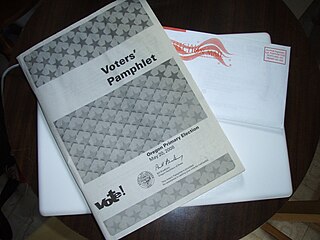
Elections in Oregon are all held using a Vote by Mail (VBM) system. This means that all registered voters receive their ballots via postal delivery and can vote from their homes. A state Voters’ Pamphlet is mailed to every household in Oregon about three weeks before each statewide election. It includes information about each measure and candidate in the upcoming election.
2008 Oregon state elections

On November 4, 2008, the U.S. state of Oregon held statewide general elections for three statewide offices, both houses of the Oregon Legislative Assembly, and twelve state ballot measures. The primary elections were held on May 20, 2008. Both elections also included national races for President of the US, US Senator, and US House Representatives. Numerous local jurisdictions — cities, counties, and regional government entities — held elections for various local offices and ballot measures on these days as well.
2008 Oregon Ballot Measure 65

Ballot Measure 65 was an initiated state statute ballot measure for the November 4, 2008 general election ballot in the state of Oregon. If it had passed, it would have replaced the current closed primary election system for partisan offices, in which each political party nominates its own candidate for the general election. The system proposed by Measure 65 bore similarities to a blanket primary and nonpartisan blanket primary.

Washington Initiative 872

Initiative 872 was an Initiative to the People in 2004 that replaced the "Montana Primary" being used in Washington State with a top-two nonpartisan blanket primary. It was challenged in court up to the US Supreme Court, which upheld the top-two primary in Washington State Grange v. Washington State Republican Party.

June 2010 California elections

The California state elections, June 2010 were held on June 8, 2010 and included five propositions and two special elections, one for a State Senate seat and the other for a State Assembly seat. Primary elections for all statewide offices, a seat to the United States Senate, all Californian seats to the House of Representatives, all of the seats of the State Assembly, and all even-numbered seats of the State Senate, along with the first round election for the nonpartisan Superintendent of Public Instruction were also held.

Christina Tobin American political activist

Christina Tobin is an American activist and leader in the election reform and voters’ rights movements. She is the founder and chair of The Free & Equal Elections Foundation, and president and chief executive officer of Free and Equal, Inc. Tobin also serves on the board of the Coalition for Free and Open Elections. Under Tobin's leadership, The Free and Equal Elections Foundation has had their independent candidate debates broadcast on CSPAN, RT, and Al Jazeera.

2010 California Proposition 14

Proposition 14 is a California ballot proposition that appeared on the ballot during the June 2010 state elections. It was a constitutional amendment that effectively transformed California's non-Presidential elections from first-past-the-post to a nonpartisan blanket primary. The proposition was legislatively referred to voters by the State Legislature and approved by 54% of the voters.

Primary elections in the United States are elections in which the candidates for a particular office at federal, state or local level are chosen by registered voters in a particular jurisdiction. This includes the presidential primary, which nominates candidates for the presidential election. After the preliminary primary election, a general election is held to fill the office with one of the candidates chosen in the primary election. The United States is one of few countries to select candidates through popular vote in a primary election system; most countries rely on party leaders to vet candidates, as was previously the case in the U.S. State law, not federal, regulates most aspects of primary elections, and local election officials are predominantly responsible for administering them.

STAR voting

STAR voting is an electoral system for single-seat elections. The name stands for "Score then Automatic Runoff", referring to the fact that this system is a combination of score voting, to pick two frontrunners with the highest total scores, followed by a "virtual runoff" in which the frontrunner who is preferred on more ballots wins. It is a type of cardinal voting electoral system.

References

  1. Griffiths, Shawn M. (2014-01-03). "The Unified Primary: A New Way to Conduct Nonpartisan Elections". Independent Voter Network. Retrieved 2018-06-23.
  2. Sharnak, Debbie. "Different Types of Primary Elections". Independent Voter Project. Retrieved 2018-06-23.
  3. Hamlin, Aaron (2014-08-21). "The Primary: What Is It Good For?". The Center for Election Science. A Primary If You Insist. Retrieved 2018-06-23.
  4. Frohnmayer, Mark. "Unified Primary Initiative Frequently Asked Questions (FAQ)".
  5. "Electoral System Glossary". The Center for Election Science. 2015-05-21. Retrieved 2018-07-17.
  6. Atkins, David (2014-01-05). "Calitics:: Law of unintended consequences: CA's top-two primary helps cement intra-party control". Archived from the original on 2015-03-17. Retrieved 2018-07-17.
  7. "Compare". Unified Primary. Archived from the original on 2014-06-22. Retrieved 2018-07-17.
  8. "The Equal Vote Campaign". Archived from the original on 2014-08-25. Retrieved 2018-07-17.
  9. Equal Vote Coalition (2014-06-11), Dude, where's my vote? Part 1/2 , retrieved 2018-07-17
  10. Equal Vote Coalition (2014-05-10), Help us repair democracy! , retrieved 2018-07-17
  11. Equal Vote Coalition (2014-04-18), Six kittens from Catsburg , retrieved 2018-07-17
  12. "Could approval voting make jungle primaries less objectionable?". D Gary Grady. 2016-06-03. Retrieved 2018-07-17.
  13. "Top Two (With a Twist) for Oregon?". FairVote.org. 2013-10-18. Retrieved 2018-07-17.
  14. "Range voting with mixtures of honest and strategic voters". RangeVoting.org. Retrieved 2018-07-17.
  15. Fishburn, Peter C.; Gehrlein, William V. (1976). "An analysis of simple two-stage voting systems". Behavioral Science. 21 (1): 1–12. doi:10.1002/bs.3830210102. ISSN   0005-7940.
  16. Fair and Unified Elections Initiative Page Info, Facebook [dead link]
  17. "Text of the measure". Unified Primary Elections Initiative. Archived from the original on 2014-02-19. Retrieved 2018-07-17.
  18. Duara, Nigel (2010-06-05). "Independents get their shot in Oregon's governor race". The Seattle Times. Retrieved 2018-07-17.
  19. Mapes, Jeff (2013-10-10). "Dave Frohnmayer's son proposes radical change in Oregon primary system". OregonLive.com. Retrieved 2018-07-17.
  20. Mortensen, Camilla (2013-12-12). "Effort To Change The Primary Voting System". Eugene Weekly. Retrieved 2018-07-17.
  21. "Etymology". Unified Primary Election System. Archived from the original on 2014-02-19. Retrieved 2018-07-17.
  22. Halper, Evan (2013-10-18). "For post-shutdown reform ideas, many look to California". Los Angeles Times. ISSN   0458-3035 . Retrieved 2018-07-17.
  23. Jaquiss, Nigel (2013-10-10). "Mark Frohnmayer Proposes Open Primary Initative". Willamette Week. Retrieved 2018-07-17.
  24. Oregon IP38 Draft Ballot Initiative Title, Oregon Secretary of State
  25. Oregon Secretary of State Initiative, Referendum, and Recall Petition Log Database, Oregon Secretary of State
  26. "Oregon Unified Primary Elections Initiative (2014)". Ballotpedia. Retrieved 2018-07-17.
  27. Frohnmayer, Mark (2014-07-03). "Unified Primary: The End of the Beginning". Equal Vote Coalition. Retrieved 2018-07-17.
  28. "Oregon Open Primary Initiative, Measure 90 (2014) - Ballotpedia" . Retrieved 2018-07-17.
  29. "About The Equal Vote Coalition". Equal Vote Coalition. Retrieved 2018-07-17.
  30. "Compare Top Two - Equal Vote Coalition". Equal Vote Coalition. Retrieved 2018-07-17.