Ballot Measure 65 was an initiated state statute ballot measure for the November 4, 2008 general election ballot in the state of Oregon. If it had passed, it would have replaced the current closed primary election system for partisan offices, in which each political party nominates its own candidate for the general election. The system proposed by Measure 65 bore similarities to a blanket primary and nonpartisan blanket primary.
In the politics of the United States, the process of initiatives and referendums allow citizens of many U.S. states to place new legislation on a popular ballot, or to place legislation that has recently been passed by a legislature on a ballot for a popular vote. Initiatives and referendums, along with recall elections and popular primary elections, are signature reforms of the Progressive Era; they are written into several state constitutions, particularly in the West.

Oregon is a state in the Pacific Northwest region on the West Coast of the United States. The Columbia River delineates much of Oregon's northern boundary with Washington, while the Snake River delineates much of its eastern boundary with Idaho. The parallel 42° north delineates the southern boundary with California and Nevada. Oregon is one of only three states of the contiguous United States to have a coastline on the Pacific Ocean.
A general election is an election in which all or most members of a given political body are chosen. These are usually held for a nation's primary legislative body, as distinguished from by-elections and local elections.
Under Measure 65, voters would have received the same ballot regardless of their own party registration. For each partisan position, the ballot would list all candidates, also without regard for party registration. Voters would choose one candidate, and the two candidates with the most votes would advance to the November general election. The measure would have affected chapters 188.120, 254.056 and 254.115 of the Oregon Revised Statutes, and repealed chapters 254.025 and 254.365. [2]

The Oregon Revised Statutes (ORS) is the codified body of statutory law governing the U.S. state of Oregon, as enacted by the Oregon Legislative Assembly, and occasionally by citizen initiative. The statutes are subordinate to the Oregon Constitution.
Former Oregon Secretaries of State Phil Keisling and Norma Paulus were the chief petitioners in favor of the measure. [3]

The Secretary of State of Oregon, an elected constitutional officer within the executive branch of government of the U.S. state of Oregon, is first in line of succession to the Governor. The duties of office are: auditor of public accounts, chief elections officer, and administrator of public records. Additionally, the Secretary of State serves on the Oregon State Land Board and chairs the Oregon Sustainability Board. Following every United States Census, if the Oregon Legislative Assembly cannot come to agreement over changes to legislative redistricting, the duty falls to the Secretary of State.
Phil Keisling is a politician and business executive in the U.S. state of Oregon. He served as Oregon Secretary of State from 1991 to 1999 and previously served in the Oregon House of Representatives. He is known for having championed the state's vote-by-mail system.

Norma Jean Paulus was an American lawyer and politician in the state of Oregon. A native of Nebraska, she was raised in Eastern Oregon before becoming a lawyer. A Republican, she first held political office as a representative in the Oregon House of Representatives, and then became the first woman elected to statewide public office in Oregon when she became Oregon Secretary of State in 1977. Paulus later served as Oregon Superintendent of Public Instruction for nine years. She made unsuccessful bids to become Governor of Oregon and United States Senator. Prior to her death on February 28, 2019, Paulus lived in Portland, where she was involved with several non-profit groups and sponsored a ballot measure to create open primaries in Oregon's statewide elections.
Proponents of Measure 65 argued that the closed primary unfairly excluded voters with no party affiliation, and that voters should be able to vote for any primary election candidate they wished, regardless of the party affiliation of either the voter or the candidate. [4] Opponents of the measure countered that every voter is free to register as a member of a political party to participate in the primary, and criticized the possibility that a general election race could have two candidates from the same party. [5]
A primary election is the process by which voters, either the general public or members of a political party, can indicate their preference for a candidate in an upcoming general election or by-election, thus narrowing the field of candidates.
In the United States, ballot access refers to the rules and procedues regulating the conditions under which a candidate, political party, or ballot measure is entitled to appear on voters' ballots. As the nation's election process is decentralized by Article I, Section 4, of the United States Constitution, ballot access laws are established and enforced by the states. As a result, ballot access processes may vary from one state to another. State access requirements for candidates generally pertain to personal qualities of a candidate, such as: minimum age, residency, citizenship, and being a qualified voter. Additionally, many states require prospective candidates to collect a specified number of qualified voters' signatures on petitions of support and mandate the payment of filing fees before granting access; ballot measures are similarly regulated. Each state also regulates how political parties qualify for automatic ballot access, and how those minor parties that do not can. Fundamental to democracy, topics relatred to ballot access are the subject of considerable debate in the United States.

Proposition 62 was a California ballot proposition on the November 2, 2004 ballot. It failed to pass with 5,119,155 (46.1%) votes in favor and 5,968,770 (53.9%) against.
California Democratic Party v. Jones, 530 U.S. 567 (2000), was a case in which the United States Supreme Court held that California's blanket primary violates a political party's First Amendment freedom of association.
An open primary is a primary election that does not require voters to be affiliated with a political party in order to vote for partisan candidates. In a traditional open primary, voters may select one party's ballot and vote for that party's nomination. As in a closed primary, the highest voted candidate in each party then proceeds to the general election. In a nonpartisan blanket primary, all candidates appear on the same ballot and the two highest voted candidates proceed to the runoff election, regardless of party affiliation. The constitutionality of this system was affirmed by the Supreme Court of the United States in 2008, whereas a partisan blanket primary was previously ruled to be unconstitutional in 2000.
The arguments for open primaries are that voters can make independent choices, building consensus that the electoral process is not splintered or undermined by the presence of multiple political parties.
Elections in California are held to fill various local, state and federal seats. In California, regular elections are held every even year ; however, some seats have terms of office that are longer than two years, so not every seat is on the ballot in every election. Special elections may be held to fill vacancies at other points in time. Recall elections can also be held. Additionally, statewide initiatives, legislative referrals and referenda may be on the ballot.
The Independent Party of Oregon (IPO) is a political party in the U.S. state of Oregon. With more than 125,000 registrants since its inception in January 2007. IPO is Oregon's third-largest political party, and the first political party other than the Democrats or Republicans, to be recognized by the state of Oregon as a major political party in this state.
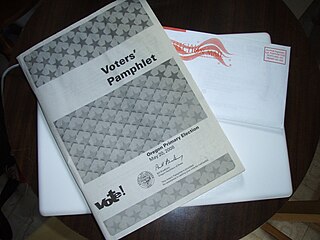
Elections in Oregon are all held using a Vote by Mail (VBM) system. This means that all registered voters receive their ballots via postal delivery and can vote from their homes. A state Voters’ Pamphlet is mailed to every household in Oregon about three weeks before each statewide election. It includes information about each measure and candidate in the upcoming election.
On November 4, 2008, the U.S. state of Oregon held statewide general elections for three statewide offices, both houses of the Oregon Legislative Assembly, and twelve state ballot measures. The primary elections were held on May 20, 2008. Both elections also included national races for President of the US, US Senator, and US House Representatives. Numerous local jurisdictions — cities, counties, and regional government entities — held elections for various local offices and ballot measures on these days as well.

Initiative 872 was an Initiative to the People in 2004 that replaced the "Montana Primary" being used in Washington State with a top-two nonpartisan blanket primary. It was challenged in court up to the US Supreme Court, which upheld the top-two primary in Washington State Grange v. Washington State Republican Party.

Proposition 14 is a California ballot proposition that appeared on the ballot during the June 2010 state elections. It was a constitutional amendment that effectively transformed California's non-Presidential elections from first-past-the-post to a nonpartisan blanket primary. The proposition was legislatively referred to voters by the State Legislature and approved by 54% of the voters.
Electoral reform in Oregon refers to efforts to change election and voting laws in the West Coast state of Oregon.
A unified primary is a proposed electoral system system for narrowing the field of candidates for a single-winner general election, similar to a nonpartisan blanket primary, but using approval voting for the first round.

The 2014 California Insurance Commissioner election was held on November 4, 2014, to elect the Insurance Commissioner of California. Incumbent Democratic Commissioner Dave Jones ran for re-election to a second term in office.

Statewide elections in North Dakota occur every two years. Most executive offices and all legislators are elected to four-year terms, with half the terms expiring on Presidential election years, and the other half of the offices expiring on mid-term election years.
Primary elections in the United States are elections in which the candidates for a particular office at federal, state or local level are chosen by registered voters in a particular jurisdiction. This includes the presidential primary, which nominates candidates for the presidential election. After the preliminary primary election, a general election is held to fill the office with one of the candidates chosen in the primary election. The United States is one of few countries to select candidates through popular vote in a primary election system; most countries rely on party leaders to vet candidates, as was previously the case in the U.S. State law, not federal, regulates most aspects of primary elections, and local election officials are predominantly responsible for administering them.
North Dakota will hold two statewide elections in 2020: a primary election on Tuesday, June 9, and a general election on Tuesday, November 3. In addition, each township will elect officers on Tuesday, March 17, and each school district will hold their elections on a date of their choosing between April 1 and June 30.