The Tennessee Valley Authority (TVA) is a federally owned corporation in the United States created by congressional charter on May 18, 1933, to provide navigation, flood control, electricity generation, fertilizer manufacturing, and economic development to the Tennessee Valley, a region particularly affected by the Great Depression. The enterprise was a result of the efforts of Senator George W. Norris of Nebraska. TVA was envisioned not only as a provider, but also as a regional economic development agency that would use federal experts and electricity to more quickly modernize the region's economy and society.

Norris Dam is a hydroelectric and flood control structure located on the Clinch River in Anderson County and Campbell County, Tennessee, United States. Its construction in the mid-1930s was the first major project for the Tennessee Valley Authority, which had been created in 1933 to bring economic development to the region and control the rampant flooding that had long plagued the Tennessee Valley. The dam was named in honor of Nebraska Senator George Norris (1861–1944), a longtime supporter of government-owned power in general, and supporter of TVA in particular. The project infrastructure was listed on the National Register of Historic Places in 2016.

The Chernobyl Nuclear Power Plant or Chernobyl Nuclear Power Station is a decommissioned nuclear power station near the city of Pripyat, Ukraine, 14.5 km (9.0 mi) northwest of the city of Chernobyl, 16 km (9.9 mi) from the Belarus–Ukraine border, and about 110 km (68 mi) north of Kiev. Reactor Number 4 was the site of the Chernobyl disaster in 1986 and the power plant is now within a large restricted area known as the Chernobyl Exclusion Zone. Both the zone and the former power plant are administered by the State Agency of Ukraine of the Exclusion Zone. All four reactors have been shut down.

The Browns Ferry Nuclear Plant is located on the Tennessee River near Decatur and Athens, Alabama, on the north side of Wheeler Lake. The nuclear power plant is named after a ferry that operated at the site until the middle of the 20th century. The site has three General Electric boiling water reactor (BWR) nuclear generating units and is owned entirely by the Tennessee Valley Authority. Browns Ferry was TVA's first nuclear power plant; its approval occurred on June 17, 1966 and construction began in September 1966. In 1974, the time of its initial operation, it was the largest nuclear plant in the world. It was the first nuclear plant in the world to generate more than 1 gigawatt of power.

The Sequoyah Nuclear Plant is a nuclear power plant located on 525 acres (212 ha) located 7 miles (11 km) east of Soddy-Daisy, Tennessee, and 20 miles (32 km) north of Chattanooga, abutting Chickamauga Lake, on the Tennessee River. The facility is owned and operated by the Tennessee Valley Authority (TVA).

The Watts Bar Nuclear Plant is a Tennessee Valley Authority (TVA) nuclear reactor pair used for electric power generation. It is located on a 1,770-acre (7.2 km²) site in Rhea County, Tennessee, near Spring City, between the cities of Chattanooga and Knoxville. Watts Bar supplies enough electricity for about 1,200,000 households in the Tennessee Valley.

The Bellefonte Nuclear Generating Station (BLN) is an unfinished nuclear power plant in Hollywood, Alabama, United States.

The Enrico Fermi Nuclear Generating Station is a nuclear power plant on the shore of Lake Erie near Monroe, in Frenchtown Charter Township, Michigan on approximately 1,000 acres. All units of the plant are operated by the DTE Energy Electric Company and owned by parent company DTE Energy. It is approximately halfway between Detroit, Michigan, and Toledo, Ohio. It is also visible from parts of Amherstburg and Colchester, Ontario as well as on the shore of Lake Erie in Ottawa County, Ohio along with Ohio Turnpike. Two units have been constructed on this site. The first unit's construction started on August 4, 1956 and reached initial criticality on August 23, 1963, and the second unit received its construction permit on September 26, 1972. It reached criticality in June 21, 1985 and was declared commercial on November 18, 1988. The plant is connected to two single-circuit 345 kV Transmission Lines and 3 120 kV lines. They are operated and maintained by ITC Transmission.
The "Nuclear Power 2010 Program" was launched in 2002 by President George W. Bush in order to restart orders for nuclear power reactors in the U.S. by providing subsidies for a handful of Generation III+ demonstration plants. The expectation was that these plants would come online by 2010, but it was not met.

Pickwick Landing Dam is a hydroelectric dam on the Tennessee River in Hardin County, in the U.S. state of Tennessee. The dam is one of nine dams on the river owned and operated by the Tennessee Valley Authority, which built the dam in the 1930s as part of a New Deal-era initiative to create a continuous navigation channel between the river's mouth and Knoxville, and bring economic development to the area. The dam impounds the 43,100-acre (17,400 ha) Pickwick Lake and its tailwaters are part of Kentucky Lake.

Kentucky Dam is a hydroelectric dam on the Tennessee River on the county line between Livingston and Marshall counties in the U.S. state of Kentucky. The dam is the lowermost of nine dams on the river owned and operated by the Tennessee Valley Authority, which built the dam in the late 1930s and early 1940s to improve navigation on the lower part of the river and reduce flooding on the lower Ohio and Mississippi rivers. It was a major project initiated during the New Deal of President Franklin D. Roosevelt's administration, to invest in infrastructure to benefit the country. The dam impounds the Kentucky Lake of 160,000 acres (65,000 ha), which is the largest of TVA's reservoirs and the largest artificial lake by area in the Eastern United States. It was listed on the National Register of Historic Places in 2017.

Douglas Dam is a hydroelectric dam on the French Broad River in Sevier County, Tennessee, in the southeastern United States. The dam is operated by the Tennessee Valley Authority (TVA), which built the dam in record time in the early 1940s to meet emergency energy demands at the height of World War II. Douglas Dam is a straight reinforced concrete gravity-type dam 1705 feet long and 202 feet high, impounding the 28,420-acre (11,500 ha) Douglas Lake. The dam was named for Douglas Bluff, a cliff overlooking the dam site prior to construction.
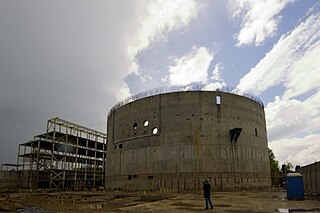
The Cherokee Nuclear Power Plant is an uncompleted energy project 10 miles (16 km) outside Gaffney, South Carolina, United States. In the early 1970s, Duke Power started construction on a three-reactor nuclear power plant at the site. However, the project stalled due to economic problems by the early 1980s, leading to the project's eventual abandonment. In 1987, the power plant was the site of an underwater film studio built by Hollywood director James Cameron, for the film The Abyss.

Marble Hill Nuclear Power Station was an unfinished nuclear power plant in Saluda Township, Jefferson County, near Hanover, Indiana, USA. In 1984, the Public Service Company of Indiana announced it was abandoning the half-finished nuclear power plant, on which $2.5 billion had already been spent.

The Hartsville Nuclear Plant is a canceled nuclear power plant project located near Hartsville, Tennessee. To be built and operated by the Tennessee Valley Authority, it was to have four General Electric boiling water reactors.

Washington Nuclear Project Nos. 1 and 4, abbreviated as WNP-1 and WNP-4 were two of the five nuclear power plants on which construction was started by the Washington Public Power Supply System (WPPSS) in order to meet projected electricity demand in the Pacific Northwest. WNP-1, WNP-2 and WNP-3 were part of the original 1968 plan, with WNP-4 and WNP-5 added in the early 1970s.
The Allens Creek Nuclear Power Plant was a proposed nuclear power plant to be located at Wallis, Texas, less than 50 miles from the western edge of Houston. The plant, consisting of two 1,150 MWe General Electric boiling water reactors, was ordered by Houston Lighting and Power Company (HL&P) in 1973, but public opposition, fueled in part by press coverage of problems at other nuclear plants around the country, led to lengthy public hearings and court action. In the meantime, construction costs escalated and the plant was officially canceled in 1982.
The Forked River Nuclear Power Plant was a proposed nuclear power plant in Lacey Township in Ocean County, New Jersey. It was proposed as a single 1,070 MW reactor in 1969 to be built by Combustion Engineering and operated by Jersey Central Power and Light. The facility would have been located on a site between JCP&L's existing Oyster Creek Nuclear Generating Station and the Garden State Parkway. Unlike the Oyster Creek Plant, the Forked River Plant would have a cooling tower to prevent the release of hot water into Oyster Creek and Barnegat Bay.
The Bailly Nuclear Power Plant was a nuclear power plant project to be located near the Indiana Dunes National Lakeshore in Porter County, Indiana, United States. The project was proposed by the Northern Indiana Public Service Company (NIPSCO) in 1967; however, it was cancelled in 1981.
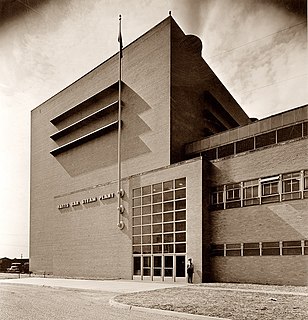
Watts Bar Steam Plant was a 267-megawatt (MW), coal power plant operated by the Tennessee Valley Authority (TVA) located in Rhea County, Tennessee near the present site of Watts Bar Nuclear Plant and Watts Bar Dam. The plant was the first coal fired power plant constructed by TVA.