
Ferry Farm is the name of the farm and home at which George Washington spent much of his childhood. The site is located in Stafford County, Virginia, along the northern bank of the Rappahannock River, across from the city of Fredericksburg. In July 2008, archaeologists announced that they had found remains of the boyhood home, which had suffered a fire during 1740, including artifacts such as pieces of a cream-colored tea set probably belonging to George's mother, Mary Ball Washington. In 2015, the George Washington Foundation began constructing a replica of Washington's boyhood home on the site of the original building. The replica house was completed in 2018 and is open to the public.

The Spencer–Peirce–Little Farm is a Colonial American farm located at 5 Little's Lane, Newbury, Massachusetts, United States, in the midst of 231 acres (93 ha) of open land bordering the Merrimack River and Plum Island Sound. The farmhouse, dating to c. 1690, was designated a National Historic Landmark in 1968 as an extremely rare 17th-century stone house in New England. It is now a nonprofit museum owned and operated by Historic New England and open to the public several days a week during the warmer months; an admission fee is charged for non Members.
Watkinson School is a private co-educational independent day school in Hartford, Connecticut, United States. Watkinson is situated on Bloomfield Avenue adjacent to the University of Hartford. It serves students from 6th through 12th grade. Watkinson also offers a postgraduate option, called The Academy at Watkinson, which allows students who have just graduated from high school to spend an additional year taking courses at Watkinson as well as the University of Hartford. Watkinson is the oldest independent school located within the city limits of Hartford.
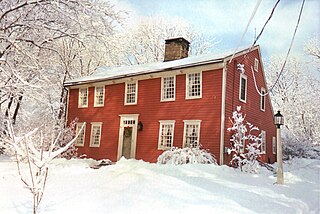
Nichols, a historic village in southeastern Trumbull in Fairfield County, Connecticut, is named after the family who maintained a large farm in its center for almost 300 years. The Nichols Farms Historic District, which encompasses part of the village, is listed on the National Register of Historic Places. Originally home to the Golden Hill Paugussett Indian Nation, the area was colonized by the English during the Great Migration of the 1630s as a part of the coastal settlement of Stratford. The construction of the Merritt Parkway through the village, and the subsequent closing of stores and factories, turned the village into a bedroom community in 1939. Aviation pioneer Igor Sikorsky lived in three separate homes in Nichols during his active years between 1928 and 1951, when he designed, built and flew fixed-wing aircraft and put the helicopter into mass production for the first time.

Nichols Farms is a historic area within the town of Trumbull, Connecticut. The Nichols Farms Historic District, which encompasses part of the area, is listed on the National Register of Historic Places.

The Farwell Barn, also known as Jacobson Barn or Jacobson's Barn, is a historic property on Horsebarn Hill Road in Storrs, Connecticut, on the campus of the University of Connecticut. The property is also the site of the archaeological remains of the Farwell House. The barn "is a 19th-century post-and-beam framed clapboarded barn that was built as part of a family farm and then in 1911 was acquired by the Connecticut Agricultural College, the institution that became the University of Connecticut at Storrs." The corresponding house was burned in 1976. The barn was listed on the National Register of Historic Places in 2001.

Town Creek Indian Mound is a prehistoric Native American archaeological site located near present-day Mount Gilead, Montgomery County, North Carolina, in the United States. The site, whose main features are a platform mound with a surrounding village and wooden defensive palisade, was built by the Pee Dee, a South Appalachian Mississippian culture people that developed in the region as early as 980 CE. They thrived in the Pee Dee River region of North and South Carolina during the Pre-Columbian era. The Town Creek site was an important ceremonial site occupied from about 1150—1400 CE. It was abandoned for unknown reasons. It is the only ceremonial mound and village center of the Pee Dee located within North Carolina.

Fort Corchaug Archeological Site is a prehistoric archaeological site in Cutchogue on eastern Long Island in New York State. It is located west of the North Fork Country Club, on the south side of Main Road. The site shows evidence of 17th century contact between Native Americans and Europeans. Fort Corchaug itself was a log fort built by Native Americans. It may have been to protect the Corchaug tribe from other Indians, built with the help of Europeans. Ralph Solecki, a prominent American archaeologist, grew up nearby and conducted several digs on site.

The Mashantucket Pequot Reservation Archeological District is a historic district in the northeast corner of the town of Ledyard, Connecticut. The district includes nearly 1,638 acres (6.63 km2) of archeologically sensitive land in the northern portion of the uplands historically called Wawarramoreke by the federally recognized Mashantucket Pequot Tribe. It is within territory documented as Pequot land in the earliest-known surviving map (1614) of the region. The district was listed on the National Register of Historic Places in 1986 and was declared a National Historic Landmark in 1993.

Harrisville Historic District is a well-preserved historic New England mill village located in the southwest part of New Hampshire. It consists of about 200 acres (0.81 km2) and about 135 structures. It was declared a National Historic Landmark in 1977.

The Locusts, also known as the Peter Eltinge House, is a 19th-century brick Federal style house built in 1826 located on Plains Road in the Town of New Paltz, New York, United States, two miles (3 km) south of the village of New Paltz. It was once the center of a large farm. The house and several outbuildings have been listed on the National Register of Historic Places as well-preserved examples of that style in Ulster County.

The former Smith Tavern is located on Bedford Road in the hamlet of Armonk, New York, United States. It is a red frame building dating to the late 18th century, one of the few left in a region that has rapidly suburbanized over the past century. The Smith family, for whom it is named, did not build it but owned it for most of the 19th century.

The Millen House is a historic residence on the campus of Indiana University in Bloomington, Indiana, United States. Built by an early farmer, it is one of Bloomington's oldest houses, and it has been named a historic landmark.

Susannah Place is a heritage-listed former grocery store and workers' cottages and now historic house museum located at 58-64 Gloucester Street in the inner city Sydney suburb of The Rocks in the City of Sydney local government area of New South Wales, Australia. It was built during 1844. It is also known as Susannah Place Museum. The property is owned by Property NSW and managed by Sydney Living Museums, agencies of the Government of New South Wales. It was added to the New South Wales State Heritage Register on 10 December 1999.

Historic Oak View, also known as the Williams-Wyatt-Poole Farm, is a 19th-century historic farmstead and national historic district located east of downtown Raleigh, North Carolina, United States. Founded as a forced-labor farm worked by black people enslaved by the land's white owners, Oak View features an early 19th-century kitchen, 1855 farmhouse, livestock barn, cotton gin barn, and tenant house dating to the early 20th century. The Farm History Center located on site provides information to visitors regarding the history of the Oak View and the general history of farming in North Carolina. Aside from the historic buildings, the site also features an orchard, a honey bee hive, a small cotton field, and the largest pecan grove in Wake County.

Hyde Park, also known as Old Field, Hyde Farmlands, Hyde Farmlands Academy, Hyde Farms, and Hyde Park Farm, is a historic home and farm complex located at Burkeville, Nottoway County, Virginia. The original section was built between 1762 and 1782, and is a three-story, three bay, brick vernacular Federal style central passage dwelling. It was enlarged between 1840 and 1860. Between 1906 and 1911, a two-story Greek Revival-inspired brick addition was added to the east gable and a three-story Colonial Revival brick addition to the northwest corner. The farm complex also includes the tenant house, kitchen/wash house, ten log chicken houses, dairy barn, six small outbuildings, and the Fowlkes family cemetery. Also on the property is a large, multi-component archaeological site as well as the ruins of brooder houses, additional farm outbuildings, the tenant farmer house site, the cattle barn ruin, the old mill complex site, and the new mill complex site. During the 1930s and early 1940s, the property provided the opportunity for agriculturally skilled Jewish refugees from Nazi Germany to immigrate to America and expand the farm's productivity.

The Lawrence Farm is a historic farm at 9 Lawrence Road in Troy, New Hampshire. Established in the early 19th century, the property has been in continuous ownership by the same family since then. Its farmstead, including a c. 1806 farmhouse, exemplifies the changing trends in domestic agricultural practices of the 19th and 20th centuries. The farm was listed on the National Register of Historic Places in 2000.

The Captain William Bull Tavern is a historic inn at 571 Torrington Road in Litchfield, Connecticut. It is part of the Tollgate Hill Inn and Restaurant, and is listed on the National Register of Historic Places. It is significant both as an excellent local example of Colonial architecture, and for its role in early architectural preservation efforts in the region.

The Isaac M. Raymond Farm, now Uphill Farm, is a historic farm property on North Bridgewater Road in Woodstock, Vermont. The farm is the reduced core of a larger farm property accumulated in the first half of the 19th century by Isaac Raymond, and revived as a gentleman's farm in 1940. The property includes an altered 1805 Cape style farmhouse and 20th-century Colonial Revival farm buildings. It was listed on the National Register of Historic Places in 1993.

Hilltop Farm is a historic country estate and gentleman's farm on Mapleton Avenue in northern Suffield, Connecticut. It was established in 1913 by George M. Hendee, one of the founders of the Indian Motorcycle Manufacturing Company, one of the nation's first motorcycle makers. Although its manor house was demolished in 1961, the estate retains many buildings built for Hendee, as well as a cluster of older farm buildings that he retained. The farm was listed as a historic district on the National Register of Historic Places in 2005.


