Colored Knights of Pythias Castle Hall | |
 Rear view of the historic Colored Knights of Pythias Castle Hall with construction scaffolding visible. | |
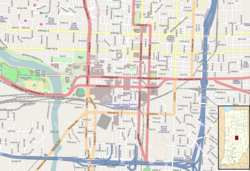     | |
| Location | 701 N. Senate Ave., Indianapolis, Indiana |
|---|---|
| Coordinates | 39°46′41″N86°9′47″W / 39.77806°N 86.16306°W |
| Area | Less than one acre |
| Built | 1910 |
| Architect | Frank Baldwin Hunter |
| Architectural style | Tudor Revival |
| NRHP reference No. | 100007176 |
| Added to NRHP | November 15, 2021 |
The Colored Knights of Pythias Castle Hall, also known simply as "Castle Hall", is a historic building in downtown Indianapolis, Indiana, United States. This building was a hub of commercial and social activity for Colored Knights of Pythias who came together from several different Indianapolis lodges. The brick building was designed in the Tudor Revival style with sparse detail compared to other examples of the style, likely due to cost-saving measures taken during construction. Remnants of the original, grander design can be seen on external features of the castle hall, such as a label lintel with a stone hood around the entrance, as well as hooded windows and stepped parapets resembling castle turrets.
Contents
While the outside was sparse in comparison with original building plans, the inside had many ornate details. The inside of the building contains three floors, with a historic paint scheme of dark reds, greens, and mustard used throughout the building. The first floor contained the main lobby, which had a terrazzo floor with the Knights of Pythias emblem in the middle. The ceilings were made of pressed metal and showcased elaborate cove moldings. Similar ceiling design was also in the main staircase and second floor assembly hall. [1] : 15–17 Seven storefronts, rented to retail tenants, could be accessed from the street. Both stairs and an elevator could be used to access the other floors of the building. [1] : 26
The second floor landing had a check-in room that may have been used as a ticket booth. Most of the second floor is taken up by a large assembly hall with a stage opposite the entrance. In the assembly hall, Knights of Pythias emblems are in the ceiling panels over the bays. The space is decorated with the pressed metal ceilings and cove moldings similar to the lobby and main staircase and stenciling on the front wall of the stage. [1] : 16–17 The remainder of the space on the second story is taken up by hallways and two separate men's and women's lounges that connect to their own coat rooms and restrooms. [1] : 27
The third floor consisted of three meeting rooms, labeled "West", "Middle", and "East". The West meeting room had a platform parallel to the far wall. A kitchen was also located between the East meeting room and stairwell. [1] : 27 As a Knights of Pythias meeting space, the building was out of commission by the 1940s due to loss of retail tenants and mounting financial issues faced by the Castle Hall Association. The building was operated as a storage facility until recently, and is currently under renovation. [1] : 13–15