Belle Meade is a city in Davidson County, Tennessee. Its total land area is 3.1 square miles (8.0 km2), and its population was 2,901 at the time of the 2020 census.

Forest Hills is a city in Davidson County, Tennessee. The population was 5,038 at the 2020 census and 4,866 in a 2018 estimate.

Mount Olivet Cemetery is a 206-acre (83 ha) cemetery located in Nashville, Tennessee. It is located approximately two miles East of downtown Nashville, and adjacent to the Catholic Calvary Cemetery. It is open to the public during daylight hours.

Centennial Park is a large urban park located approximately two miles west of downtown Nashville, Tennessee, United States, across West End Avenue from the campus of Vanderbilt University. The 21st-century headquarters campus of the Hospital Corporation of America was developed adjacent to the park.
Belle Meade Plantation, now officially titled Belle Meade Historic Site and Winery, is a historic farm established in 1807 in Nashville, Tennessee, built, owned, and controlled by five generations of the Harding-Jackson family for nearly a century. The farm, named "Belle Meade", grew to encompass 5,400 acres (22 km2) at its zenith and used a labor force of 136 enslaved workers. The farm's centerpiece was a Greek revival mansion built in 1853. Belle Meade Farm gained a national reputation in the latter half of the 19th century for breeding thoroughbred horse racing stock, notably a celebrated stallion, Iroquois. In the Civil War, when the Union Army took control of Nashville, the mansion was pillaged and looted by soldiers who spent weeks quartered there; the owner was imprisoned. In the aftermath, the plantation recovered, but with greatly reduced capacity. Roughly half of the enslaved persons returned as paid employees after the war and lived in their own homes nearby. After a financial downturn in 1893 and later the death of the owner and his heir, the estate was dismantled and sold in parcels in 1906.
The Ensworth School is a private school located on two separate campuses in Nashville, Tennessee.

William Giles Harding was a Southern planter, attorney, and horse breeder who was made a Brigadier General in the Tennessee militia before the American Civil War. He took over operations of Belle Meade Plantation near Nashville from his father in 1839. During the course of his management, he acquired more property, expanding it from 1300 acres to 5,400 acres (22 km2) in 1860. He specialized in breeding and raising Thoroughbred horses, as well as other purebred livestock. In 1862 after Union forces took over Nashville, Harding was arrested as a leader and imprisoned at Fort Mackinac in northern Michigan on Mackinac Island for six months. He was released on a $20,000 bond. After being imprisoned at Fort Mackinac, he took the oath of allegiance to the Union and did not take an active part in the conflict from 1862 onwards.
Edward Saunders Cheatham was an American politician and businessman.

Beech Grove is a historic mansion in Nashville, Tennessee. Built as a log house circa 1850, it was a Southern plantation with African slaves in the Antebellum era. In the 1910s, it became a livestock farm.

Belle Vue II is a historic mansion in Bellevue, a suburb of Nashville, Tennessee, USA. It was a Southern plantation worked by enslaved African Americans prior to the American Civil War of 1861–1865. After the war, it remained in the same family until the 1970s.

Skipwith Hall, also known as Skipwith Place, Oakwood Farm, Skipwith Harlan Hill, and Oakwood Hall, is a former plantation and plantation house located in Maury County, Tennessee. It was initially built by Edward Brinley Littlefield and Cornelia Lott Skipwith as their residence.
Mark Robertson Cockrill (1788-1872) was an American cattleman, horse breeder and planter. He was the owner of a large farm in Davidson County, Tennessee and a cotton plantation with 300 slaves in Mississippi. He won many prizes for his sheep-rearing both nationally and internationally, and he became known as the "Wool King of the World". He was a multi-millionaire prior to the American Civil War, and he loaned gold to the Confederate States of America during the war.

Ashcrest Farm is a historic mansion in Hendersonville, Tennessee, United States. Designed in the Classical Revival architectural style, it was built by slaves before the American Civil War and black laborers after the war. The land has been owned by the same family since 1810. Today, it is a horse farm.

The Hall-Harding-McCampbell House is a former plantation and historic mansion in Nashville, Tennessee. It has been listed on the National Register of Historic Places since March 23, 2010.
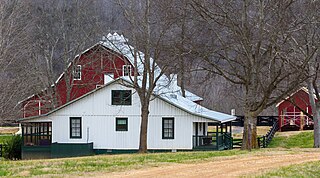
Dozier Farm, also known as Cliffview Farm, is a historic mansion in Nashville, Tennessee, U.S..

The Alexander Ewing House is a historic mansion in Nashville, Tennessee, U.S. The two-story plantation home was built in 1821 in the Federal architecture style for Alexander Ewing. It is constructed of brick with a stone foundation and a gable roof. Both the north and south side elevations feature a pair of chimneys connected by a parapet wall. The house has been listed on the National Register of Historic Places since November 25, 1980.

The Andrew Scott House is a historic two-story farmhouse in Culleoka, Tennessee, U.S.
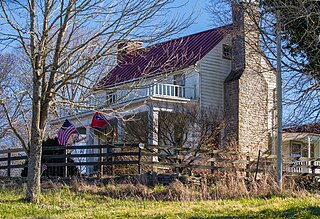
The Prewitt-Amis-Finney House, also known as Turnhill Farm, is a historic three-story house in Culleoka, Tennessee, U.S.. Built for the slaveholding Prewett family in 1810, it was established as a mule farm. It is located a few miles away from Columbia, and it overlooks Fountain Creek.
The Maple Dean Farm is a historic farmhouse in Shelbyville, Tennessee, U.S.. Built in 1886 on a farm established in 1819, it was designed in the Eastlake architectural style. It became a century farm in 1976, and it was listed on the National Register of Historic Places in 1976.

Murray Farm is a historic farmhouse in Readyville, Tennessee, U.S..