The Nazgûl, introduced as Black Riders and also called Ringwraiths, Ring-wraiths, Dark Riders, the Nine Riders, or simply the Nine, are fictional characters in J. R. R. Tolkien's Middle-earth legendarium. They were nine men who succumbed to Sauron's power and attained immortality as wraiths, servants bound to the power of the One Ring and completely under the dominion of Sauron. They are first mentioned in The Lord of the Rings, originally published in 1954–1955.
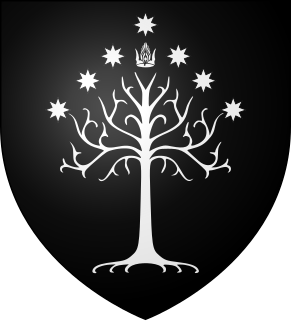
Gondor is a fictional kingdom in J. R. R. Tolkien's writings, described as the greatest realm of Men in the west of Middle-earth by the end of the Third Age. The third volume of The Lord of the Rings, The Return of the King, is largely concerned with the events in Gondor during the War of the Ring and with the restoration of the realm afterward. The history of the kingdom is outlined in the appendices of the book.

Rohan is a kingdom in J. R. R. Tolkien's fantasy setting of Middle-earth. It is mainly a grassland, and lies north-west of its ally Gondor, and further north-west of Mordor, the realm of Sauron, their enemy. It is inhabited by the Rohirrim, a people of herdsmen and farmers who are well known for their horses and cavalry. The realm is of significant importance in the author's book, The Lord of the Rings. Much of the background of Rohan is grounded in Anglo-Saxon tradition.
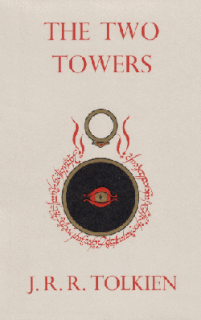
The Two Towers is the second volume of J. R. R. Tolkien's high fantasy novel The Lord of the Rings. It is preceded by The Fellowship of the Ring and followed by The Return of the King.
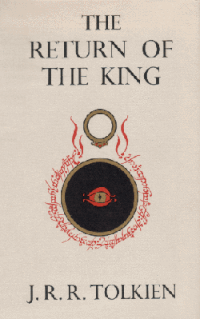
The Return of the King is the third and final volume of J. R. R. Tolkien's The Lord of the Rings, following The Fellowship of the Ring and The Two Towers. The story begins in the kingdom of Gondor, which is soon to be attacked by the Dark Lord Sauron.
Minas Tirith is a fictional city in J. R. R. Tolkien's Legendarium. It became the heavily fortified capital of the kingdom of Gondor in the second half of the Third Age. It had originally been built to guard the former capital, Osgiliath, from attack from the west, but became the capital when Osgiliath fell into ruin following the Kin-strife and the Great Plague.
In the fictional high fantasy-world of J. R. R. Tolkien, the War of the Ring was fought between Sauron and the free peoples of Middle-earth for control of the One Ring and dominion over the continent. The War of the Ring took place at the end of the Third Age. Together with the Quest of Mount Doom, it is one of the overarching events of The Lord of the Rings. Gandalf and Elessar Telcontar led the free peoples of Middle-earth to victory over the Dark Lord.

In J. R. R. Tolkien's legendarium, Isengard is a large fortress in the fictional universe of Middle-earth. It is a translation of the term Angrenost from the fictional language of Sindarin. Both terms mean "iron fortress". Additionally, Isengard can mean "West Guard".

Minas Morgul also known by its earlier name of Minas Ithil is a fictional fortified city in J. R. R. Tolkien's Middle-earth.
In J. R. R. Tolkien's Legendarium, the Battle of the Pelennor Fields [pɛˈlɛnnɔr] is the battle for the city of Minas Tirith between the forces of Gondor and its allies, and the forces of the Dark Lord Sauron. Tolkien recounts this battle in The Return of the King, the third volume of his 1954–55 novel The Lord of the Rings as originally printed. It is the largest battle and one of the most important events of the War of the Ring, the war in which the Third Age of Middle-earth comes to a close. It takes place on 15th 'March' T.A. 3019 in the Pelennor Fields, the townlands and fields between Minas Tirith and the River Anduin. The concept and history of composition of the battle is detailed in the fourth volume of The History of the Lord of the Rings.

In J. R. R. Tolkien 's (fictional) legendarium, Dol Amroth was a hill along the coast of Gondor, on a peninsula on the Bay of Belfalas; and also the city that grew up there, mainly in the Third Age as the seat of the principality of the same name. The Prince of Dol Amroth was one of the principal subjects of Gondor. In The Lord of the Rings, Prince Imrahil is the Prince of Dol Amroth, a supporting character in the book's third volume, The Return of the King.
The White Mountains are a fictional mountain range in J. R. R. Tolkien's Middle-earth, where they lie primarily in the Kingdom of Gondor, but partly also in the Kingdom of Rohan. The name White Mountains is a loose translation of Ered Nimrais, meaning "mountains of white horns" in Sindarin, one of the languages created by Tolkien. The mountains are named after the glaciers and snowcaps of their highest peaks.
Beregond and Bergil are father-and-son fictional characters in J. R. R. Tolkien's Middle-earth legendarium. They appear in The Return of the King, where Beregond has a key role in saving Faramir from death. Bergil plays a smaller part in saving a number of characters.
In J. R. R. Tolkien's legendarium, the Battle of the Morannon or Battle of the Black Gate is a fictional event that took place at the end of the War of the Ring. It is depicted in The Return of the King, the third volume of his epic fantasy book The Lord of the Rings.
Erkenbrand is a fictional character in J. R. R. Tolkien's legendarium. He appears in The Two Towers, the second volume of Tolkien's fantasy novel The Lord of the Rings.
Grimbold of Grimslade is a character in J. R. R. Tolkien's Middle-earth legendarium. He appears in The Two Towers and The Return of the King, the second and third volumes of the fantasy novel The Lord of the Rings as originally published. He also appears in the posthumously published Unfinished Tales.
J. R. R. Tolkien's Middle-earth fantasy writings include many wars and battles set in the lands of Aman, Beleriand, Númenor, and Middle-earth. These are related in his various books such as The Hobbit and The Lord of the Rings, and The Silmarillion, Unfinished Tales and other posthumously published books edited by his son Christopher Tolkien.
Théoden is a fictional character in J. R. R. Tolkien's fantasy novel, The Lord of the Rings. The King and Lord of the Mark of Rohan, he appears as a major supporting character in The Two Towers and The Return of the King. When first introduced, Théoden is weak with age and sorrow and the machinations of his top advisor, Gríma Wormtongue, and he does nothing as his kingdom is crumbling. Once roused by Gandalf, however, he becomes an instrumental ally in the war against Saruman and Sauron.
The Witch-king of Angmar, also known as the Lord of the Nazgûl and the Black Captain, is a character in Tolkien's legendarium. In J. R. R. Tolkien's The Lord of the Rings, he is the chief of the Nazgûl or "Ringwraiths", the chief servants of the Dark Lord, Sauron. His name is not revealed in any of Tolkien's writings, nor are the names of any of the other Nazgûl except Khamûl.
Elrond Half-elven is a fictional character in J. R. R. Tolkien's Middle-earth legendarium. He is introduced in The Hobbit, and plays a supporting role in The Lord of the Rings and The Silmarillion.


