
The Arcade in downtown Cleveland, Ohio, is a Victorian-era structure of two nine-story buildings, joined by a five-story arcade with a glass skylight spanning over 300 feet (91 m), along the four balconies. Erected in 1890, at a cost of $867,000, the Arcade opened on Memorial Day, and is identified as one of the earliest indoor shopping arcades in the United States. The Arcade was modified in 1939, remodeling the Euclid Avenue entrance and adding some structural support. It was designated a National Historic Landmark in 1975.
Notre Dame College was a private Roman Catholic college in South Euclid, Ohio. Established in 1922 by the Sisters of Notre Dame as a women's college, it was coeducational from January 2001 until its closure. The Sisters of Notre Dame ended their sponsorship of the college in 2023. In February 2024, the college announced it would be closing at the end of the spring semester, with agreements in place for existing students to complete their degrees at partner colleges and universities. The college ultimately closed on May 2, 2024.

State Route 83, also or primarily known as Euclid Avenue, is a state highway and city street in the U.S. state of California. Officially, SR 83 runs from the Chino Valley Freeway in Chino Hills north to the San Bernardino Freeway in Upland. Euclid Avenue then continues north through Upland to the unincorporated community of San Antonio Heights.
The May Company Ohio was a chain of department stores that was based in Cleveland, Ohio, United States.
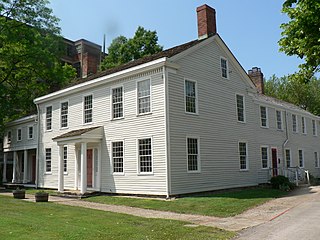
The Dunham Tavern, also known as the Dunham Tavern Museum, is the oldest building in Cleveland, Ohio, located at 6709 Euclid Avenue. Rufus and Jane Pratt Dunham built their first home on the site in 1824, and the existing taproom was built in 1842. It is believed to be the first building constructed on Euclid Avenue east of East 55th Street and the first frame house on the street. It later became a stagecoach stop and tavern.
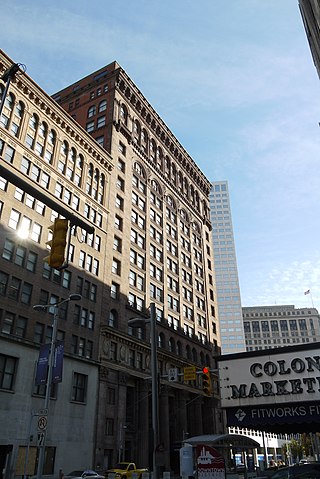
The Guardian Bank Building is a high–rise building on Euclid Avenue in downtown Cleveland, Ohio.

This is a list of the National Register of Historic Places listings in Cleveland, Ohio.

Euclid Avenue School is a historic school building located at Jamestown in Chautauqua County, New York. It is a two-story, rectangular brick structure built in 1911 and enlarged in 1920 and 1956. The structure combines Neoclassical features and proportions with elements of the Spanish Mission and American Craftsman styles in an eclectic composition that is characteristic of early 20th-century architectural fashion.
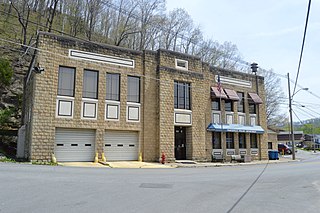
Paintsville City Hall was completed in January 1940 by the WPA, in order to house the city government, fire department, and police department of Paintsville, Kentucky. The structure is located at 101 Euclid Avenue in downtown Paintsville. It was added to the National Register of Historic Places on January 26, 1989.

The Tavern Club is a private social club in the Central neighborhood of Cleveland, Ohio, USA. Its home is a building designed by architect J. Milton Dyer in a Northern Renaissance style. It was listed on the National Register of Historic Places in 1984. It was also designated as a landmark by the City of Cleveland. Tavern was built at a time when, just a block away, Cleveland's Millionaire's Row on Euclid Avenue was among the wealthiest neighborhoods in the world, and home to many members.

The Euclid Avenue Historic District is a historic district in downtown Cleveland, Ohio, United States. Established and listed on the National Register of Historic Places in 2002, it comprises 125 acres (51 ha) along Euclid Avenue and parallel streets from Public Square to East 21st Street. In 2007, another 4 acres (1.6 ha) was added to the district; the boundary increase included buildings exclusively located along parallel streets. it was again enlarged in 2022.

First Methodist Church is a historic church in the Central neighborhood on the east side of Cleveland, Ohio.

Trinity Cathedral is a historic church on Euclid Avenue at East 22nd Street in Cleveland, Ohio. It is the cathedral of the Episcopal Diocese of Ohio.

The Masonic Temple in Great Falls, Montana is a building from 1914. It was listed on the National Register of Historic Places in 2000.

The Terre Haute Masonic Temple in Terre Haute, Indiana is a Classical Revival-style Masonic building that ground was broken for in 1915, cornerstone was laid in 1916, and opened in 1917. It was listed on the National Register of Historic Places by the United States Department of the Interior in 1995. The structure was commissioned by the Terre Haute Masonic Temple Association which was included one director from each of the following bodies that funded the building of the temple: Social Lodge No. 86 F&AM, Humboldt Lodge No. 42 F&AM, Terre Haute Lodge #19 F&AM, Euclid Lodge No. 573 F&AM, Terre Haute Chapter No. 11 R.A.M., Terre Haute Council No. 8 R. & S.M., Terre Haute Commandery No. 16 K.T. The Temple was built by A.W. Stoolman with Archie H. Hubbard serving as architect.

Fairfax is a neighborhood on the East Side of Cleveland, Ohio. It is roughly bounded between Euclid Avenue to the north, Woodland Avenue to the south, E. 71st Street to the west and E. 105th Street to the east. Fairfax is located on the edge of University Circle, an area containing Cleveland's major educational institutions and museums. The Karamu House is on the National Register of Historic places and is the nation's oldest African-American theater. The northeastern quadrant of Fairfax, along Euclid Avenue to 105th Street, is dominated by the Cleveland Clinic.
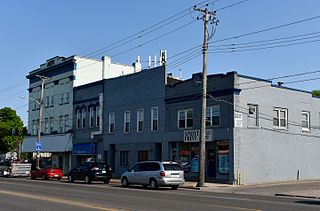
The College Corner Commercial Historic Business District, also known as the Highland Park Historic Business District at Euclid and Second, is located in the north-central section of Des Moines, Iowa, United States. It is located in the Highland Park neighborhood that also includes the Highland Park Historic Business District at Euclid and Sixth Avenues. The College Corner historic district has been listed on the National Register of Historic Places since 1998.

The Highland Park Historic Business District at Euclid and Sixth Avenues is located in the north-central section of Des Moines, Iowa, United States. It is located on the border of the Oak Park and Highland Park neighborhoods. The commercial historic district has been listed on the National Register of Historic Places since 1998. The Highland Park neighborhood also includes the College Corner Commercial Historic Business District.

Euclid Avenue Historic District is a national historic district located at Bristol, Virginia. The district encompasses 573 contributing buildings and 3 contributing structures in a predominantly residential area of Bristol. The neighborhood developed in the late-19th and early-20th centuries, and contains primarily one- to two-story frame and brick dwellings constructed from 1890 through the 1940s. Notable buildings include the William G. Lindsey House, Euclid Avenue Baptist Church (1928), R.C. Horner House (1930), architect Clarence B. Kearfott House, James Cecil House, and the dwelling at 611 Arlington Avenue, which is the only example of a Lustron house known to exist in Bristol. The Virginia High School (1914) is separately listed.
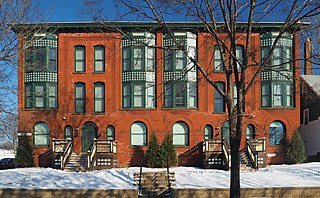
Euclid View Flats is a historic apartment building in Saint Paul, Minnesota, United States, constructed 1894–1895. It is listed on the National Register of Historic Places for its local significance in architecture. Euclid View Flats is a sophisticated early example of an apartment building designed to attract the middle class. Prior to the 1890s, multi-family housing in the United States was overwhelmingly in the form of tenements catering to the poor. Euclid View Flats provided an acceptable alternative to the single-family houses that dominated middle-class residential options in Saint Paul and the Dayton's Bluff neighborhood in particular. In addition to representing a change in housing preferences, the building reveals in its transitional architecture a shift from the highly ornamented Queen Anne style to the more restrained Romanesque Revival style during the same period.


