
Elmwood, also known as the Oliver-Gerry-Lowell House, is a historic house and centerpiece of a National Historic Landmark District in Cambridge, Massachusetts. It is known for several prominent former residents, including: Thomas Oliver (1734–1815), royal Lieutenant Governor of Massachusetts; Elbridge Gerry (1744–1814), signer of the US Declaration of Independence, Vice President of the United States and eponym of the term "gerrymandering"; and James Russell Lowell (1819–1891), noted American writer, poet, and foreign diplomat.
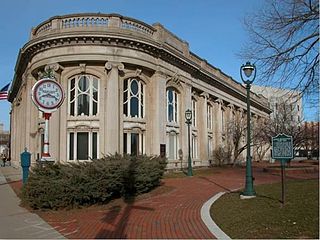
The Milwaukee County Historical Society, also known as MCHS, is a local historical society in Milwaukee County, Wisconsin. Founded in 1935, the organization was formed to preserve, collect, recognize, and make available materials related to Milwaukee County history. It is located in downtown Milwaukee in the former Second Ward Savings Bank building.

Jacob Kamm was a prominent early transportation businessman in Oregon, USA.
Thomson Francis Mason was an American lawyer, planter and politician who served as the mayor of Alexandria between 1827 and 1830, and as a justice of the peace for many years and briefly in the months before his death as a judge of the Washington D.C. criminal court.

Huntley, also known as Historic Huntley or Huntley Hall is an early 19th-century Federal-style villa and farm in the Hybla Valley area of Fairfax County, Virginia. The house sits on a hill overlooking Huntley Meadows Park to the south. The estate is best known as the country residence of Thomson Francis Mason, grandson of George Mason of nearby Gunston Hall. It is listed on the National Register of Historic Places (NRHP), the Virginia Landmarks Register (VLR), and the Fairfax County Inventory of Historic Sites.
Lowell is an unincorporated community in Summers County, West Virginia, United States. Lowell is located on the Greenbrier River, east of Hinton and southwest of Alderson. The community was first settled in 1770 and is the oldest community in Summers County.

Seguin Light is a lighthouse on Seguin Island, in the Gulf of Maine south of the mouth of the Kennebec River, Maine. Established in 1795, it is the second-oldest of Maine's coastal lighthouses, and the only lighthouse in the state housing a first-order Fresnel lens. With its light at 180 feet (55 m) above mean sea-level, the present tower, built in 1857, is its highest of the state's lighthouses. Automated in 1985, the buildings of the light station are now operated as a museum property by a non-profit organization, and are seasonally open to the public via scheduled ferry from Popham Beach in Phippsburg. The light was listed on the National Register of Historic Places as Seguin Island Light Station in 1977.
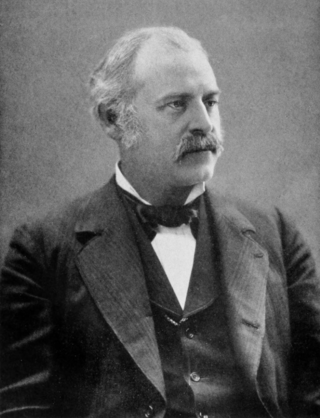
Andrew Jackson Warner, also known as A. J. Warner, was a prominent architect in Rochester, New York.

The Gorgas–Manly Historic District is a historic district that includes 12 acres (4.9 ha) and eight buildings on the campus of the University of Alabama in Tuscaloosa, Alabama. The buildings represent the university campus as it existed from the establishment of the institution through to the late 19th century. Two buildings included in the district, Gorgas House and the Little Round House, are among only seven structures to have survived the burning of the campus by the Union Army, under the command of Brigadier General John T. Croxton, on April 4, 1865. The other survivors were the President's Mansion and the Old Observatory, plus a few faculty residences.
Harry Verner Gates was an American engineer and politician in the state of Oregon. A native of Massachusetts, he later lived in Iowa worked on the railroads before settling in Hillsboro, Oregon, where he shifted to water projects. A member of the Republican Party, he served a single term in the Oregon House of Representatives. His former home in Hillsboro is the historic Rice–Gates House, and his former ranch in Central Oregon is now the Crooked River Ranch.

The Washington Opera House is a 2 and 1/2 story structure near the western end of the main downtown shopping district of Maysville, Kentucky. The sides and rear of the theater are of red brick while the façade is of buff brick trimmed with red brick, stone, and cast iron.

The Dr. Fred Stone Sr. Hospital is a six-story brick structure in Oliver Springs, Tennessee. Noted for its castle-like appearance and eccentric, unplanned design, the building was home to a one-doctor hospital operated by retired U.S. Army physician Fred Stone Sr. (1887–1976) in the 1940s, 1950s, and 1960s. Stone delivered over 5,000 babies while working at the hospital, and expanded the building room-by-room, floor-by-floor in his spare time. In 2006, the building was added to the National Register of Historic Places for its association with the region's medical services history, namely the transition from rural country doctors to modern hospitals.
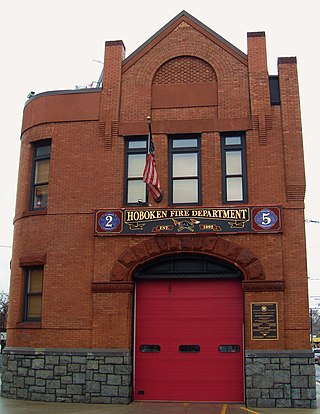
Engine Company No. 3 is located in Hoboken, Hudson County, New Jersey, United States. The firehouse was designed by Charles Fall and was built in 1892. The firehouse was added to the National Register of Historic Places on March 30, 1984. The firehouse currently houses Engine Company 2 and Ladder Company 2 of the Hoboken Fire Department.

Marshall House, also known as McNeil House, is a historic home located at New Cumberland, Hancock County, West Virginia. It was built in 1887 and is a 2+1⁄2-story, Queen Anne style brick dwelling. It was built by West Virginia State Senator Oliver S. Marshall (1850-1934) and remained his home until his death.

The House of Providence, also known as The Academy, is a former orphanage and school located in Vancouver, Washington. It was built c. 1873 by Mother Joseph of the Sacred Heart.
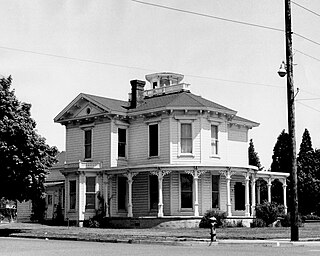
The Slocum House is a Victorian style house located in Vancouver, Washington, in the United States, which today stands at the southwest corner of Esther Short Park. It is the only surviving structure in its former residential neighborhood of the Vancouver historic core.

Kluge House, also known as Maverick House, is a rare example of Silesian fachwerk, log and half-timber construction, located in Helena, Montana. In mid-1964 the home was almost destroyed as a fire hazard as it had fallen into disrepair and transients were living in it. A shed is attached to the north side of the house. The second floor was built in 1882. Prior to that Kluge had apparently done significant work on the original cabin's first floor, which has hewn squared logs. The second floor is half-timber filled in with bricks. The second floor diagonal logs brace the framing logs. The overall dimensions of the house are 30'-11" x 16'-4" with a foundation of stone found locally. There are front and rear doors on the first floor. The front door is asymmetrically located and the rear door is near a corner. The second floor is reached only via an exterior staircase. The house has a brick fireplace. The first floor has an entrance vestibule and two rooms of dissimilar size. The smaller room has a hatch leading to a cellar. The second floor has a floor plan that is very similar to that of the first floor but it is reversed, i.e., two rooms and a vestibule. Floors are wooden.
The Superior Court of California, County of Lake, also known as the Lake County Superior Court or Lake Superior Court, is the branch of the California superior court with jurisdiction over Lake County.


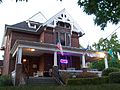 Lowell M. Hidden House
 W. Foster Hidden House


