| LAMC3 | |||||||||||||||||||||||||||||||||||||||||||||||||||
|---|---|---|---|---|---|---|---|---|---|---|---|---|---|---|---|---|---|---|---|---|---|---|---|---|---|---|---|---|---|---|---|---|---|---|---|---|---|---|---|---|---|---|---|---|---|---|---|---|---|---|---|
| Identifiers | |||||||||||||||||||||||||||||||||||||||||||||||||||
| Aliases | LAMC3 , OCCM, laminin subunit gamma 3 | ||||||||||||||||||||||||||||||||||||||||||||||||||
| External IDs | OMIM: 604349 MGI: 1344394 HomoloGene: 21222 GeneCards: LAMC3 | ||||||||||||||||||||||||||||||||||||||||||||||||||
| |||||||||||||||||||||||||||||||||||||||||||||||||||
| |||||||||||||||||||||||||||||||||||||||||||||||||||
| |||||||||||||||||||||||||||||||||||||||||||||||||||
| |||||||||||||||||||||||||||||||||||||||||||||||||||
| |||||||||||||||||||||||||||||||||||||||||||||||||||
| Wikidata | |||||||||||||||||||||||||||||||||||||||||||||||||||
| |||||||||||||||||||||||||||||||||||||||||||||||||||
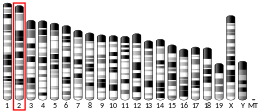
Laminin subunit gamma-3 also known as LAMC3 is a protein that in humans is encoded by the LAMC3 gene. [5] [6]
Laminins, a family of extracellular matrix glycoproteins, are the major noncollagenous constituent of basement membranes. They have been implicated in a wide variety of biological processes including cell adhesion, differentiation, migration, signaling, neurite outgrowth and metastasis. Laminins are composed of 3 non identical chains: laminin alpha, beta and gamma (formerly A, B1, and B2, respectively) and they form a cruciform structure consisting of 3 short arms, each formed by a different chain, and a long arm composed of all 3 chains. Each laminin chain is a multidomain protein encoded by a distinct gene. Several isoforms of each chain have been described. Different alpha, beta and gamma chain isomers combine to give rise to different heterotrimeric laminin isoforms which are designated by Arabic numerals in the order of their discovery, i.e. alpha1beta1gamma1 heterotrimer is laminin 1.
The biological functions of the different chains and trimer molecules are largely unknown, but some of the chains have been shown to differ with respect to their tissue distribution, presumably reflecting diverse functions in vivo. This gene encodes the gamma chain isoform laminin, gamma 3. The gamma 3 chain is most similar to the gamma 1 chain, and contains all the 6 domains expected of the gamma chain. It is a component of laminin 12. The gamma 3 chain is broadly expressed in skin, heart, lung, and the reproductive tracts. In skin, it is seen within the basement membrane of the dermoepidermal junction at points of nerve penetration. However, it was also found that the gamma 3 is a prominent element of the apical surface of ciliated epithelial cells of lung, oviduct, epididymis, ductus deferens, and seminiferous tubules. The distribution of gamma 3-containing laminins along ciliated epithelial surfaces suggests that the apical laminins are important in the morphogenesis and structural stability of the ciliated processes of these cells. [6]
A recent study found that LAMC3 plays a critical role in forming the convolution of the cerebral cortex. Particularly LAMC3 is expressed during the embryonic period, which contributes the formation of dendrites. [7]
Laminins are a family of glycoproteins of the extracellular matrix of all animals. They are major components of the basal lamina, the protein network foundation for most cells and organs. The laminins are an important and biologically active part of the basal lamina, influencing cell differentiation, migration, and adhesion.
CD49d is an integrin alpha subunit. It makes up half of the α4β1 lymphocyte homing receptor.
Integrin alpha-3 is a protein that in humans is encoded by the ITGA3 gene. ITGA3 is an integrin alpha subunit. Together with beta-1 subunit, it makes up half of the α3β1 integrin duplex that plays a role in neural migration and corticogenesis, acted upon by such factors as netrin-1 and reelin.
Integrin alpha-5 is a protein that in humans is encoded by the ITGA5 gene.
Collagen alpha-4(IV) chain is a protein that in humans is encoded by the COL4A4 gene.
Laminin subunit alpha-5 is a protein that in humans is encoded by the LAMA5 gene.
Laminin subunit gamma-2 is a protein that in humans is encoded by the LAMC2 gene.
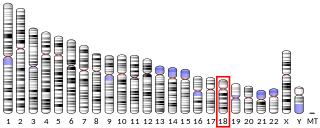
Laminin subunit alpha-3 is a protein that in humans is encoded by the LAMA3 gene.
Laminin subunit beta-3 is a protein that in humans is encoded by the LAMB3 gene.
Laminin subunit alpha-1 is a protein that in humans is encoded by the LAMA1 gene.
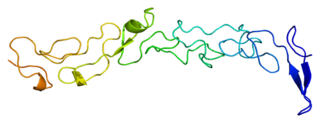
Laminin subunit gamma-1 is a protein that in humans is encoded by the LAMC1 gene.
Laminin subunit beta-1 is a protein that in humans is encoded by the LAMB1 gene.
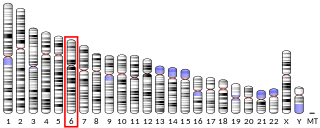
Laminin subunit alpha-2 is a protein that in humans is encoded by the LAMA2 gene.
Alpha-7 integrin is a protein that in humans is encoded by the ITGA7 gene. Alpha-7 integrin is critical for modulating cell-matrix interactions. Alpha-7 integrin is highly expressed in cardiac muscle, skeletal muscle and smooth muscle cells, and localizes to Z-disc and costamere structures. Mutations in ITGA7 have been associated with congenital myopathies and noncompaction cardiomyopathy, and altered expression levels of alpha-7 integrin have been identified in various forms of muscular dystrophy.
Disintegrin and metalloproteinase domain-containing protein 9 is an enzyme that in humans is encoded by the ADAM9 gene.
Laminin subunit alpha-4 is a protein that in humans is encoded by the LAMA4 gene.
Fibulin-2 is a protein that in humans is encoded by the FBLN2 gene.
Laminin subunit beta-2 is a protein that in humans is encoded by the LAMB2 gene.
Guanine nucleotide-binding protein G(I)/G(S)/G(O) subunit gamma-3 is a protein that in humans is encoded by the GNG3 gene.
Integrin beta-8 is a protein that in humans is encoded by the ITGB8 gene.
This article incorporates text from the United States National Library of Medicine, which is in the public domain.