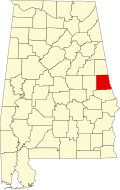
Lanett is a city in Chambers County, Alabama, United States. As of the 2020 census, Lanett had a population of 6,970.[3] Lanett, originally called Bluffton, is located in eastern Alabama, on the Chattahoochee River, southwest of Atlanta. The city's name is derived from Lafayette Lanier and Theodore Bennett, founders of the West Point Manufacturing Company.
Lanett is located on the eastern edge of Chambers County. Its eastern boundary is the Alabama–Georgia state line, with the town of West Point, Georgia, bordering Lanett to the east. Interstate 85 forms the southeast boundary of Lanett, with the city of Valley, Alabama, on the other side of the highway. The unincorporated community of Huguley is along Lanett's southwest border.
The Chattahoochee River forms the state line and eastern boundary of Lanett from I-85 north to the downtown area, at which point the state line turns north-northwest and becomes a land boundary between Lanett and West Point, Georgia.
According to the U.S. Census Bureau, Lanett has a total area of 6.2 square miles (16.1km2), all land.[4]
As of the 2020 census, Lanett had a population of 6,970 and contained 2,695 households and 1,487 families.[7]
The median age was 39.1 years; 22.5% of residents were under the age of 18 and 20.1% were 65 years of age or older. For every 100 females there were 94.4 males, and for every 100 females age 18 and over there were 93.0 males age 18 and over.[7]
95.6% of residents lived in urban areas, while 4.4% lived in rural areas.[8]
There were 2,695 households in Lanett, of which 29.5% had children under the age of 18 living in them. Of all households, 29.8% were married-couple households, 21.5% were households with a male householder and no spouse or partner present, and 42.9% were households with a female householder and no spouse or partner present. About 31.3% of all households were made up of individuals and 14.7% had someone living alone who was 65 years of age or older.[7]
There were 3,145 housing units, of which 14.3% were vacant. The homeowner vacancy rate was 2.6% and the rental vacancy rate was 6.7%.[7]
As of the census[10] of 2010, there were 6,468 people, 2,723 households, and 1,746 families residing in the city. The population density was 1,040 inhabitants per square mile (400/km2). There were 3,338 housing units at an average density of 538 per square mile (208/km2). The racial makeup of the city was 57.5% Black or African American, 39.3% White, 0.2% Native American, 0.1% Asian, 1.4% from other races, and 1.5% from two or more races. 2.4% of the population were Hispanic or Latino of any race.
There were 2,723 households, out of which 23.2% had children under the age of 18 living with them, 32.6% were married couples living together, 25.4% had a female householder with no husband present, and 35.9% were non-families. 32.1% of all households were made up of individuals, and 14.6% had someone living alone who was 65 years of age or older. The average household size was 2.34 and the average family size was 2.93.
In the city, the age distribution of the population shows 22.3% under the age of 18, 8.8% from 18 to 24, 22.6% from 25 to 44, 28.0% from 45 to 64, and 18.3% who were 65 years of age or older. The median age was 41.8 years. For every 100 females, there were 85.1 males. For every 100 females age 18 and over, there were 87.4 males.
The median income for a household in the city was $25,220, and the median income for a family was $27,487. Males had a median income of $32,386 versus $24,794 for females. The per capita income for the city was $14,178. About 22.7% of families and 28.7% of the population were below the poverty line, including 48.0% of those under age 18 and 16.8% of those age 65 or over.
This page is based on this Wikipedia article Text is available under the CC BY-SA 4.0 license; additional terms may apply. Images, videos and audio are available under their respective licenses.


 United States
  Alabama