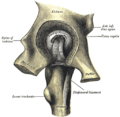
Pubis

Last updated

Pubis may refer to:

Related Research Articles

The acetabulum is a concave surface of a pelvis. The head of the femur meets with the pelvis at the acetabulum, forming the hip joint.

Mons pubis Rounded mass of fatty tissue found over the pubic symphysis

In human anatomy, and in mammals in general, the mons pubis or pubic mound is a rounded mass of fatty tissue found over the pubic symphysis of the pubic bones.

Pubic symphysis

The pubic symphysis a cartilaginous joint that sits between and joins the left and right superior rami of the pubic bones. It is located in front of and below the urinary bladder. In males, the suspensory ligament of the penis attaches to the pubic symphysis. In females, the pubic symphysis is intimately close to the clitoris. In normal adults it can be moved roughly 2 mm and with 1 degree rotation. This increases for women at the time of childbirth.

Osteitis pubis noninfectious inflammation of the pubis symphysis (also known as the pubic symphysis, symphysis pubis, or symphysis pubica), causing varying degrees of lower abdominal and pelvic pain

Osteitis pubis is a noninfectious inflammation of the pubis symphysis, causing varying degrees of lower abdominal and pelvic pain. Osteitis pubis was first described in patients who had undergone suprapubic surgery, and it remains a well-known complication of invasive procedures about the pelvis. It may also occur as an inflammatory process in athletes. The incidence and cause of osteitis pubis as an inflammatory process versus an infectious process continues to fuel debate among physicians when confronted by a patient who presents complaining of abdominal pain or pelvic pain and overlapping symptoms. It was first described in 1924.

Obturator foramen

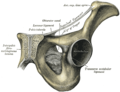
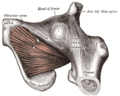
The obturator foramen is the large opening created by the ischium and pubis bones of the pelvis through which nerves and blood vessels pass.

Osteitis is inflammation of bone. More specifically, it can refer to one of the following conditions:

Ischium lower and back part of the hip bone

The ischium forms the lower and back part of the hip bone.

Pubis (bone) the ventral and anterior of the three principal bones composing either half of the pelvis

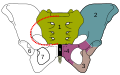
In vertebrates, the pubic bone is the ventral and anterior of the three principal bones composing either half of the pelvis.

<i>Marasuchus</i> Marasuchus was a small, two-legged reptile that was a close relative of dinosaurs.

Marasuchus is a genus of basal dinosauriform archosaur which lived during the late Triassic in what is now La Rioja Province, Argentina. It possessed some, but not all of the adaptations which traditionally characterized dinosaurs. For example, its proportions indicate that it was likely bipedal as in early dinosaurs, and it shared certain specific characteristics with that group such, most relating to the hip and the head of the femur. Nevertheless, it lacked certain dinosaur-like features such as a perforated acetabulum, and it had several plesiomorphic ("primitive") features of the ankle.

Unquillosaurus is a genus of maniraptoran dinosaur from the Late Cretaceous Period, discovered in Argentina. Known only from a single fossilized pubis, its total body length may have reached 2 to 3 metres.

Superior pubic ramus

The superior pubic ramus is a part of the pubic bone which forms a portion of the obturator foramen. The obturator foramen, along with the ilium and other fused bones, forms part of either side of the pelvis.

Pectineal line (pubis)

The pectineal line of the pubis is a ridge on the superior ramus of the pubic bone. It forms part of the pelvic brim.

Hypogastrium

The hypogastrium is a region of the abdomen located below the umbilical region. The pubis bone constitutes its lower limit. The roots of the word hypogastrium mean "below the stomach"; the roots of suprapubic mean "above the pubic bone".

Diastasis symphysis pubis

Diastasis symphysis pubis is the separation of normally joined pubic bones, as in the dislocation of the bones, without a fracture. Separation of the symphysis pubis can occur spontaneously in at least 1 in 800 vaginal delivery. It is usually noticed after delivery and has been associated with forceps delivery, rapid second stage of labour or severe abduction of the thighs during delivery. Common signs and symptoms include symphyseal pain aggravated by weight bearing and walking, a waddling gait, pubic tenderness, and a palpable interpubic gap

The pubovesical ligament is a ligament that extends from the neck of the bladder to the inferior aspect of the pubis bones. In the female it is divided into two branches, the lateral pubovesical ligament and the medial pubovesical ligament. The lateral branch extends from the neck of the bladder to the tendinous arch of the pelvic fascia. The medial pubovesical ligament arises from the neck of the bladder and is a forward continuation of the tendinous arch to the pubis.

Bone disease refers to the medical conditions which affect the bone.

Hip bone bone of the pelvis

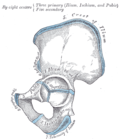
The hip bone is a large irregular bone, constricted in the center and expanded above and below. In some vertebrates it is composed of three parts: the ilium, ischium, and the pubis.

<i>Ojoraptorsaurus</i> genus of reptiles (fossil)

Ojoraptorsaurus is a genus of oviraptorosaurian dinosaur from the late Cretaceous. Ojoraptorsaurus is only known from pubic bones found at the Naashoibito Member of the Ojo Alamo Formation dating to the early Maastrichtian, about 69 million years ago. It was first named by Robert M. Sullivan, Steven E. Jasinski and Mark P.A. van Tomme in 2011 and the type species is Ojoraptorsaurus boerei. The generic name combines a reference to the formation with a Latin raptor, "plunderer", and a Latinised Greek saurus, "lizard". The specific name honours oceanographer Arjan Boeré who found the specimen.

Fuyuansaurus is an extinct genus of "protorosaur" reptiles known from the Middle Triassic Falang Formation of southern China. Fuyuansaurus was first named by Nicholas C. Fraser, Olivier Rieppel and Li Chun in 2013 and the type species is Fuyuansaurus acutirostris.

Jinbeisaurus is a genus of tyrannosauroid dinosaur from the Huiquanpu Formation from Shanxi Province in China. The type and only species is Jinbeisaurus wangi. It is the first non-avian theropod known from Shanxi. Analysis of the specimen indicates that Jinbeisaurus is more derived than related tyrannosauroids such as Xiongguanlong and phylogenetically more advanced than Suskityrannus, to which it has been compared.