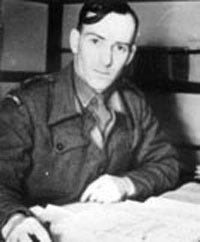
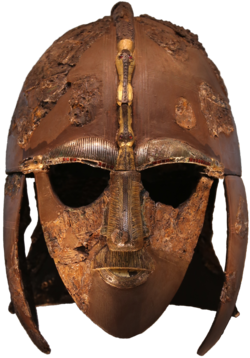
Rupert Leo Scott Bruce-Mitford (14 June 1914 – 10 March 1994) was a British archaeologist and scholar. He spent the majority of his career at the British Museum, primarily as the keeper of the Department of British and Medieval Antiquities, and was particularly known for his work on the Sutton Hoo ship-burial. Described as the spiritus rector of such research, he oversaw the production of the monumental three-volume work The Sutton Hoo Ship-Burial, termed by the president of the Society of Antiquaries as "one of the great books of the century".[1]
Though Bruce-Mitford was born in London, his preceding two generations had lived largely abroad: his maternal grandparents as early settlers of British Columbia, his paternal grandparents as missionaries in India, and his parents as schoolteachers in Japan. When Bruce-Mitford was five his father died in Japan, having returned there two years earlier. His mother was left to raise the four sons, of whom Bruce-Mitford was the youngest, on a tiny salary; the stresses were substantial, and he was fostered for a time after his mother had a breakdown. He attended preparatory school with the support of a relative, enrolled at the charity schoolChrist's Hospital five years later, and, in 1933, earned a Baring Scholarship in History to attend Hertford College, Oxford. Recommending him for a museum curatorship in 1936, the University Appointments Board noted that he "has an exceptional gift for research, a sphere in which he could do work of outstanding merit".[2]
After spending a year as an assistant keeper at the Ashmolean Museum, during which he produced the first standardized chronology of medieval pottery, in December 1937, Bruce-Mitford joined the British Museum's Department of British and Medieval Antiquities. The ship-burial was excavated in 1939, weeks before the outbreak of the Second World War; Bruce-Mitford spent 1940 to 1946 in the Royal Corps of Signals, and returned with responsibility over Sutton Hoo. Bruce-Mitford spent much of the next four decades focused on the subject, publishing dozens of works, studying contemporary graves in Scandinavia (excavating a boat-grave in Sweden and learning Swedish and Danish along the way), and leading a second round of excavations at Sutton Hoo from 1965 to 1970.
Rupert Leo Scott Bruce-Mitford was born on 14 June 1914 at 1 Deerhurst Road, Streatham, London.[3] Following Terence, Vidal and Alaric (Alec), he was the fourth of four sons born to Charles Eustace and Beatrice Jean Bruce-Mitford; a daughter did not survive.[4] Family tradition has it that Rupert's brothers were responsible for his given names, selecting them from their reading: Rupert from Anthony Hope's Rupert of Hentzau, Leo from Rider Haggard's She, and Scott from either Robert Falcon Scott's diary, or his "Message to England".[5][note 1]
Bruce-Mitford's paternal great-grandparents, George and Elizabeth Beer, sailed to the Godavari River Delta in India to work as Baptist missionaries in 1836;[7][8] poor and unordained when they left, they went on, according to Anthony Norris Groves's biographer, to "stand amongst the most tenacious Christian workers of all time".[9][10][11] Their two sons, John William and Charles Henry, continued the calling, while their two daughters married schoolteachers in the area.[12][10][13] In 1866 John Beer married Margaret Anne Midford, the daughter of an English family living in Machilipatnam.[14] They had five children, including in 1871 Herbert Leonard and in 1875 Eustace, Rupert Bruce-Mitford's father.[14] The family returned to Devon in 1884, when John Beer fell ill.[14] He died shortly after arrival; his wife returned to India, but died there four years later.[14] Eustace Beer, Rupert Bruce-Mitford would later write, was thereby "himself twice orphaned while still a small boy".[14] By 1891 he was in England, having either returned or never left following his father's death.[14] After studying in Exeter he taught English and Classics at Blackburn Grammar School, but then sailed from Genoa in 1901 to teach at the Weihaiwei School in China, an institution for European boys founded by his brother Herbert.[15][16] He left less than nine months later for Japan, intending to establish his own school there with a curriculum and ethos reflecting his own ideas.[17][18]
Shortly before his 1902 departure to China, Eustace Beer adopted the surname Bruce-Mitford—perhaps indicative of his desire to separate himself from his family's missionary past.[18] "Mitford" was a take on "Midford", his mother's maiden name, and, perhaps not unintentionally, that of the unrelated Bertram Freeman-Mitford, 1st Baron Redesdale, whose name carried respect in the British expatriate community in Japan.[19] "Bruce" may have been taken from Major Clarence Dalrymple Bruce, an acquaintance who commanded the Weihaiwei Regiment.[20] In Japan Eustace founded the Yokohama Modern School, which targeted the sons of English, and English-speaking, businessmen and missionaries.[20] In 1903, and likely on the basis of his book and articles on Weihaiwei, he was elected a fellow of the Royal Geographical Society; he subsequently became interested in geography and vulcanology, writing additional works on Japan.[21][22][note 2]
Eustace Bruce-Mitford had met Beatrice Allison on his ship to Yokohama, and soon after founding his school recruited her as an assistant teacher; they married on 27 July 1904, at Christ Church, Yokohama.[31][32][note 3] She was the eldest daughter of early settlers of British Columbia, Susan Louisa (née Moir)[35] and John Fall Allison, an explorer, gold prospector, and cattle rancher.[32] In 1908, however, by which time the family had three sons, William Awdry, the Bishop of South Tokyo, announced from the pulpit of Christ Church that "certain marriages of British subjects celebrated in Japan" might not be legally valid, and if so "the couples ... will find that they have been and are living together ... in concubinage and that their children are 'illegitimate'".[36][37] Though a legal technicality, and one which was remedied by an Act of Parliament in 1912,[38] the announcement disgraced the Bruce-Mitfords, and Eustace lost his leadership of the Yokohama Modern School.[36][note 4] He was taken on as an assistant editor by Francis Brinkley, owner and editor of The Japan Mail, though by 1911 had returned to England as a freelance journalist.[39] Rupert Bruce-Mitford was born three years after his family returned from Japan.[40] Three years later, his father left for India to work as an assistant editor at The Madras Mail.[40] Eustace died following a short fever in 1919, when he was forty-four and Rupert five.[40]
Following the death of his father, Bruce-Mitford later wrote, "the family was stranded in London and fell on very hard times".[41][40] His mother then earned roughly £170 a year (equivalent to £12,200in 2023), of which she lent £120 (equivalent to £8,600in 2023) to Terence and Vidal, to be repaid after their studies, and spent approximately £42 18s yearly (equivalent to £3,090in 2023) for part of a house, with rent paid weekly.[42] Bruce-Mitford was frequently sick as a child, coming down with scarlet fever and diphtheria when aged two, and influenza when around six.[42] The stresses on the family were substantial, and at one point Beatrice had a breakdown, causing Rupert to be fostered for a time.[43]
Education
July 1929 photograph of Peele A House at Christ's Hospital; Bruce-Mitford is indicated with a red dot at the back left
Fatherless and poor, Rupert Bruce-Mitford was educated with the financial support of his mother's cousin.[44] The support hinged, Bruce-Mitford later wrote, "on one condition – that my father's novel, depicting life in Yokohama at the turn of the century, should be burnt; she thought it immoral and scurrilous".[41][42] Around 1920, Bruce-Mitford was thereby sent to Brightlands preparatory school in Dulwich, London, which his brothers Terence and Alec also attended before receiving scholarships to Dulwich College.[42] Bruce-Mitford was baptised around the same time, perhaps to improve his later chances of admittance to the charity schoolChrist's Hospital.[42] Five years later the Brightlands headmaster nominated Bruce-Mitford to take an examination for Christ's Hospital.[42] Following success in the examination—covering the three compulsory subjects of English, arithmetic and practical mensuration, and history and geography, as well as all three optional subjects of Latin, French, and mathematics—and his mother's application, he was admitted on 17 September 1925.[42]
Bruce-Mitford was successful, and happy, at Christ's Hospital.[43] He was also introduced to archaeology; in 1930 he participated in a dig with S. E. Winbolt at the Jacobean ironworks in Dedisham, Sussex.[43] Winbolt wrote in the school magazine that "unhappily the 'dig' produced no useful results", but added that "possibly, however, the C.H. diggers learnt something", and named Bruce-Mitford "among willing helpers, mentioned honoris causa".[43] Meanwhile, Bruce-Mitford was active in school events, including playing rugby and cricket, acting in (and directing the orchestra for) John Galsworthy's The Little Man, debating at the Horsham Workers' Educational Association, and writing his first article, on a ten-day signals camp held over the 1931 summer holiday.[43]
The illustration from folio 74r of the Ashmole Bestiary, which captured Bruce-Mitford's attention at Oxford
By the time Bruce-Mitford was 16 or 17, he had switched his studies from classics to history—the result, in no small part, of his shaky grasp of Greek and Latin, despite devoted tutoring by his brother Terence.[45][43] Around the same time, he came across Samuel Gardner's English Gothic Foliage Sculpture in the school's library,[46] and upon reading it discovered his love of the concrete and visual.[45][47][note 5] In 1933, he was awarded a £100 (equivalent to £9,000in 2023) Baring Scholarship in History to attend Hertford College, Oxford.[48][43] This came as surprise, he wrote, "for I never had a head for dates and treaties".[45][43] But as he recalled four decades later, at Oxford "I fell in love with the atmosphere and smell of the oldest part of the Library where, under the flat-arched 15th century ceiling, cases displaying illuminated manuscripts were set out".[45] One, the twelfth-century Ashmole Bestiary, open to a folio of a red eagle on a background of gold, so captured his attention that "after some weeks I could stand my ignorance and quell my curiosity no longer", and, "[s]crewing up my courage", asked for permission to see it; he remained absorbed in the work through lunch and until evicted at the end of the day.[45][47]
During school vacations, Bruce-Mitford often took the tram to the British Museum, where he spent time in the Reading Room.[45][49] He also walked around the building, listening to guest lecturers speak on the objects, and particularly enjoying hearing about the Chinese paintings and the Royal Gold Cup.[45][50] In 1936, he obtained his bachelor's degree with a Second Class in Modern History,[51] and in Michaelmas term began a postgraduate Bachelor of Letters on "The Development of English Narrative Art in the Fourteenth Century".[50] The research included an investigation of the pigments (particularly Egyptian blue) used in early illuminated manuscripts.[50][52] Bruce-Mitford's supervisor was Robin Flower, deputy keeper of manuscripts at the British Museum.[50] The same year, the University Appointments Board recommended Bruce-Mitford for the curatorship of the York Castle Museum, writing that he "would do well in a trading or administrative post, but has an exceptional gift for research, a sphere in which he could do work of outstanding merit".[2][note 6] He never finished the Bachelor of Letters, although he was promoted to the rank of Master of Arts in 1961 and awarded a Doctor of Letters in 1987, both from Hertford College.[50][note 7]
Career
Ashmolean Museum
By 1937, Bruce-Mitford had taken a one-year position as an assistant keeper at the Ashmolean Museum.[55] Initial work included rearranging and displaying the museum's collection of medieval pilgrims' badges.[45][55] Soon, however, he was introduced to what would be later termed rescue archaeology, when a group of seventeenth-century houses was demolished in favour of a large extension to the Bodleian Library.[45][56] Before the demolition, the head of the library invited the Oxfordshire Architectural and Historical Society to investigate the houses for their architectural or antiquarian interest, and observe the forthcoming demolition and excavations of foundations.[57][56] The Society, in turn, created a subcommittee consisting of Edward Tudor Long, Edward Thurlow Leeds, and William Abel Pantin to direct an investigation of the houses and watch for finds during their demolition.[57][56]
Demolition lasted from December 1936 to March 1937,[58] after which began, according to the geologist William Joscelyn Arkell, "the removal of the greatest quantity of subsoil ... ever taken out of one hole within the City of Oxford".[59][55] Bruce-Mitford was tasked with watching the site during the excavation.[45][55] Much of his work involved waiting for the well in front of each house to be dug out, revealing two or three feet (around half a metre to a metre) of mud at the bottom, filled with broken medieval pottery and other artefacts.[45][55] He waited "impotently", he later recalled, for the jaws of the mechanical diggers (which would not wait for the archaeologists) to pick up the mud and transfer it to a lorry; he then jumped aboard, and picked out the artefacts as the lorry made its way "to some gravel hungry site at Cumnor".[45][55] When back at the Ashmolean, he would wash the sherds and stick them together.[45][55] Bruce-Mitford's energy and eye resulted in a collection of pottery that was exceptionally useful.[60] Because the wells quickly silted up during their use and had to be replaced by new ones every 50 or so years, Bruce-Mitford found it possible to accurately date pottery within particularly short time-frames.[61] In 1939, he published an article on the finds, to be read in conjunction with an article by Pantin,[62] in which he described five distinct groups of pottery in their probable chronological order; his brother Alaric provided the illustrations.[63][64] This was "the first serious study of medieval pottery", wrote the archaeologist Maureen Mellor in 1997, and "has never had to be challenged, although refined and extended".[65][66][67] Bruce-Mitford's work also influenced him, decades later, to create a national reference collection of medieval pottery at the British Museum.[68][69][70][71]
British Museum
On 3 December 1937, Bruce-Mitford was named assistant keeper (second class) of the Department of British and Medieval Antiquities at the British Museum.[72][69] He was possibly helped in this position by his professor from two years previously, Robin Flower, also the deputy keeper of manuscripts.[73] The following year Bruce-Mitford was reacquainted with archaeological work, spending three weeks with Gerhard Bersu at the Iron Age site of Little Woodbury in Wiltshire.[74][75][76] "I learned a lot", he later wrote, "and loved being out on the chalk, in the fresh air."[75] There, Bruce-Mitford met Charles Phillips, the secretary of The Prehistoric Society (for which Bersu was digging).[74][75]
In 1939 Bruce-Mitford was tasked with leading an excavation, this time at the medieval village of Seacourt in Oxfordshire.[74] Though Seacourt was a difficult site, Bruce-Mitford thought it would be possible to determine a complete ground plan of domestic buildings and of the church.[74][77] It was also a village that was known to have been deserted and archaeologically sealed by 1439, within a century of the Black Death.[78] This provided a terminus ante quem for any artefacts found there, offering the chance to obtain important chronological evidence as to pottery and small objects such as brooches, ornaments, bucks, fittings, shears, horseshoes, and nails, the dating of which was particularly imprecise.[79] Excavations wrapped up 15 July 1939,[80] seven weeks before Britain's entry into the Second World War.[81][note 8]
Bruce-Mitford spent the war awaiting his return to the Department of British and Medieval Antiquities.[94] As early as 1940, T. D. Kendrick—then keeper of the department, later director of the museum—wrote to Bruce-Mitford at his army camp, telling him he would be responsible for the collection of Anglo-Saxon antiquities, the Germanic collections of Europe, and the Late Celtic collections of the British Isles.[95] The letter closed with a warning: "You will also be responsible for Sutton Hoo. Brace yourself for this task."[95] Bruce-Mitford's responsibility for the Anglo-Saxon Sutton Hoo ship-burial, wrote the Oxford scholar Martin Biddle, would become "the defining moment of Rupert's life, his greatest challenge, the source of almost insuperable difficulties, and his greatest achievement".[94] Discharged from the army as an honorary captain in early 1946, Bruce-Mitford immediately returned to the museum;[96][94] the first lecture he attended after discharge was by Phillips on Sutton Hoo.[97]
Bruce-Mitford returned to a museum that had suffered during the war.[94] Understaffed and with inadequate facilities, the museum had much of its collection still in storage.[94] The Sutton Hoo finds, excavated in 1939 and promptly taken to the safety of the tunnel connecting the Aldwych and Holborn tube stations,[98] had been returned to the museum only a year or two before.[99][100]Herbert Maryon, a technical attaché recruited for the task,[101] set to work restoring what Bruce-Mitford later termed "the real headaches – notably the crushed shield, helmet and drinking horns".[99] "When I began work", he continued, "I sat with Maryon while he took me through the material and with infectious enthusiasm, demonstrated what he was doing".[99] "There followed great days for Sutton Hoo when new, often dramatic, discoveries were being made in the workshops all the time. Built from fragments, astonishing artefacts – helmet, shield, drinking horns, and so on – were recreated."[95]
Early in 1946, Kendrick and Bruce-Mitford placed restored artefacts from Sutton Hoo on display in the museum's King Edward VII Gallery.[102][103][99] In January 1947, Bruce-Mitford was elected a fellow of the Society of Antiquaries of London,[104][note 9] and the museum published The Sutton Hoo Ship-Burial: A Provisional Guide, which Bruce-Mitford had written and produced during evenings at his kitchen table.[112][113] The work quickly proved to be one of the museum's most successful publications, going through ten impressions even before the second edition was issued.[114] Also in 1947, in what he later termed "one of the most rewarding experiences of my life", Bruce-Mitford visited Sweden for six weeks at the invitation of the archaeologist Sune Lindqvist.[99] Bruce-Mitford studied the similar finds from Vendel and Valsgärde and helped Lindqvist excavate the boat-grave from Valsgärde 11, learning Swedish along the way.[115][114][note 10]
Although Bruce-Mitford continued to write prolifically on Sutton Hoo—he quickly became, in the words of Francis Peabody Magoun, the "spiritus rector of present-day Sutton Hoo research"[117]—a definitive publication remained elusive.[112] Writing a memorandum to Kendrick in May 1949, Bruce-Mitford outlined a plan for "[t]hree large volumes" and possibly a fourth, buttressed by "a formidable array of technical reports obtained at my request from outside scientists", and accompanied by the "hope that the publication will set a new standard in archaeological publication".[112] But he admitted that he could not see "any real prospect of getting the catalogue out the way things are at present".[118] The museum had other needs, and Bruce-Mitford other responsibilities; the country plunged into the Korean War, and resources were diverted elsewhere.[112][119] In a 1957 addendum to his 1949 memorandum, Bruce-Mitford wrote "[t]here was no reply to this report".[118]
Though Bruce-Mitford helped secure acquisitions throughout his 21 years as keeper, two of his most significant efforts came in 1958.[164] That year, the museum purchased the Lycurgus Cup from Victor Rothschild, 3rd Baron Rothschild, for £20,000 (equivalent to £525,000in 2023).[165][166] The museum also purchased Courtenay Adrian Ilbert's collection of clocks and watches. This, wrote Biddle, was "the greatest collection of horology in the world", and Bruce-Mitford's "greatest coup".[164] After Ilbert died in 1956,[167] his collection—some 210 clocks and 2,300 watches and watch movements—was set for auction at Christie's.[168] Although the treasury declined a request for funds, Bruce-Mitford approached the Worshipful Company of Clockmakers, which was able to secure a donor to purchase the clocks for the museum.[164] The company then again approached the treasury, the head of which this time agreed to petition parliament for funds to purchase the remainder of the collection.[164] The collection was purchased for the museum, and the company made Bruce-Mitford a liveryman.[164]
Shortly thereafter, in 1960, Bruce-Mitford embarked on an ultimately unsuccessful two-year attempt to acquire what would become known as the Cloisters Cross.[164] The ivory cross, which a panel of experts at the museum declared "one of the finest and most impressive objects of the 12th century they [had] ever seen", appeared at the museum on 5 December 1960, prior to which it was virtually unknown;[164] Bruce-Mitford was alerted by an urgent note that a man had arrived with an ivory cross, and that it was his last day in London.[169][note 15] Bruce-Mitford studied the cross over the ensuing two years—including four days spent in a bank vault in Zurich—assembled a file an inch and a half thick, and successfully persuaded the treasury to allocate £195,000 (equivalent to £5,030,000in 2023) for its purchase.[171][172] But as unsavoury rumours swirled around the owner, Ante Topić Mimara, and doubts persisted that the unprovenanced cross might be Nazi loot, Mimara steadfastly refused to disclose how he had obtained possession.[171] With the museum unwilling to pay without this information and Mimara unwilling to disclose it, the museum's option expired at midnight on 31 January 1963.[173] The Metropolitan Museum of Art had been waiting in the wings; its curator Thomas Hoving, untroubled by the issues with the cross and owner, stayed up over dinner with Mimara and purchased it immediately.[173][174][note 16]
Return to Sutton Hoo
Frank Francis succeeded Kendrick as director in 1959,[177] and the following year made two floors of a Montague Street house available for Bruce-Mitford to devote to the Sutton Hoo operation.[178] A research assistant was added in 1962 and, eventually, thirteen people were involved.[179] By then, criticism over the delays in publication had begun to mount; a 1964 article by Christopher Hawkes lamented the fact that "[a] quarter of a century has passed ... and Sutton Hoo is still not published", and concluded that the museum "really must go to it".[180] Much of the criticism landed on the shoulders of Bruce-Mitford, leading the archaeologist Robert T. Farrell[181] to observe that "it has become something of a trend to slate Bruce-Mitford for delay".[182] After the volumes were ultimately published, Hawkes and his wife Sonia went as far as to translate, privately publish, and distribute amongst colleagues a biting German review by Joachim Werner.[183][184][185] Sir David M. Wilson, who became director of the museum in 1977, disparaged Bruce-Mitford in his 2002 book The British Museum: A History, and wrote that work on the Sutton Hoo volumes "presents a precautionary, if unique, tale of procrastination and obfuscation".[186][note 17] To others, including Biddle and Rosemary Cramp, while Bruce-Mitford's perfectionism and penchant for detail did not speed matters, the criticism failed to account for the many other demands on his time, and the museum's delay in making resources available for the publication.[188][108] Nor, wrote Biddle, did it appreciate the scope of the undertaking, which involved modernising multiple fields of research—such as the proper chronology of Merovingian coins, used to date the burial; the study of textiles; and the study of soil, used to determine whether the burial was a grave or a cenotaph—and the re-excavation of the ship-burial.[189][190][191]
From 1965 to 1970, Bruce-Mitford led another round of excavations at Sutton Hoo in order to acquire more information about the mound, the ship, and the burial.[192] Especially given that the original two-week excavation had been an exercise in rescue archaeology, it was hoped that an excavation without the looming spectre of war might discover items or features that had been missed.[193] In 1968, Bruce-Mitford updated the Provisional Guide with a new edition, now entitled The Sutton Hoo Ship-Burial: A Handbook;[194][195] second and third editions of the Handbook followed in 1972 and 1979.[196] In 1973, he delivered the second G.N.Garmonsway Memorial Lecture at the University of York, speaking on Sutton Hoo,[197] and in 1974, he published Aspects of Anglo-Saxon Archaeology.[198] The book contained twelve updated and rewritten chapters that had appeared elsewhere, along with four new chapters; originally conceived as a reference work which the forthcoming Sutton Hoo publication would cite throughout, it also provided a more high-level overview of certain portions of the burial.[199][note 18]
The first volume of The Sutton Hoo Ship-Burial finally appeared in 1975.[205][191] It focused on the larger issues of the burial—such as the site, the excavations, the ship, the date of the burial, and the questions of whom it honoured, and whether or not it was a cenotaph.[206] The book was widely welcomed; A. J. Taylor, then president of the Society of Antiquaries, hailed the publication as "one of the great books of the century".[1][191] The book was "splendid", wrote Birgit Arrhenius,[207] and to Biddle, "the firm foundation on which all subsequent work on the site and on the contents of the mound will safely rest".[208] Cramp wrote of "the consistently high standard of argument and presentation" in the work,[209] and even beyond the specific site of Sutton Hoo, the art critic Terence Mullaly suggested the book "sets standards for archaeologists everywhere".[210] The authors and the museum, James Graham-Campbell wrote in Antiquity, "merit every congratulation on the appearance of this first volume".[211]
Also in 1975, Bruce-Mitford relinquished his role as keeper of the Department of British and Medieval Antiquities to spend two years as research keeper.[212] This period was the only time during his career which he was able to devote exclusively to Sutton Hoo.[191] Amidst some internal conflict, some of the museum's trustees, led by Eric Fletcher, Baron Fletcher, sought to terminate the keepership six months early; the effort was thwarted by the advocacy of Sir Grahame Clark and A. J. Taylor, who had seen the first volume of The Sutton Hoo Ship-Burial shortly after printing, and were able to report being "impressed ... by the copiousness and quality of the volume".[213] During this period, in 1976, Bruce-Mitford was also elected a fellow of the British Academy.[214]
The second volume of The Sutton Hoo Ship-Burial, covering arms, armour, and regalia, followed in 1978.[215] The work was again widely praised, with Graham-Campbell calling it a "tour de force",[216] Farrell a "very great accomplishment",[217] and Vera Evison a "mighty effort" with "no sign of limitation on the length of the text or the number and scale of the illustrations".[218] This resulted in what J.N.L.Myres termed an "open-ended approach" that emphasised exploring judgment calls in reconstructions and interpretations rather than presenting conclusions as unimpeachable.[219] The third volume, published in two parts and covering many items including the silver objects, hanging bowls, drinking vessels, textiles, and lyre, came in 1983.[220][221][note 19] Writing of the series as a whole, Farrell termed it "a series which in scope and format is one of the most monumental to have been undertaken in the field of medieval archaeology",[222]Catherine Hills "[a] monument of publication [which] enshrines the original monument",[223] and Myres "a truly heroic achievement in archaeological publishing".[224]Martin Carver, who led research and excavation at Sutton Hoo after Bruce-Mitford, called the publication "the most compendious ever produced for a British archaeological site".[225]
A fourth volume had been planned to offer thoughts on the relationship between Sutton Hoo and Beowulf, the connection between Sutton Hoo and Sweden, studies of comparable materials, and any needed revisions, although its fate was uncertain even after volume one was in press.[226][227][228] The plan was ultimately shelved in the face of financial considerations and a desire to focus on facts rather than interpretation.[229] Writing in the preface to the final volume, Bruce-Mitford stated that "the Trustees felt that with the completion of the third volume their essential responsibility to archaeology had been discharged, the factual record being completed with Volume 3".[230][note 20]
In his years after leaving the British Museum, Bruce-Mitford worked to bring old works to publication.[214] He finished his work on the excavations at Mawgan Porth; the book was published posthumously in 1997.[124][214] He also resumed work on A Corpus of Late Celtic Hanging-Bowls, on which he had begun work in the 1940s, and which was finished by Shiela Raven and published in 2005.[126][214] The result, a 500-page tome with 800 illustrations, was reviewed as "a fitting memorial to Dr Bruce-Mitford whose contribution to early medieval archaeology — and to metalwork studies in particular — was immense".[232]
Personal life
Bruce-Mitford was married three times and had three children. In November 1941 he married Kathleen Dent, with whom he fathered Myrtle (b.1943), Michael (b.1946), and Miranda (b.1951).[81] A professional cellist, Myrtle Bruce-Mitford herself contributed to the Sutton Hoo finds, being employed by the British Museum to work on the remnants of the lyre and co-authoring a paper with her father.[233][234] She was also the longtime partner of Nigel Williams,[235] who from 1970 to 1971 reconstructed the Sutton Hoo helmet.[236]
Bruce-Mitford's relationship with Dent was long troubled, and he left home in the later 1950s (with the marriage officially dissolved in 1972[108]) and formed a series of relationships.[110] In March 1975 he and his former research assistant Marilyn Roberta Luscombe announced their engagement,[237] marrying on 11 July.[110][238][note 21] The two had met eight years prior, when Bruce-Mitford was interviewing her for the position; knowing Bruce-Mitford's work but believing him to be dead, Luscomb said she spoke at length about one of his papers before realising she was interviewing with its author.[238][240] The marriage was dissolved in 1984,[110] at which point Bruce-Mitford found it necessary to sell his library, which went to Okinawa Christian Junior College in Japan.[214][note 22] In 1986 he married for a third time, to Margaret Edna Adams, a child psychiatrist and published poet, whom he had met at Oxford fifty years before.[214]
In 1987, Bruce-Mitford visited British Columbia, the homeland of his mother's family.[32] He met cousins living on a reservation there and, Biddle wrote, was "deeply moved" by The Lake, an opera about early life in the Okanagan Valley.[32] Biddle noted that Bruce-Mitford "was fascinated by his family's background" in both British Columbia and Japan;[32] Bruce-Mitford wrote two essays to feature in the 1989 auction catalogue for his library, one of which was titled "My Japanese Background".[243]
Bruce-Mitford was a fan of boxing, rugby, and cricket.[251][247] He was a member of Marylebone Cricket Club, and frequented the Athenaeum and the Garrick.[252][247] An avid reader of the books of Dick Francis, he was fond of recalling a two-day transcontinental train journey in Australia during which he shared a compartment with the author.[108]
Publications
Many of the works below are listed in the 1989 catalogue of Bruce-Mitford's library produced in preparation for its sale.[253] The first 156 items in the catalogue are works by or about Bruce-Mitford;[253] Bruce-Mitford's personal copy is held by Columbia University's Avery Architectural and Fine Arts Library, and contains 14 additional works added by hand.[254]
Books
Bruce-Mitford, Rupert (1947a). The Sutton Hoo Ship-Burial: A Provisional Guide. London: Trustees of the British Museum. OCLC869758063.
——— (1978a). The Sutton Hoo Ship-Burial, Volume 2: Arms, Armour and Regalia. London: British Museum Publications. ISBN0-7141-1335-2.
——— (1983a). The Sutton Hoo Ship-Burial, Volume 3: Late Roman and Byzantine silver, hanging-bowls, drinking vessels, cauldrons and other containers, textiles, the lyre, pottery bottle and other items. Vol.I. London: British Museum Publications. ISBN0-7141-0529-5.
——— (1979). The Sutton Hoo Ship-Burial: Reflections after thirty years. University of York Medieval Monograph Series. Vol.2. York: William Sessions. ISBN0-900657-46-4.
——— (April 1950). "The Sutton Hoo Ship-Burial: A New Chapter in Anglo-Swedish Relations". The Anglo-Swedish Review. London: The Swedish Chamber of Commerce for the United Kingdom: 69–72.
——— (October–November 1950). "3rd International Congress of Prehistoric and Protohistoric Sciences, Zurich, August 14th to 19th, 1950". The Archaeological News Letter. 3 (5). Linden Publicity: 78–79. ISSN0003-8040.
——— (1951). "Anglo-Saxon Suffolk"(PDF). The Archaeological Journal. CVIII. Royal Archaeological Institute: 132–133.
——— (March 1951). "The Sutton Hoo Ship-Burial". The American-Scandinavian Review. XXXIX (1). Princeton, New Jersey: The American-Scandinavian Foundation: 27–32.
Bruce-Mitford, Rupert (1955). "Gold and Silver Cloisonné Buckle from Wynaldum, Friesland". Verslag van het Fries Genootschap van Geschied-, Oudheid- en Taalkunde. 126. Leeuwarden: Friesch Genootschap van Geschied-, Oudheid- en Taalkunde: 16–17. OCLC73136678.
——— (1955). "Recent Studies of Late Saxon Metalwork". Transactions of the Lancashire and Cheshire Antiquarian Society. LXV. Manchester: Lancashire and Cheshire Antiquarian Society: 134–135.
——— (1963). "The Early Gospel-Book in the British Isles, with Special Reference to the Gospels of St. Chad". Annual Report. 30. Llandaff, Wales: Friends of Llandaff Cathedral: 16–19. OCLC896111779.
——— (September 1966). "Archaeology: A National Museum Viewpoint". The Relationship of National and Provincial Museums. Museums Journal. 66 (2). London: The Museums Association: 99–106.
——— (1967). "A New Wooden Ship's Figure-Head Found in the Scheldt, at Moerzeke-Mariekerke". Miscellanea. Acta Archaeologica. XXXVIII: 199–209. ISSN0065-101X.
——— (1969). "The Art of the Codex Amiatinus: Jarrow Lecture 1967". Journal of the British Archaeological Association. XXXII: 1–25. doi:10.1080/00681288.1969.11894883.
——— (June 1970). "Ships' Figure-heads in the Migration Period and Early Middle Ages". Antiquity. XLIV (174). Cambridge: Antiquity Publications Ltd.: 146–148. doi:10.1017/S0003598X00104764. S2CID163282907.
——— (March 1975). "New Galleries for Medieval and Later Antiquities". The British Museum Society Bulletin (18): 6–7.
——— (1977). "Obituary: Basil Brown"(PDF). Proceedings of the Suffolk Institute of Archaeology. XXXIV (1). Ipswich: 71.
——— (January 1978b). "The Archaeologist". Antique Collector. 49 (1). London: National Magazine Company LTD.: 68–69.
——— (1980). "Obituary: Leslie Dow, F.S.A"(PDF). Proceedings of the Suffolk Institute of Archaeology. XXXIV (4). Ipswich: 287–288.
——— (December 1982). "The Sutton Hoo Helmet-Reconstruction and the Design of the Royal Harness and Sword-Belt: A Reply to Hofrat Dr. Ortwin Gamber with some additional comments on the Sutton Hoo Arms and Armour". The Journal of the Arms & Armour Society. X (6). London: 217–274. ISSN0004-2439.
Response to: Gamber, Ortwin (December 1982). "Some Notes on the Sutton Hoo Military Equipment". The Journal of the Arms & Armour Society. X (6). London: 208–216. ISSN0004-2439.
——— (1989b). Anglo-Saxon and Mediaeval Archaeology, History and Art, with special reference to Sutton Hoo: The highly important Working Library and Archive of more than 6,000 titles formed by Dr. Rupert L.S. Bruce-Mitford FBA, D.Litt., FSA. Wickmere: Merrion Book Co. OCLC858531182.
Includes prefatory essays My Japanese Background and Forty Years with Sutton Hoo by Bruce-Mitford.
——— (1954). "Preface". In Lasko, Peter (ed.). Catalogue of an Exhibition of Ivory Carvings Lent by the City of Liverpool Public Museums, Mostly from the Mayer-Fejervary Collection. London: Trustees of the British Museum. p.3. OCLC30175308.
Contains ——— (1956). "A Dark-Age Settlement at Mawgan Porth, Cornwall". In Bruce-Mitford, Rupert (ed.). Recent Archaeological Excavations in Britain: Selected Excavations 1939–1955 with a Chapter on Recent Air-Reconnaissance. New York: Macmillan. pp.167–196.
Briefly summarised in Griffiths, W. E. (May 1955). "The Second Viking Congress". The Archaeological News Letter. 5 (1). Linden Publicity: 17–19. ISSN0003-8040.
Contains ——— (1956). "Treasure Trove: A Note on Law and Practice". In Bruce-Mitford, Rupert (ed.). Recent Archaeological Excavations in Britain: Selected Excavations 1939–1955 with a Chapter on Recent Air-Reconnaissance. New York: Macmillan. pp.297–301.
——— (1956). "Late Saxon Disc-Brooches". In Harden, Donald Benjamin (ed.). Dark-Age Britain: Studies presented to E. T. Leeds with a bibliography of his works. London: Methuen & Co. Ltd. pp.171–201.
——— (1956). "The Pectoral Cross". In Battiscombe, Christopher Francis (ed.). The Relics of Saint Cuthbert. Oxford: Oxford University Press. pp.308–325, 542–544.
——— (1964). "Preface & Appendix B: Iconography of the Fuller Brooch". In Wilson, David M. (ed.). Anglo-Saxon Ornamental Metalwork 700–1100. Catalogue of Antiquities of the Later Saxon Period. Vol.I. London: The Trustees of the British Museum. pp.v, 91–98. OCLC886634250.
——— (1967). "The Reception by the Anglo-Saxons of Mediterranean Art Following their Conversion from Ireland to Rome". La conversione al Cristianesimo nell'Europa dell'Alto Medioevo: 14–19 aprile 1966. Settimane di studio del Centro italiano di studi sull'alto Medioevo. Vol.14. Spoleto: Centro Italiano di Studi sull'Alto Medioevo. pp.797–825.
——— (1967). "The Lindisfarne Gospels". Great Books of Ireland: Thomas Davis Lectures. Dublin: Clonmore & Reynolds Ltd. pp.26–37. OCLC20194.
——— (1970). "Preface". In Grohskopf, Bernice (ed.). The Treasure of Sutton Hoo. New York: Atheneum. pp.vii–x. LCCN74-86555.
——— (1972). "The Dating of the Sutton Hoo Coins: Some Comments". In Hall, E. T. & Metcalf, David Michael (eds.). Methods of Chemical and Metallurgical Investigation of Ancient Coinage: A Symposium Held by the Royal Numismatic Society at Burlington House, London on 9-11 December 1970. Royal Numismatic Society Special Publication. Vol.8. London: Royal Numismatic Society. pp.108–109. OCLC962994865.
——— (1976). "The Chapter House Vestibule Graves at Lincoln and the Body of St. Hugh of Avalon". In Emmison, Frederick & Stephens, Roy (eds.). Tribute to an Antiquary: Essays presented to Marc Fitch by some of his friends. London: Leopard's Head Press. pp.127–140. ISBN0-904920-00-3.
——— (1978). "A Comparison Between the Sutton Hoo Burial Deposit and Childeric's Treasure". Actes du Colloque International d'Archéologie, Rouen 3-4-5 Juillet 1975: La Période Mérovingienne. Vol.III. Rouen: Musée départemental des antiquités de Seine-Maritime. pp.365–372. OCLC633625288.
——— (1978). "La Matériel archéologique de la sépulture royale de Sutton Hoo (Grand-Bretagne, Suffolk): dernier bilan des recherches" [The archaeological material of the royal burial of Sutton Hoo (Great Britain, Suffolk): latest research report]. In Fleury, Michel & Périn, Patrick (eds.). Problèmes de chronologie relative et absolue concernant les cimetières mérovingiens d'entre Loire et Rhin: Actes du IIe colloque archéologique de la IVe Section de l'Ecole pratique des Hautes Etudes (Paris, 1973)[Problems of relative and absolute chronology concerning the Merovingian cemeteries between Loire and Rhine: Proceedings of the 2nd archaeological colloquium of the 4th Section of the École pratique des hautes études (Paris, 1973)]. Bibliothèque de l'Ecole des hautes études: IVe Section — Sciences historiques et philologiques (in French). Vol.326. Paris: Librairie Honoré Champion. pp.13–17. OCLC932310155.
——— & Wilson, David M. (1979). "Die Angelsachsen" [The Anglo-Saxons]. In Roth, Helmut (ed.). Kunst der Völkerwanderungszeit[Art of the Migration Period]. Propyläen Kunstgeschichte: Supplementbänd (in German). Vol.IV. Berlin: Propyläen Verlag. pp.206–222. OCLC1078702695.
——— (1986). "The Sutton Hoo Ship-Burial: Some Foreign Connections". Angli e Sassoni al di qua e al di là del mare: 26 aprile-lo maggio 1984. Settimane di studio del Centro italiano di studi sull'alto Medioevo. Vol.XXXII. Spoleto: Centro italiano di studi sull'alto Medioevo. pp.171–210.
——— (1987). "Ireland and the Hanging Bowls—A Review". In Ryan, Michael (ed.). Ireland and Insular Art, A.D. 500–1200: Proceedings of a Conference at University College Cork, 31 October-3 November 1985. Dublin: Royal Irish Academy. pp.30–39. ISBN0-901714-54-2.
——— (November 1948). "Review of Medieval English Pottery, by Bernard Rackham". The Archaeological News Letter. 1 (7). Linden Publicity: 7. ISSN0003-8040.
——— (June 1949). "Review of Essai sur les Origines de la Miniature Dite Irlandaise, by François Masai". New Books Reviewed. The Connoisseur. CXXIII (512): 126. ISSN0010-6275.
——— (August 1949). "Review of Late Saxon and Viking Art, by T. D. Kendrick". The Archaeological News Letter. 2 (4). Linden Publicity: 61–62. ISSN0003-8040.
——— (1962). "Review of Excavations at Helgö, I: Report for 1954–1956, edited by Wilhelm Holmqvist in collaboration with Birgit Arrhenius and Per Lundström". The Antiquaries Journal. XLII (1). London: Society of Antiquaries of London: 99–100. doi:10.1017/S000358150002415X.
——— (June 1962). "Review of Archäologische Denkmäler der Gepiden im Mitteldonaubecken (454–568 u. Z.), by Dezsö Csallány". Museums Journal. 62 (1). London: The Museums Association: 354–355.
——— (1986). "Review of Corpus of Anglo-Saxon Sculpture in England, Vol. I: County Durham and Northumberland, by Rosemary Cramp". The Antiquaries Journal. LXVI (1). London: Society of Antiquaries of London: 179–181. doi:10.1017/S0003581500085000.
——— (1956). "Preface to Second Edition". In Watson, William (ed.). Flint Implements: An Account of Stone Age Techniques and Cultures. London: The Trustees of the British Museum. p.v.
——— (1968). "Preface to Third Edition". In Watson, William (ed.). Flint Implements: An Account of Stone Age Techniques and Cultures. London: The Trustees of the British Museum. p.6. ISBN0-7141-1306-9.
——— (1958). "Anglo-Sassoni e Irlandesi Centri e Tradizioni". Enciclopedia Universale dell'Arte (in Italian). Vol.I. Venice: Istituto per la Collaborazione Culturale. col. 408–425, pl. 248–265.
——— (1961). "Revival of Roman influences in the 7th and 8th centuries in Anglo-Saxon Archaeology". In Bersu, Gerhard & Dehn, Wolfgang (eds.). Bericht über den V. Internationalen Kongress für Vor- und Frühgeschichte Hamburg vom 24. bis 30. August, 1958. Berlin: Verlag Gebr. Mann. p.158. OCLC1046238019.
——— (1969). "Preface". In Zürn, Hartwig & Schiek, Siegwalt (eds.). Die Sammlung Edelmann im Britischen Museum zu London[The Edelmann Collection in the British Museum in London]. Urkunden zur Vor- und Frühgeschichte aus Südwürttemberg-Hohenzollern (in German). Vol.3. Stuttgart: Verlag Müller & Gräff. p.5. OCLC17063707.
——— (2 February 1971). "Sutton Hoo Stag". Letters to the Editor. The Times. No.58088. London. p.15. Archived from the original on 9 May 2023. Retrieved 9 May 2023.
——— (27 July 1971). "Treasure Trove". Letters to the Editor. The Times. No.58235. London. p.20. Archived from the original on 27 September 2022. Retrieved 30 July 2021.
——— (May 1976). "The Paglesham brooch". Letters. Current Archaeology. Vol.V, no.56. p.287.
Letter regarding article in previous issue: Clarke, David Tyrwhitt-Drake (January 1976). "Saved for Britain!". Current Archaeology. Vol.V, no.54. pp.214–215.
Bruce-Mitford, Rupert (12 December 1979). "Mr Leslie Dow". Obituary. The Times. No.60498. London. p.16. Archived from the original on 4 April 2023. Retrieved 3 August 2021.
Not attributed to Bruce-Mitford in The Times, but listed in Bruce-Mitford 1989b, p. 28 (#55).
Oddy, Andrew & Bruce-Mitford, Rupert (1 May 1992). "Nigel Reuben Rook Williams, 1944–1992: Two Tributes". Unpublished.
Notes
↑Per Bruce-Mitford's obituary, he "always considered himself lucky not to have been named after Rudolf Rassendyll, the English gentleman hero of [Rupert of Hentzau]".[6]
↑Eustace Bruce-Mitford's books included The Territory of Wei-hai-wei: A Descriptive Guide and Handbook with Maps and Illustrations a Historical Note and Appendix (1902),[23]A New Geography of Japan for the Upper Forms of Schools and Colleges (1905),[24] and Japan's Inheritance: The Country, Its People, and Their Destiny (1914).[25] His articles included "Wei-Hai-Wei: Some Physical Characteristics of Our New Dependency in the Far East" (1903),[26] "Mountain and Cliff at Weihaiwei" (1903),[27] "Notes on the Physiography of Certain Volcanoes in Northern Japan" (1908),[28] and "The Active Volcanoes of Japan" (1909).[29] He also wrote a three-column article, "The Volcanoes of Japan", as part of a lengthy Japan supplement in The Times in 1910.[30]
↑Beatrice Allison was the sister of Rose Isabella Allison, who in May 1898 married Samuel Dickinson Sandes, an English mining engineer.[33] Sandes was the brother of First World War soldier Flora Sandes, about whom Bruce-Mitford may have read as a child.[34]
↑Writing in 1989, Bruce-Mitford observed that "about 1909 my father seems to have fallen out with his Committee of Governors. I never learnt what this was about."[17]
↑Writing in 1978, Bruce-Mitford incorrectly recalled the book as English Gothic Stiff-leafed Foliage by W.R.Lethaby.[45][47]
↑The spot was filled by Allen Grove, however, for the founder, John Kirk, wanted a curator who came with experience in modern museum practices.[2]
↑Consistent with the practice at Oxford and certain other UK universities, Hertford awards Masters of Arts upon application by alumni after a certain number of years.[53] No further study is undertaken to obtain the degree.[53] A Doctor of Letters is also awarded without further university study.[54] It is awarded based on an evaluation of the applicant's post-graduation contributions to a field, such as key publications.[54]
↑Excavations at the site were continued two decades later by Martin Biddle.[82]
↑Bruce-Mitford served as Secretary of the organisation from 1950 to 1954,[105][106] and as a Vice-President from 1972 to 1976.[107][108] In September 1973, during the 24th meeting of the Internationales Sachsensymposion, held in London,[109] Bruce-Mitford gave a dramatic unveiling of the Royal Armouries replica of the Anglo-SaxonSutton Hoo helmet.[110] Preceding an evening address, the lights were dimmed; down the aisle came Nigel Williams holding a replica of the Sutton Hoo whetstone; and behind him followed Bruce-Mitford, wearing a carriage rug and with hands hieratically crossed, wearing the helmet and reciting the opening lines of Beowulf.[111][110]
↑Bruce-Mitford also visited Copenhagen in 1951.[116]
↑On 6 December 1957, Bruce-Mitford had read a paper, "Some Comments on the Miniatures and Ornaments of the Lindisfarne Gospels", as his first presidential address to the Society for Medieval Archaeology.[152][153] The book itself is frequently catalogued under Kendrick's name, as he is listed first amongst seven authors.[154] Bruce-Mitford was listed third, but contributed most heavily to the work.[154]
↑As far back as 1952, Bruce-Mitford was noted as a "fluent and witty speaker".[158]
↑Grahame Clark used a review "to congratulate the translator on making an excellent job".[160] Sir Barry Cunliffe termed the book "splendid", and "attractively translated".[161] He added that "[i]n some places the translator delights in explaining the subtleties of the Danish language", which, per Cunliffe, "adds much to the enjoyment of the work".[161] To John Amyas Alexander, the book was "[w]ritten and translated in a pleasant if rather dramatic style".[162] To Ralph Rowlett, writing in American Anthropologist, the translation was "fluent" but "a sort of linguistic curiosity", with "a slight tendency to over-translate, even in place names".[163]
↑The note read: "[There is a man] at present over in Manuscripts ... Mr Lasko is very anxious for you to see an object which he has with him — it appears to be a 2' Winchester style morse ivory altar cross, carved back and front. He asks if you could go over there — this is the last day the man will be in London. URGENT."[170]
↑Hoving published a book about the acquisition in 1981.[175] In a later telling, he wrote that to acquire the cross for the Cloisters, "I had to conceal some nasty stuff I'd learned about the owner."[176] This included that Mimara had "made off with hundreds of art treasures from what was called the Collecting Point established in Munich after the fall of the Third Reich", a deposit which "contained hundreds of thousands of works of art stolen primarily from Jewish collectors by the Nazis".[176]
↑Wilson also wrote that "Rupert Bruce-Mitford was a stubborn and devious man, a scholar of international repute but limited vision, who irritated practically everyone he worked with."[186] He likewise disparaged Bruce-Mitford's work in acquiring the Ilbert collection of clocks and watches—such as by writing that Bruce-Mitford "wrote memorandum after memorandum to the Trustees, until they became heartily sick of them".[187]
↑Reviews offered more criticism than praise. A reviewer in Archaeology termed the papers "valuable in themselves", but criticised the number of references to the forthcoming Sutton Hoo publication: "When a major text makes reference to a paper which can be fully understood only through reference back to the still unpublished major text, confusion and irritation result. Let us hope other scholars will not follow the precedent."[200] To Peter Hunter Blair, the book contained "much of interest", but also many misspellings of Anglo-Saxon and Latin text.[201]Tania Dickinson called the publication "an unsatisfactory book"; despite Bruce-Mitford's claim to have "substantially revised and updated" the papers, she said, they had really undergone only "cosmetic surgery on the language and textual adjustment within the original framework".[202] Christopher Hawkes opened his review with "[t]his book gives plenty to relish. Yet it has its unpleasing flavours."[203] He followed this with a page of criticism, closing with "[s]uch are the graceless flavours that I find unpleasing."[204]
↑The delay between these volumes was, in large part, attributable to difficulties in production.[190]
↑Writing in 1989, Wilson stated that "it was felt that [a fourth volume] would have been too one-sided and complicated in view of the vast literature on the subject ... Rupert Bruce-Mitford has had his say, not only in the final publication, but also in his book Aspects of Anglo-Saxon Archaeology."[231]
↑Luscombe had undertaken the bulk of editorial work on Bruce-Mitford's 1974 book Aspects of Anglo-Saxon Archaeology, and coauthored with him its eleventh chapter, "The Benty Grange Helmet".[239]
↑Six more of Bruce-Mitford's books were auctioned in 1997.[241][242]
↑"Tele-Topics". Lincolnshire Echo. No.10, 498. Lincolnshire. 26 February 1959. p.6. Archived from the original on 20 September 2023. Retrieved 2 April 2023.
↑"Treasure talk". Despatch Man's Diary. Evening Despatch. No.19, 126. Birmingham. 17 November 1952. p.4. Archived from the original on 20 September 2023. Retrieved 20 September 2023– via Newspapers.com.
↑"Library of R.L.S. Bruce-Mitford". Academia: Academic books from the libraries of A.A. Kassman, Rupert Bruce-Mitford and other vendors. Swindon: Dominic Winter Book Auctions. 30 January 1997. pp.21–22.
The Celebrated Collection of English and Continental Clocks Formed by the Late Courtenay A. Ilbert, Esq., F.B.H.I . London: Christie, Manson & Woods, Inc. 1958. OCLC4020841.
Dann, Robert Bernard (2004). Father of Faith Missions: The Life and Times of Anthony Norris Groves. Waynesboro, Georgia: Authentic Media. OCLC58027950.
Hinton, David A. (1977). ""Rudely Made Earthen Vessels" of the Twelfth to Fifteenth Centuries A.D.". In Peacock, David Philip Spencer (ed.). Pottery and Early Commerce: Characterization and Trade Roman and Later Ceramics. London: Academic Press. pp.221–238. ISBN0-12-547850-X. LCCN77-77360.
Jope, E. M. (1989). "Preface". In Henderson, Julian (ed.). Scientific Analysis in Archaeology and Its Interpretation. Monograph (Oxford University Committee for Archaeology). Vol.19. Oxford: Oxford University Committee for Archaeology Institute of Archaeology. pp.xi–xv. ISBN0-947816-19-4. LCCN89-26932.
Tatford, Frederick Albert (1983). "The Godavari Delta". The Challenge of India. That the World May Know. Vol.3. Bath: Echoes of Service. pp.91–128. ISBN0-946-214-02-6.
Werner, Joachim (1982). "Das Schiffsgrab von Sutton Hoo: Forschungsgeschichte und Informationsstand zwischen 1939 und 1980" [The Sutton Hoo Ship-Burial: Research and Publication Between 1939 and 1980]. Germania (in German). 60 (1): 193–209. doi:10.11588/ger.1982.94642.
Wilson, David M. (1992). "Sutton Hoo – Pros and Cons". In Farrell, Robert & Neuman de Vegvar, Carol (eds.). Sutton Hoo: Fifty Years After. American Early Medieval Studies. Vol.2. Oxford, Ohio: Miami University. pp.5–12. ISBN1-879836-01-7.
This page is based on this Wikipedia article Text is available under the CC BY-SA 4.0 license; additional terms may apply. Images, videos and audio are available under their respective licenses.