The Colonel John Ashley House is a historic house museum at 117 Cooper Hill Road in Sheffield, Massachusetts. Built in 1735 by a prominent local leader, it is one of the oldest houses in southern Berkshire County. The museum is owned and operated by The Trustees of Reservations, and is listed on the National Register of Historic Places.

The Highland Historic District is a U.S. historic district in Middletown, Connecticut. Centered at the junction of Atkins Street and Country Club Road, the district encompasses a collection of well-preserved 18th and 19th-century architecture, including some of Middletown's oldest surviving buildings. The district was listed on the National Register of Historic Places in 1982.

The Daniel's Village Archeological Site is an historic industrial archaeological site in Killingly, Connecticut. Located in the vicinity of the crossing of Putnam Road and the Five Mile River, the area is the site of one of the earliest textile mills in Connecticut. The mills burned in 1861 and were not rebuilt, ending the village's economic reason to exist. The site was added to the National Register of Historic Places in 1978. The entire site was purchased in 2015 by a historic building expert who has put the original parcel back together. It is now private property.

The Captain Seth Chandler House is a historic house in the East Woodstock section of Woodstock, Connecticut. With a construction history dating to 1760, it has a number of unusual features and form for a rurally sited house of that period, including unusually fine stonework in the chimney and stencilled plaster. The house was listed on the National Register of Historic Places in 1993.

The Gurleyville Historic District encompasses a formerly industrial rural crossroads village in Mansfield, Connecticut. Centered on Gurleyville and Chaffeeville Roads, it includes a collection of mainly vernacular 19th-century residences, a stone gristmill dating to about 1749, and the archaeological remains of later industrial endeavours. The district was listed on the National Register of Historic Places in 1975.
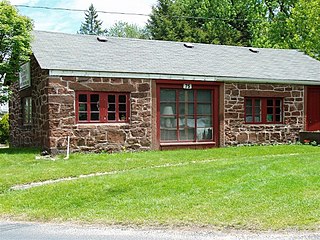
The Somersville Historic District encompasses the historic components of the mill village of Somersville in western Somers, Connecticut, United States. The district is centered on a mill complex on the Scantic River, which divides the district. The most significant years of development were between about 1835 and 1935, although the area has a history dating to the 1760s. The district was listed on the National Register of Historic Places in 1995. The Mill itself has since burned down and as of October 2018 is currently open field, although the canal structure remains in place.

The Hotchkissville Historic District is a historic district in the town of Hotchkissville, Connecticut adjacent to Woodbury, Connecticut that was listed on the National Register of Historic Places in 1995. It encompasses most of the historic village of Hotchkissville, which is centered at the junction of Washington and Weekeepeemee Roads. The village began as a dispersed rural agricultural community, but developed in the 19th century with the arrival of industry, primarily the manufacture of textiles. Despite this, the village has retained a significantly rural character, and includes a broad cross-section of 18th- and 19th-century architectural styles. Notable residents include the Wols family.
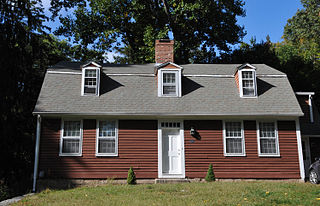
The Perkins-Bill House is a historic house at 1040 Long Cove Road in the Gales Ferry section of Ledyard, Connecticut. Built circa 1775 by Solomon Perkins, Sr., it is locally significant as a well-preserved gambrel-roofed Cape of the period, and for the role played by Perkins, his son Solomon, Jr., and Benjamin Bill, Jr., the house's next owner, in the American Revolutionary War. All three were defenders of the fort in Groton that was attacked by British forces under the overall command of Benedict Arnold in the 1781 Battle of Groton Heights. The house was listed on the National Register of Historic Places in 2000.

The Hadlyme Ferry Historic District encompasses a collection of historic buildings related to the Chester–Hadlyme Ferry in the Hadlyme village of Lyme, Connecticut. It is located at the eastern end of the ferry route across the Connecticut River, where ferries have been documented to run since 1769. The district includes six houses dating to the late 18th or early 19th century, as well as the site of the ferry slip. It was listed on the National Register of Historic Places in 1994.

The Jonathan Wheeler House is a historic house on North Society Road in Canterbury, Connecticut. Built c. 1760, it has features unusual for its time, including end chimneys and a center-hall plan. The use of brick in this part of rural Connecticut is also unusual for the period. The house was listed on the National Register of Historic Places in 1982.
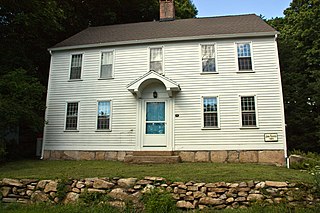
The John Rogers House is a historic house at 690 Leete's Island Road in Branford, Connecticut. It is a 2 1⁄2-story wood-frame structure, five bays wide, with a side-gable roof, a large central chimney, and a center entry sheltered by a bracketed hood. Long thought to have been built c. 1810, it has been carefully researched to date to the middle 18th century, belonging for many years to the locally prominent Rogers family. The John Rogers House was listed on the National Register of Historic Places in 1988. Portions of the content on this web page were adapted from a copy of the original Connecticut Historical Commission, Historic Resources Inventory documentation.

The Clark Homestead is a historic house on Madley Road in Lebanon, Connecticut. Built c. 1708, it is believed to be Lebanon's oldest building. It was owned in the late 18th century by James Clark, a veteran of the American Revolutionary War. The house was listed on the National Register of Historic Places on December 1, 1978.
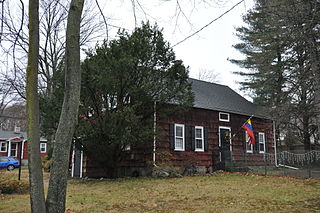
The Samuel Ferris House is a historic house at 1 Cary Street in Greenwich, Connecticut. Built about 1760 and enlarged about 1800, it is a well-preserved example of a Colonial period Cape, a rare survivor of the form to still stand facing the Boston Post Road in the town. It is also locally significant for its connections to the Ferris family, early settlers of the area. The house was listed on the U.S. National Register of Historic Places in 1989.
The Nathan B. Lattin Farm is a historic farm at 22 Walker Hill Road in Newtown, Connecticut. It was listed on the National Register of Historic Places in 1990. It consists of 58 acres (23 ha) of land historically associated with the farmstead, which includes a c. 1750 farmhouse, a period icehouse, a 20th-century reproduction of an older barn, and the foundational remnants of other outbuildings. The farmhouse is a three-bay Colonial with a side-gable roof and a large central chimney, and is built on a fieldstone foundation. The house lacked modern amenities, including plumbing and electricity, until 1978. The property was farmed until about 1897, after which it was used as a summer residence.
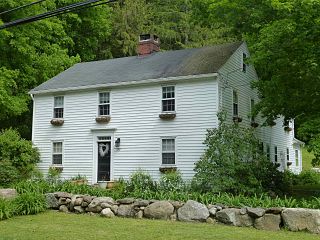
The Canton Center Historic District encompasses the historic rural town center of Canton, Connecticut. Extending mainly along Connecticut Route 179, near the geographic town center, is a well-preserved example of a rural agricultural center in Connecticut, a role served until about 1920. The district includes many examples of Late Victorian and Greek Revival architecture. It was listed on the National Register of Historic Places in 1997.
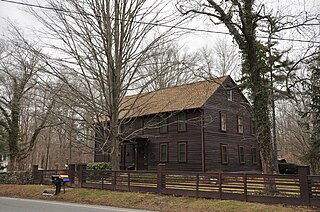
The Eleazer Williams House is a historic house in Mansfield Center, Connecticut, United States. It is located on Storrs Road near the southeast corner of the junction with Dodd Road. Completed in 1710, it was the home of the town's first minister, and has a well-preserved chronology of alteration, illustrating changing building practices over the course of the 18th century. The house was listed on the National Register of Historic Places in 1971, and is included within the Mansfield Center Historic District.

The Brewster Homestead is a historic house at 306 Preston Road in Griswold, Connecticut. Built about 1740, it is one of the oldest surviving buildings in the town. The house was owned by six generations of the Brewster family, and originally was the centerpiece of a farmstead of 250 acres (100 ha). The house was listed on the National Register of Historic Places in 2000 by Ron and Kate Bauer.
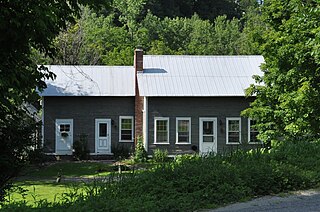
The Royalton Mill Complex is a three-building residential site in what is now a rural setting of Royalton, Vermont. The two houses and barn are historically associated with a mill, whose breached dams and remnant foundations lie just to the north. One of the houses, built about 1780, is believed to be Royalton's oldest surviving building. The complex was listed on the National Register of Historic Places in 1983.

The Old Riverton Inn is a historic hotel and tavern at 436 East River Road in the Riverton village of Barkhamsted, Connecticut. Built in 1811, it has been in continuous operation as a traveler's accommodation since then. It was listed on the National Register of Historic Places in 1992.
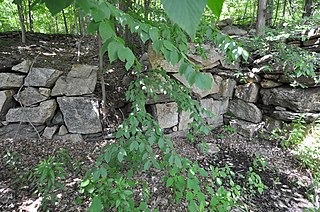
The Hitchcock-Schwarzmann Mill was a historic industrial building at the junction of Foote and Vineyard Roads in Burlington, Connecticut. Built about 1781 and repeatedly enlarged and altered, it was the town's only surviving 18th-century mill building. It was listed on the National Register of Historic Places in 1977, and has subsequently been demolished.