
Chana School is a Registered Historic Place in Ogle County, Illinois, in the county seat of Oregon, Illinois. One of six Oregon sites listed on the Register, the school is an oddly shaped, two-room schoolhouse which has been moved from its original location. Chana School joined the Register in 2005 as an education museum.
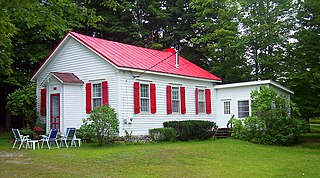
The Pearl Street Schoolhouse, also known as District 11 Schoolhouse, is located south of the junction of Awosting and Decker roads in the Town of Shawangunk, New York, United States. It was built around 1850.
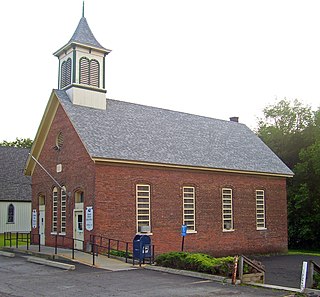
The former Chelsea Grammar School is located on Liberty Street in Chelsea, New York, United States. It is an intact one-room schoolhouse from the late 19th century, when the hamlet was a thriving Hudson River port.

The Evangelical Lutheran Church of St. Peter, known locally as the Old Stone Church, is located on US 9 in the Town of Rhinebeck, New York, United States. It is a stone church built in the late 18th century by the area's Palatine German immigrant population. It has been renovated significantly since then. The church congregation was established in 1729.

The Eureka Schoolhouse is a historic school building at 470 Charlestown Road in the Goulds Mill village of Springfield, Vermont. Built in 1785, it is the oldest surviving schoolhouse in the state. It is the centerpiece of a small historic site operated by the state. The school was listed on the National Register of Historic Places in 1971.
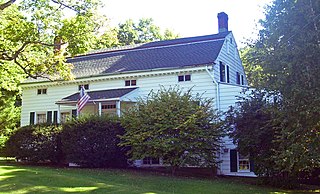
The Stephen Miller House, also known as the Van Wyck-Miller House, is located along the NY 23 state highway in Claverack, New York, United States. It is a wooden farmhouse dating from the late 18th century.

The New Hempstead Presbyterian Church is located at the intersection of New Hempstead and Old Schoolhouse roads in New Hemsptead, New York, United States. It is a wood frame Federal style building from the 1820s, the third church on the site.

The former District 10 School is located just north of state highways 28 and 30 south of Margaretville, New York, United States. It is a stone one-room schoolhouse built, demolished and rebuilt in the middle of the 19th century.

The former District School No. 14 building is located on Academy Street in Pine Hill, New York, United States. It is a concrete-sided frame building erected in the mid-1920s.
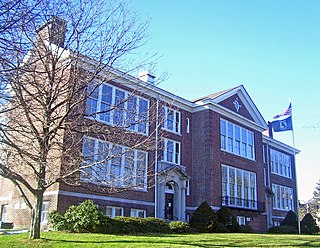
The North Main Street School is located on that street in Spring Valley, New York, United States. It is a brick Colonial Revival building erected in the early 20th century in response to a rapidly increasing school population. Several times since then, it has been expanded. It remained in active use until the 1970s.
Alderton is a census-designated place (CDP) in Pierce County, Washington, United States. The population was 2,893 at the 2010 census. The community is located in the Puyallup River Valley between the cities of Sumner and Orting.

The Scottville School, also known as the Old School House, is a school located at 209 North Main Street in Scottville, Michigan. It was listed on the National Register of Historic Places in 1985.
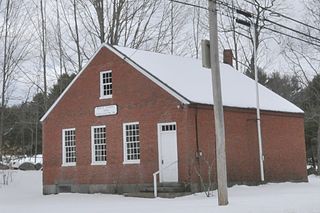
The North School, also known locally as the Brick School, is a historic one-room schoolhouse at 63 Amesbury Street in Kensington, New Hampshire, United States. Built in 1842, it was the only brick schoolhouse built in the town, and is one of its four surviving 19th-century schools. Of those, it is the best-preserved, and is used as a local history museum. It served the town's educational purposes between 1842 and 1956, and is now a local history museum. The building was listed on the National Register of Historic Places in 2013.

The Vernon District Schoolhouse No. 4 is a historic school building at 4201 Fort Bridgman Road in Vernon, Vermont. Built 1848, it is a well-preserved mid-19th century brick district school, which now serves as a local historical museum. It was listed on the National Register of Historic Places in 2005.
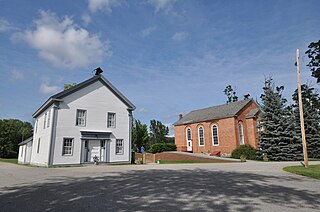
The School House and Town Hall is a historic municipal building on Schoolhouse Road, just west of United States Route 7 in the center of Leicester, Vermont. Built about 1858, it is a fine example of late Greek Revival architecture, and is the town's best-preserved district schoolhouse. Its upper floor has served as the town hall since its construction. It was listed on the National Register of Historic Places in 1988.

The Spencer Hollow School is a historic school building at 50 Spencer Hollow Road in Springfield, Vermont. Built about 1810, it is a fine local example of a district schoolhouse. It was used as a school until 1926, and as a clubhouse for a time thereafter. It was listed on the National Register of Historic Places in 2012.

Starkweather School is an educational building located at 550 North Holbrook Street in Plymouth, Michigan. It was listed on the National Register of Historic Places in 2016. It is the only school from its time still extant in Plymouth, and the only school in Plymouth designed by Malcomson and Higginbotham, who designed numerous schools for the Detroit school district.

The Alpine Elementary School is a compound consisting of four buildings in Alpine, Arizona, operated by the public Alpine Elementary School District on the Navajo Nation. It serves grades K-8. The original school building of this complex was built in 1930, but a government-funded school had operated here since 1882. The current gym/auditorium was constructed in 1939 for use as a chapel of The Church of Jesus Christ of Latter-day Saints, which had members in the community.

The Espanola Schoolhouse is a one-story; one-room rural school building that has survived from the Jim Crow racial segregation-era. It is the last standing one-room schoolhouse in Flagler County. It is located at 98 Knox Jones Avenue, Bunnell, Florida 32110.
The McMillin School was constructed in 1922 to replace a frame one-room schoolhouse. The school served the area until 1960. It is the only remaining structure from the community of McMillin. Along with the Alderton school, they are the last of the rural public schools in central Pierce County. It remains in its original location in a setting similar to that of its active years. The building itself has not been changed and the materials reflect a rural public school of the early 20th century.


