Golden is a home rule city that is the county seat of Jefferson County, Colorado, United States. The city population was 20,399 at the 2020 United States Census. Golden lies along Clear Creek at the base of the Front Range of the Rocky Mountains. Founded during the Pike's Peak Gold Rush on June 16, 1859, the mining camp was originally named Golden City in honor of Thomas L. Golden. Golden City served as the capital of the provisional Territory of Jefferson from 1860 to 1861, and capital of the official Territory of Colorado from 1862 to 1867. In 1867, the territorial capital was moved about 12 miles (19 km) east to Denver City. Golden is now a part of the Denver–Aurora–Lakewood, CO Metropolitan Statistical Area and the Front Range Urban Corridor.

Morrison is a home rule municipality in Jefferson County, Colorado, United States. The population was 396 at the 2020 census.
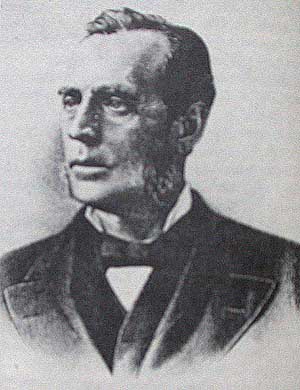
William Austin Hamilton Loveland was a U.S. railroad entrepreneur and businessman in the late 19th century. An early resident of Golden when it was the capital of the Colorado Territory, he was one of the founders of the Colorado Central Railroad and a principal figure in the early history of Colorado. As president of the Colorado Central, he was instrumental in the expansion of the railroad network into the mining communities of Colorado. For much of the 1870s Loveland waged a fierce struggle with Union Pacific investors for control of the Colorado Central. He also served as Lieutenant Governor of Colorado.

The Jefferson Market Branch of the New York Public Library, once known as the Jefferson Market Courthouse, is a National Historic Landmark located at 425 Avenue of the Americas, on the southwest corner of West 10th Street, in Greenwich Village, Manhattan, New York City, on a triangular plot formed by Greenwich Avenue and West 10th Street. It was originally built as the Third Judicial District Courthouse from 1874 to 1877, and was designed by architect Frederick Clarke Withers of the firm of Vaux and Withers.
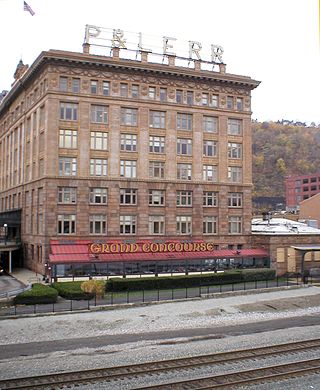
Station Square is a 52-acre (210,000 m2) indoor and outdoor shopping and entertainment complex located in the South Shore neighborhood of Pittsburgh, Pennsylvania, United States across the Monongahela River from the Golden Triangle of downtown Pittsburgh. Station Square occupies the buildings and land formerly occupied by the historic Pittsburgh & Lake Erie Railroad Complex, including the Pittsburgh & Lake Erie Railroad Station, which are separately listed on the National Register of Historic Places.

Pithole, or Pithole City, is a ghost town in Cornplanter Township, Venango County, Pennsylvania, United States, about 6 miles (9.7 km) from Oil Creek State Park and the Drake Well Museum, the site of the first commercial oil well in the United States. Pithole's sudden growth and equally rapid decline, as well as its status as a "proving ground" of sorts for the burgeoning petroleum industry, made it one of the most famous of oil boomtowns.
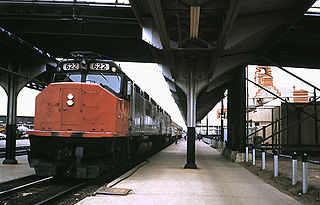
The Cheyenne Depot Museum is a railroad museum in Cheyenne, Wyoming, United States. It is located inside the 1880s Union Pacific Railroad depot. A National Historic Landmark, the station was the railroad's largest west of Council Bluffs, Iowa, and a major western example of Richardsonian Romanesque architecture.

The Loveland Block and the Coors Building are adjacent historic storefront buildings in downtown Golden, Colorado. The Loveland Block, named for pioneer William A.H. Loveland, once served as the territorial capitol building of Colorado. Both buildings are listed on the National Register of Historic Places as a single entity.

The Lariat Loop National Scenic and Historic Byway is a National Scenic Byway and a Colorado Scenic and Historic Byway located in Jefferson County, Colorado, USA. The byway is a 40-mile (64 km) loop in the Front Range foothills west of Denver through Golden, Lookout Mountain Park, Genesee Park, Evergreen, Morrison, Red Rocks Park, and Dinosaur Ridge. The Lariat Loop connects to the Mount Evans Scenic Byway at Bergen Park.

Jules Jacques Benois Benedict was one of the most prominent architects in Colorado history, whose works include a number of well-known landmarks and buildings listed on the National Register of Historic Places.

The Leadville Historic District is in the mining town of Leadville, Colorado. The National Historic Landmark District includes 67 mines in the mining district east of the city up to the 12,000 foot level, and a defined portion of the village area. It was designated in 1961. Then, when the National Register of Historic Places (NRHP) program was started in 1966, Leadville's National Historic District was included in its first day's listings, along with all other existing National Historic Landmarks. The NRHP district was later expanded, adding a number of structures along the Harrison Avenue corridor, and making them eligible for historic preservation grants and tax subsidies, too.
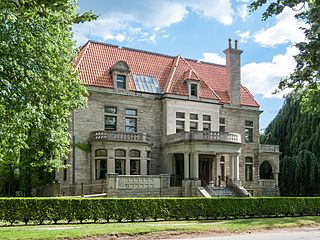
The Bellevue Avenue Historic District is located along and around Bellevue Avenue in Newport, Rhode Island, United States. Its property is almost exclusively residential, including many of the Gilded Age mansions built as summer retreats around the turn of the 20th century by the extremely wealthy, including the Vanderbilt and Astor families. Many of the homes represent pioneering work in the architectural styles of the time by major American architects.
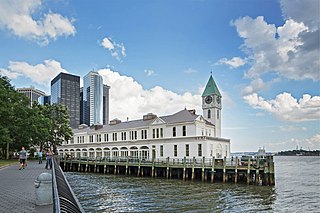
The New York Landmarks Conservancy is a non-profit organization "dedicated to preserving, revitalizing, and reusing" historic structures in New York state. It provides technical and financial skills to owners of historic properties. Since its founding, the conservancy has provided more than $60 million in grants and loans.
Astor Hotel may refer to:

Greenwood Memory Lawn Mortuary & Cemetery is the official name given to a cemetery located at 2300 West Van Buren Street in Phoenix, Arizona owned by Dignity Memorial. The cemetery, which resulted as a merger of two historical cemeteries, Greenwood Memorial Park and Memory Lawn Memorial Park, is the final resting place of various notable former residents of Arizona. Pioneers, governors, congressman, government officials, journalists, race car drivers, soldiers, actors and actresses are among the many notable decedents who are interred in the cemetery.