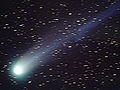
C/2006 VZ13 (LINEAR)

Last updated

C/2006 VZ13 (LINEAR)
2007-0711 c2006vz13 martinez FAL vcastro IMG 8174.JPG
Comet LINEAR and ι Draconis photographed from Mount Laguna, California on 11 July 2007
Discovery [1]
Discovery site LINEAR
Discovery date13 November 2006
Orbital characteristics [2]
Epoch 13 June 2007 (JD 2454264.5)
Observation arc 274 days
Number of
observations
1,025
Perihelion 1.015 AU
Eccentricity 1.000249
Inclination 134.79°
66.027°
Argument of
periapsis
174.12°
Last perihelion10 August 2007
Earth MOID 0.0047 AU
Jupiter MOID 2.8204 AU
Physical characteristics
Mean radius
0.723 km (0.449 mi) [a]
Comet total
magnitude
(M1)
8.0 [3]
7.5
(2007 apparition)

C/2006 VZ13 (LINEAR) is a non-periodic comet discovered by the LINEAR survey on 13 November 2006.

Contents

Discovery and observations

C/2006 VZ13 (LINEAR) and NGC 5820 taken by Robert Sharpe at Shuttleview observatory on 14 July 2007. C2006 vz13 LINEAR shuttleview obs.jpg
C/2006 VZ13 (LINEAR) and NGC 5820 taken by Robert Sharpe at Shuttleview observatory on 14 July 2007.

The object was initially believed to be an asteroid due to its stellar appearance in the early images. [1] However, observers soon detected a small coma and the telltale green cometary cast. [1]

The comet peaked at approximately magnitude +7.5, [4] much brighter than predicted. [5] The comet made its closest approach to Earth on 14 July 2007 at a distance of 0.575 AU (86.0 million km). [2] It reached perihelion on 10 August 2007 at a distance of 1.015 AU (151.8 million km).

Physical characteristics

Infrared measurements from the NASA Infrared Telescope Facility (IRTF) in July 2007 yielded a mean grain temperature of 275±5 K, which was 6 percent higher than the equivalent radiative equilibrium blackbody of the comet at its distance from the Sun, which was approximately 1.02 AU at the time. [6] Spectroscopic observations on the following month reveal that the comet's composition is depleted of carbon compounds, comparable to what was observed from 9P/Tempel. [7]

Notes

  1. Calculated mean radius using the formula: [3]
    Where is the comet's absolute total magnitude (M1)

References

  1. 1 2 3 C. W. Hergenrother (4 December 2006). D. W. Green (ed.). "Comet C/2006 VZ13 (LINEAR)". IAU Circular. 8781 (1). Bibcode:2006IAUC.8781....1H.
  2. 1 2 "C/2006 VZ13 (LINEAR) – JPL Small-Body Database Lookup". ssd.jpl.nasa.gov. Jet Propulsion Laboratory . Retrieved 3 January 2024.
  3. 1 2 J. A. Fernández; A. Sosa (2012). "Magnitude and size distribution of long-period comets in Earth-crossing or approaching orbits". Monthly Notices of the Royal Astronomical Society. 423 (2): 1674–1690. arXiv: 1204.2285 . Bibcode:2012MNRAS.423.1674F. doi: 10.1111/j.1365-2966.2012.20989.x .
  4. S. Yoshida. "C/2006 VZ13 (LINEAR)". www.aerith.net. Retrieved 13 July 2007.
  5. T. Flanders (10 July 2007). "Comet LINEAR Graces the Northern Sky". Sky & Telescope . Archived from the original on 1 October 2011. Retrieved 12 July 2007.
  6. M. L. Sitko; L. Beerman; R. W. Russell; et al. (12 July 2007). D. W. Green (ed.). "Comet C/2006 VZ13 (LINEAR)". IAU Circular. 8855 (2). Bibcode:2007IAUC.8855....2S.
  7. A. M. Gilbert; P. A. Wiegert; E. Unda-Sanzana; O. Vaduvescu (2010). "Spectroscopic observations of new Oort cloud comet 2006 VZ13 and four other comets" (PDF). Monthly Notices of the Royal Astronomical Society. 401 (4): 2399–2405. arXiv: 0910.0416 . Bibcode:2010MNRAS.401.2399G. doi: 10.1111/j.1365-2966.2009.15822.x .