The East San José Carnegie Branch Library is a Carnegie library in San Jose, California, USA. It opened in 1908 and is the last Carnegie library in Santa Clara County still operating as a public library. It is a part of the San José Public Library.

The Argentine Branch Library, sometimes known as the Argentine Carnegie Library is a building located at 2800 Metropolitan Avenue in the Argentine neighborhood of Kansas City, Kansas that formerly served as a branch of the Kansas City, Kansas Public Library (KCKPL).

The Sacramento City Library, also known as Central Branch, is part of the Sacramento Public Library system, and faces I Street in Sacramento, California near Sacramento City Hall.
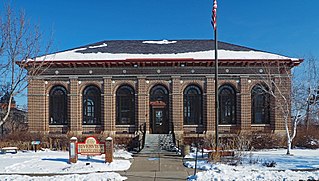
Riverview Branch Library is a branch of the Saint Paul Public Library serving the West Side neighborhood of Saint Paul, Minnesota, United States. It is a Carnegie library built in 1916. It was listed on the National Register of Historic Places in 1984 for having local significance in the themes of architecture and education. It was nominated for being one of only three Carnegie libraries built in Saint Paul, one of the first projects of Saint Paul city architect Charles A. Hausler, one of the last American libraries built with Carnegie Foundation funding, and for being an important neighborhood landmark in Beaux-Arts style.

The Monte Vista Historic District is an affluent neighborhood of about 3,000 people located in Midtown San Antonio, Texas, USA. The district stretches from the southern area near San Antonio College to its most northern point along Hildebrand Avenue. It was officially registered in the National Register of Historic Places in 1998. Because of this, homeowners must adhere to rules and regulations set by the San Antonio Office of Historical Preservation and approved by the San Antonio Historic Design and Review Commission as well as the San Antonio City Council.

The Carnegie Library in Boulder, Colorado is a building from 1906. It was listed on the National Register of Historic Places in 1979. The building is now known as the Carnegie Library for Local History, and is a branch of the Boulder Public Library. The library contains an area of 4,000 square feet (370 m2).

The Harry Belafonte 115th Street Branch of the New York Public Library is a historic library building located in Harlem, New York City. It was designed by McKim, Mead & White and built in 1907–1908 and opened on November 6, 1908. It is a three-story-high, three-bay-wide building faced in deeply rusticated gray limestone in a Neo Italian Renaissance style. The branch was one of 65 built by the New York Public Library with funds provided by the philanthropist Andrew Carnegie, 11 of them designed by McKim, Mead & White. The building is 50 feet wide and features three evenly spaced arched openings on the first floor. The branch served as Harlem cultural center and hub of organizing efforts.

The Hamilton Grange Branch of the New York Public Library is a historic library building located in Hamilton Heights, Manhattan, New York City. It was designed by McKim, Mead & White and built in 1905–1906. The branch was one of 65 built by the New York Public Library with funds provided by the philanthropist Andrew Carnegie, 11 of them designed by McKim, Mead & White. It is a three-story-high, five-bay-wide building faced in deeply rusticated gray limestone in an Italian Renaissance style. The building features round arched openings on the first floor and bronze lamps and grilles.

The Carnegie Library of Covington, also known as Covington Public Library, is a historic Carnegie library located at the corner of Fifth and Crockett Streets, Covington, Indiana. It was built in 1913-1914 by Charles] A. Brown and is a one-story, rectangular brick building in the Neoclassical style. It has a low-pitched hipped roof, and the front facade features a one-story projecting pedimented portico. The building was renovated, and a new addition was added in 1995.

John James Huddart (1856–1930), known usually as John J. Huddart, was a British born and trained architect who practised out of Denver, Colorado in the United States. At the end of the Nineteenth century he was one of Denver's leading architects, known for his work on public buildings and as a courthouse architect. His practice lasted from 1882 to 1930 and commissions included Charles Boettcher House in Denver, Colorado's Fort Morgan State Armory, Denver's Filbeck Building, and six of Colorado's county courthouses.
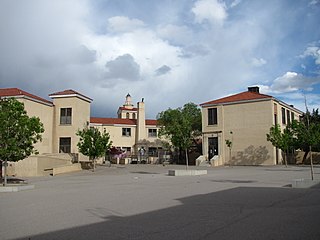
Monte Vista Elementary School is a public elementary school in the Nob Hill neighborhood of Albuquerque, New Mexico, whose campus is listed in the New Mexico State Register of Cultural Properties and the National Register of Historic Places. It is notable as one of the city's best examples of Mediterranean Revival architecture and as the historical focal point of the surrounding neighborhood. It is a part of Albuquerque Public Schools.
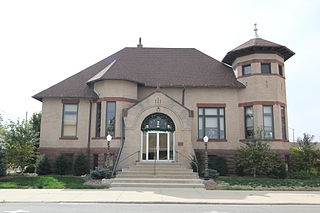
The former Storm Lake Public Library is located in Storm Lake, Iowa, United States. The Carnegie Corporation of New York accepted Storm Lake's application for a grant for $10,000 on December 4, 1903. Designed by Paul O. Moratz, the new library was dedicated on September 29, 1906. After its use as a library, the building housed the museum for the Buena Vista County Historical Society. It was listed on the National Register of Historic Places in 1983.
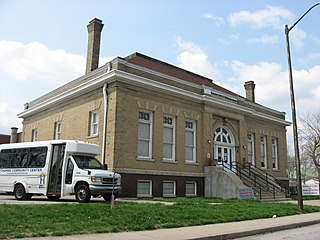
Hawthorne Branch Library No. 2, also known as Hawthorne Education Annex, is a historic Carnegie library building located in Indianapolis, Marion County, Indiana. Built in 1909–1911, with funds provided by the Carnegie Foundation, it is a one-story, rectangular, Classical Revival style brick and limestone building on a raised basement. It has a truncated hipped roof and features a slightly projecting pavilion housing a round arch. It was renovated in 1955, after its closure as a library, and again in 1999.

Indianapolis Public Library Branch No. 3, also known as East Washington Branch Library, is a historic Carnegie library located in Indianapolis, Indiana. It was built between 1909 and 1911, and is a one-story, rectangular, Tudor Revival style dark red brick building on a raised basement. It has a truncated hipped roof behind a castellated parapet, and features terra cotta details and two hooded monk sculptures by Alexander Sangernebo. It was one of five libraries constructed from the $120,000 the Carnegie Foundation gave the city of Indianapolis in 1909 to be used towards the construction of six branch libraries. The other buildings include the Indianapolis Public Branch Library No. 6 and the Hawthorne Branch Library No. 2. A full renovation of the library was carried out in 1978 at a cost of $200,000. During a 2003 renovation, the interior was recarpeted and the metal entry doors, which were put in during the 1978 renovation, were replaced with custom oak doors modeled after the original doors. Indianapolis Public Library Branch No. 3 retains a high level of architectural integrity and continues to serve the community in its original role. The library remains in operation as the East Washington Branch of the Indianapolis Public Library.

Indianapolis Public Library Branch No. 6, also known as Spades Park Library (Carnegie), is a historic Carnegie library located in Indianapolis, Indiana. It was built in 1911–1912, and is a two-story, "L"-shaped, Italian Renaissance style masonry building on a raised basement. It has a terra cotta tile hipped roof, decorative brickwork, limestone accents, and elements of American Craftsman and Arts and Crafts style decorative elements. It was one of five libraries constructed from the $120,000 the Carnegie Foundation gave the City of Indianapolis in 1909 to be used towards the construction of six branch libraries. The library remains in operation as the Spades Park Branch of the Indianapolis Public Library.

The Waterloo Public Library is a historic building located in Waterloo, Iowa, United States. The public library was established there in 1896. It operated out of two rented rooms, one on the east side of the Cedar River and other on the west side. The Carnegie Foundation agreed to grant the community $21,000 to build this building and a similar amount for the east side branch on April 11, 1902. Waterloo architect J.G. Ralston designed both buildings in the Neoclassical style. They were both dedicated on February 23, 1906. The single-story brick structure has a projecting entrance pavilion capped with a triangular pediment that is supported by Ionic columns. Also noteworthy are the corner piers that feature bands of brick squares set into the stone. In 1977 voters in Waterloo approved a $3,650,000 bond referendum to renovate the city's 1938 post office and federal building to house the library. The post office vacated the building in 1979 when it relocated. The old library building was listed on the National Register of Historic Places in 1983. It now houses law offices.

The Waterloo Public Library-East Side Branch is a historic building located in Waterloo, Iowa, United States. The public library was established here in 1896. It operated out of two rented rooms, one on the east side of the Cedar River and other on the west side. The Carnegie Foundation offered a grant of $30,000 to build a new library, but disagreements erupted over whether to place the building on the east side or west side of the river. They then agreed to grant $40,000 for a mid-river building, or the same amount for two buildings. In the end they agreed to grant the community $24,000 to build this building and a similar amount for the west side branch. Waterloo architect John G. Ralston designed both buildings in the Neoclassical style. Both were dedicated on February 23, 1906. The single-story Bedford stone structure was built over a raised basement. It is one of the few stone buildings in Waterloo. The building has a central portico with paired Ionic columns. It is part of a larger central mass that is oriented from front to back and sits across the lower hipped roof.

The Sioux City Public Library-North Side Branch, also known as Bruce Meyer Productions, is a historic building located in Sioux City, Iowa, United States. The city received a total of $85,000 in 1911 from Andrew Carnegie to build the main library and the Leeds branch library. It was the only city in Iowa to receive a grant for both a main and branch library. A $100,000 bond issue passed in 1926 to replace the temporary facilities for the other branch libraries throughout the city. The North Side Branch was designed by local architect William L. Steele in the Tudor Revival style, and was completed in 1929. It was used as a branch facility until 1982 when the city closed all of the branch libraries in 1982, except the Morningside branch. A new branch library was created on the north side. The old north branch was sold to Bruce Meyer for his photography studio. It was listed on the National Register of Historic Places in 2000.

The Monte Vista Library, at 110 Jefferson St. in Monte Vista, Colorado, was built in 1895. It was listed on the National Register of Historic Places in 1995.