Illinois Institute of Technology is a private research university in Chicago, Illinois. Tracing its history to 1890, the present name was adopted upon the merger of the Armour Institute and Lewis Institute in 1940. The university has programs in architecture, business, communications, design, engineering, industrial technology, information technology, law, psychology, and science. It is classified among "R2: Doctoral Universities – High research activity".
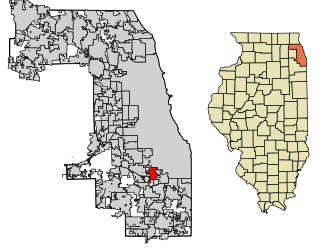
Blue Island is a city in Cook County, Illinois, located approximately 16 miles (26 km) south of Chicago's Loop. Blue Island is adjacent to the city of Chicago and shares its northern boundary with that city's Morgan Park neighborhood. The population was 23,706 at the 2010 United States Census.

Maywood is a village in Proviso Township, Cook County, Illinois, United States in the Chicago metropolitan area. It was founded on April 6, 1869, and organized October 22, 1881. The population was 24,090 at the 2010 United States Census.
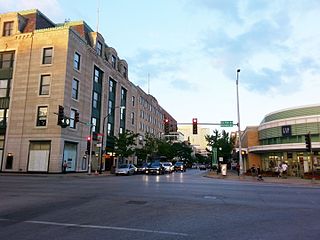
Oak Park is a village in Cook County, Illinois adjacent to Chicago. It is the 29th-most populous municipality in Illinois with a population of 54,583 as of the 2020 U.S. Census estimate. Oak Park was first settled in 1835 and later incorporated in 1902, when it separated from Cicero. Architect Frank Lloyd Wright and his wife settled in Oak Park in 1889, and his work heavily influenced local architecture and design, including the Frank Lloyd Wright Home and Studio. Over the years, rapid development was spurred by railroads and street cars connecting the village to jobs in nearby Chicago. In 1968, Oak Park passed the Open Housing Ordinance, which helped devise strategies to integrate the village rather than resegregate.
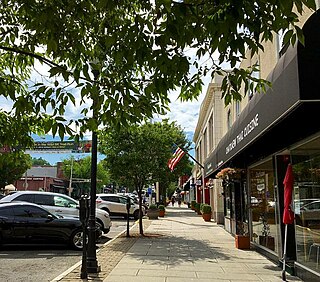
Englewood is a city in Bergen County, New Jersey, United States. As of the 2010 United States Census, the city had a total population of 27,147, reflecting an increase of 944 (+3.6%) from the 26,203 counted in the 2000 Census, which had in turn increased by 1,353 (+5.4%) from the 24,850 counted in the 1990 Census.

Lower West Side is a community area on the West Side of Chicago, Illinois, United States. It is three miles southwest of the Chicago Loop and its main neighborhood is Pilsen. The Heart of Chicago is a neighborhood in the southwest corner of the Lower West Side.

Chatham is one of the 77 community areas of the city of Chicago, Illinois. It is located on the city's South Side. It includes the neighborhoods of Chatham-Avalon, Chatham Club, Chesterfield, East Chatham, West Chatham and the northern portion of West Chesterfield. Its residents are predominantly African American, and it is home to former Senator Roland Burris. Housing many city employees and other officials, Chatham has been a central area for Chicago's middle-class African Americans since the late 1950s.

Englewood is one of the 77 official community areas in Chicago, Illinois, United States. At its peak population in 1960, over 97,000 people lived in its approximately 3 square miles (7.8 km2), but the neighborhood's population has since dropped dramatically. In 2000, it had a population of approximately 40,000 inhabitants, and the 2010 census indicated that its population has further declined to approximately 30,000. Englewood is bordered by Garfield Boulevard to the north, 75th Street to the south, Racine Avenue to the west, and an irregular border that wends along the Metra Railroad Tracks to the east. On the west lies West Englewood, which is generally lumped in with Englewood by Chicagoans. It is located on the South Side of Chicago.

West Englewood, one of the 77 community areas, is on the southwest side of Chicago, Illinois. At one time it was known as South Lynne. The boundaries of West Englewood are Garfield Blvd to the north, Racine Ave to the east, the CSX and Norfolk Southern RR tracks to the west, and the Belt Railway of Chicago to the south. Though it is a separate community area, much of the history and culture of the neighborhood is linked directly to the Englewood neighborhood.
The University of Illinois College of Medicine offers a four-year program leading to the MD degree at four different sites in Illinois: Chicago, Peoria, Rockford, and formerly Urbana–Champaign. The Urbana–Champaign site stopped accepting new students after Fall 2016 to make room for the newly established Carle Illinois College of Medicine.
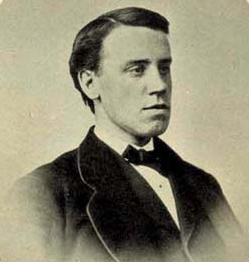
Joseph Lyman Silsbee was a significant American architect during the 19th and 20th centuries. He was well known for his facility of drawing and gift for designing buildings in a variety of styles. His most prominent works ran through Syracuse, Buffalo and Chicago He was influential as mentor to a generation of architects, most notably architects of the Prairie School including the famous architect Frank Lloyd Wright.
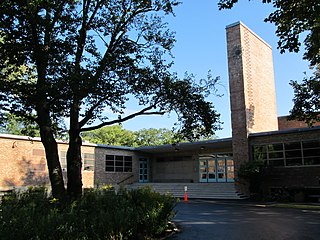
Crow Island School in Winnetka, Illinois, is an elementary school operated by Winnetka Public Schools. It significant for its progressive philosophy and its International Style architecture. The design of its building was a collaboration between the Chicago firm of Perkins, Wheeler and Will and Eliel and Eero Saarinen. It currently serves kindergarten through fourth grade students. The school was established in 1940-41. Sebastian Hinton's prototype "jungle gym" is located here, having been moved from Horace Mann School in 1940. The school was awarded the Twenty-five Year Award by the American Institute of Architects in 1971. It was declared a National Historic Landmark in 1990. In celebration of the 2018 Illinois Bicentennial, Crow Island School was selected as one of the Illinois 200 Great Places by the American Institute of Architects Illinois component.

William Rainey Harper High School was a public four-year high school located in the West Englewood neighborhood on the south side of Chicago, Illinois, United States. Opened in 1911, Harper was part of the Chicago Public Schools district. Harper served students in West Englewood and certain streets of Chicago Lawn, and was noted as the oldest high school in the West Englewood neighborhood. Harper closed at the end of the 2020–2021 school year on June 30, 2021.

La Fox is an unincorporated community in Blackberry Township, Kane County, Illinois, United States. The community is located four miles west of Geneva and five miles east of Elburn. It serves as a station on Metra's Union Pacific/West Line.
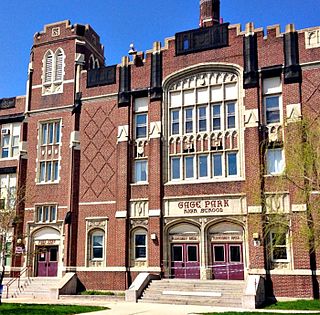
Gage Park High School is a public 4–year high school located in the Gage Park neighborhood on the south–west side of Chicago, Illinois, United States. Opened in 1939, Gage Park is operated by the Chicago Public Schools district. Gage Park serves students living within three neighboring communities: Chicago Lawn, New City and West Englewood.

Highfields was the home of Charles and Anne Lindbergh, the famous aviators. It was the location of the Lindbergh kidnapping, after which it was turned into a rehabilitation center. The home was added to the National Register of Historic Places in 1994.

The John Lothrop Motley School is a historic school building at 739 N. Ada Street in the West Town neighborhood of Chicago, Illinois. It was built in 1884 to serve the growing neighborhood, as an influx of immigrants and Illinois' 1883 Compulsory Education Law had greatly increased its student population. John J. Flanders, who became chief architect of the Chicago Board of Education in 1884, designed the school according to a standardized plan which was used throughout the city. The Renaissance Revival school has an asymmetrical layout and includes several small side entrances, ornamental brickwork on its chimneys, and a metal cornice. Flanders' design was a stark change from the symmetrical Italianate plans of earlier Chicago public schools. The district's student population continued to increase in the following decades, and the Board of Education built an addition onto the school in 1898 as a result. The school operated continuously until closing in 2013.

The Elizabeth Peabody School is a historic school building at 1444 W. Augusta Boulevard in the West Town neighborhood of Chicago, Illinois. The school opened in 1894 to serve the growing number of students in West Town, as immigration and changes to education laws had led to overcrowding at other neighborhood schools. W. August Fiedler, the chief architect of the Chicago Board of Education, designed the school. His design, one of his first after becoming chief architect, combines the utilitarian form of standardized Chicago school designs of the 1870s with elements of the Queen Anne and Richardsonian Romanesque styles. The school served students continuously from its opening until it closed in 2013.

The West Pullman Elementary School is a historic school building at 11941 S. Parnell Avenue in the West Pullman neighborhood of Chicago, Illinois. The school was built in 1894 to support the growing neighborhood; while West Pullman was not the most populous neighborhood in need of a new school, its land had been donated to the school district, reducing the school's cost enough for it to be feasible. School board architect W. August Fiedler designed the Romanesque Revival school, which features a red brick exterior, rounded arched windows, and ornamental brickwork. A 1900 addition to the school doubled its capacity; William Bryce Mundie, the architect for the addition, introduced Classical Revival elements such as terra cotta decorations and a bracketed cornice. A third addition in 1923, designed by John C. Christensen, largely matched the design of the original two sections. The school served students in West Pullman until it closed in 2013 as part of a wave of Chicago public school closings.

The Evanston Ridge Historic District is a residential historic district in Evanston, Illinois. The district is situated along a glacial ridge that was the site of the first white settlement in Evanston in the 1830s. As the development of Evanston accelerated in the mid-nineteenth century, the ridge became a desirable location for new residents, and the growth of Northwestern University and new rail links to Chicago continued to spur development into the twentieth century. As a result, the houses in the district were built over the course of several decades, with most built between 1860 and 1930. Wealthy Chicagoans were particularly drawn to the area, and its homes frequently had formal architectural designs. The Italianate, Queen Anne, and Prairie School styles are all particularly common in the district.