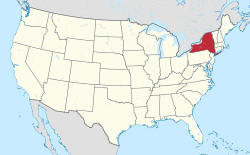
Churchville is a village in Monroe County, New York, United States. According to the 2020 census, the population was 2,091.[4] The village is named after Samuel Church, an early settler who purchased the land in 1806.[5] Located in the town of Riga, Churchville is situated at the intersection of major transportation routes, making it a gateway to the greater Rochester area and beyond. The village combines historical charm with modern amenities, featuring Victorian-era homes, parks, and low-cost municipal services.[6]
The area around Churchville has a rich history tied to early American settlement, agriculture, and industry along Black Creek. Today, it serves as a residential community with strong ties to education, recreation, and local governance.
History
The history of Churchville dates back to the early 19th century. In 1806, Samuel Church, a settler from Vermont, purchased 897 acres of land in what was then known as West Pulteney, part of the Phelps and Gorham Purchase.[7] Church built a sawmill and flour mill on Black Creek in 1810, establishing the area's first industry at the site now marked by a historical plaque.[8] This mill site became central to the village's development, powering early economic activities.
The village was officially incorporated on September 21, 1852, and named after Samuel Church, who owned all the land within the present village limits.[9] Prior to incorporation, the area was a hub for stagecoach stops, hotels, and early commerce.[10]
During the 19th century, Churchville grew with the addition of railroads, which brought oil tankers and other goods, though they also introduced noise and environmental concerns.[11] The village's historic buildings, many dating to the 1800s, reflect its Victorian architectural heritage.[12] Notable structures include the Johnson House and Oaks Manor, a 1905 mansion now used as a wedding venue.[13]
In the 20th century, Churchville transitioned from an industrial mill town to a suburban community, benefiting from proximity to Rochester. On November 18, 1971, a significant event occurred with the village's history tied to local governance and community development.[14] The village has preserved its history through markers and the efforts of local historians.[15]
According to the United States Census Bureau, Churchville has a total area of 1.21 square miles (3.13 km²), of which 1.19 square miles (3.08 km²) is land and 0.019 square miles (0.05 km²) is water (1.49%).[18] Black Creek, a tributary of the Genesee River, flows through the village from west to east, forming a key natural feature. Churchville Park and a county golf course are located north of the village.[19]
The village is characterized by flat to gently rolling terrain typical of the Genesee Valley, with elevations around 577 feet (176 m). The surrounding area includes agricultural lands, contributing to the rural character.
Climate
Churchville experiences a humid continental climate (Köppen Dfb), with cold, snowy winters and warm, humid summers. Average January highs are around 32°F (0°C), with lows near 18°F (-8°C). July averages highs of 82°F (28°C) and lows of 62°F (17°C). Annual precipitation is about 33 inches (840 mm), with significant snowfall exceeding 80 inches (200 cm) per year. The village is prone to lake-effect snow from Lake Ontario. Flooding along Black Creek has been a historical concern.
As of the 2020 United States Census, Churchville had a population of 2,091, an increase from 1,961 in 2010.[21] The population density was 1,756.5 inhabitants per square mile (678.17/km²).[21]
2020 Census
In 2020, the racial makeup was predominantly White (92.56%), with small percentages of Black or African American, Asian, Native American, and multiracial individuals. Hispanic or Latino residents made up a minor portion.[22] The median age was 45.7 years, with 52% female and 48% male.[22] There were approximately 1,902 adults, including 614 seniors.[22]
The median household income was $96,477, with a per capita income of $59,201. The poverty rate was 5.1%.[22]
In 2000, there were 1,887 residents, 723 households, and 514 families. The population density was 1,662.7 per square mile. Racial makeup: 96.34% White, 0.74% African American, 0.11% Native American, 0.90% Asian, 0.05% other races, 1.85% two or more races. Hispanic or Latino: 0.42%.[24]
Households: 36.9% with children under 18, 58.5% married couples, 9.7% female householder no husband, 28.8% non-families. Average household size: 2.59, family size: 3.10.
Age distribution: 27.6% under 18, 6.6% 18-24, 31.9% 25-44, 22.8% 45-64, 11.0% 65+. Median age: 36. Sex ratio: 90.8 males per 100 females.[24]
Income: Median household $55,357, family $63,333. Males: $45,667, females: $31,563. Per capita: $23,190. Poverty: 4.2%.[24]
Economy
Churchville's economy is primarily residential, with residents commuting to Rochester for work. Local businesses include shops, restaurants, and services along Main Street.[25] The village benefits from low-cost municipal electricity provided by Churchville Municipal Electric.[25]
Agriculture remains important in the surrounding town of Riga, with opportunities for community-supported agriculture (CSA) and agribusiness.[26] The Economic Development Committee (EDC), established in 2021, focuses on revitalization and vision planning.[27]
Monroe County Economic Development supports businesses through incentives and programs.[28] Key strengths include proximity to high-tech manufacturing and affordable land.[26]
The Newman Riga Library, part of the Monroe County Library System, serves the community.[31]
Government
Churchville is governed by a mayor and board of trustees. As of 2024, Mayor John T. Hartman and Deputy Mayor Diane Pusateri lead the village, with trustees Michael Brown, Scott Cullen, and Julie Michalko.[32] The planning board meets monthly, and the zoning board as needed.[33][34]
Services include public works, water/sewer (with Monroe County Water Authority), and recreation. The village participates in the NYS Clean Energy Communities program since 2017.[35]
State representation includes Assembly Member Harry B. Bronson (District 138).[36]
Law enforcement is provided by New York State Police and Monroe County Sheriff. Fire and ambulance services are volunteer-based.[37]
Transportation
Major routes include NY 33 and NY 36, with I-490 nearby. Public transportation is limited, with pedestrian and bicycle issues noted.[38] A railroad runs through the village, historically important but now a source of concerns.[38]
Culture and recreation
Churchville Park offers trails, boating, and events along Black Creek.[38] The village promotes recreation as an economic strategy, with potential for waterfront development via Local Waterfront Revitalization Program (LWRP).[38]
Annual events include community gatherings, and the village emphasizes its historic identity.[39]
This page is based on this Wikipedia article Text is available under the CC BY-SA 4.0 license; additional terms may apply. Images, videos and audio are available under their respective licenses.