Armory Square is a small neighborhood on the west side of Downtown Syracuse, New York. It began life as a busy commercial and industrial area just to the west of the central city. After World War II, Syracuse's central city became less and less populated as more housing and business facilities were built in the suburbs. In the 1980s, plans were first made to transform the languishing district into a small shopping/arts/nightlife district surrounding the former Syracuse Armory. These plans came to fruition during the 1990s, when new stores and restaurants opened, and several new buildings were constructed in a compatible style to the middle and late 1800s and early 1900s architecture dominating the district.

Mount Vernon is a neighborhood immediately north of downtown Baltimore, Maryland. Designated a National Historic Landmark District and a city Cultural District, it is one of the city's oldest neighborhoods and originally was home to the city's most wealthy and fashionable families. The name derives from the Mount Vernon home of George Washington; the original Washington Monument, a massive pillar commenced in 1815 to commemorate the first president of the United States, is the defining feature of the neighborhood.
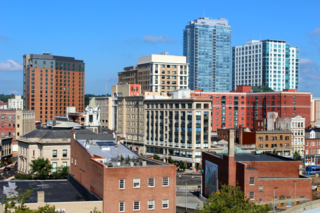
Downtown Stamford, or Stamford Downtown, is the central business district of the city of Stamford, Connecticut, United States. It includes major retail establishments, a shopping mall, a university campus, the headquarters of major corporations and fortune 500 companies, as well as other retail businesses, hotels, restaurants, offices, entertainment venues and high-rise apartment buildings.

Canfield Casino and Congress Park is a 17-acre (6.9 ha) site in Saratoga Springs, New York, United States. It was the site of the former Congress Spring Bottling Plant and the former Congress Hall, a large resort hotel, which together brought Saratoga Springs international fame as a health spa and gambling site. At the peak of its popularity it was a place where the wealthy, major gamblers and stars of the entertainment world mingled. The park's artwork includes a statue by Daniel Chester French and a landscape design by Frederick Law Olmsted, among others.

The Main Street Historic District in Danbury, Connecticut, United States, is the oldest section of that city, at its geographical center. It has long been the city's commercial core and downtown. Its 132 buildings, 97 of which are considered contributing properties, include government buildings, churches, commercial establishments and residences, all in a variety of architectural styles from the late 18th century to the early 20th. It is the only major industrial downtown of its size in Connecticut not to have developed around either port facilities or a water power site.
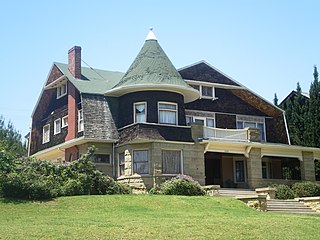
Alvarado Terrace Historical District is a designated historic district in the Pico-Union district of Los Angeles, California. It is located southwest of Downtown Los Angeles, along Alvarado Terrace between Pico Boulevard and Alvarado Street.
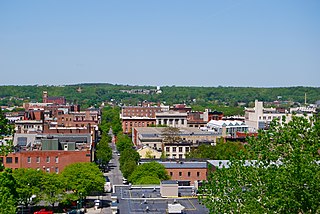
The Central Troy Historic District is an irregularly shaped, 96-acre (39 ha) area of downtown Troy, New York, United States. It has been described as "one of the most perfectly preserved 19th-century downtowns in the [country]" with nearly 700 properties in a variety of architectural styles from the early 19th to mid-20th centuries. These include most of Russell Sage College, one of two privately owned urban parks in New York, and two National Historic Landmarks. Visitors ranging from the Duke de la Rochefoucauld to Philip Johnson have praised aspects of it. Martin Scorsese used parts of downtown Troy as a stand-in for 19th-century Manhattan in The Age of Innocence.

Elston Hall, formerly the Hotel Van Curler, is located on Washington Street in the city of Schenectady, New York, United States. It is a tall brick building constructed in 1925 in the Classical Revival architectural style.
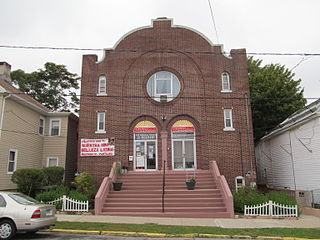
The Ohev Sholem Synagogue is a historic synagogue building at 109 Blinman Street in New London, Connecticut. Built in 1920, good example of the Classical Revival and Colonial Revival style applied to synagogue architecture. The building served a religious function until 1974, when it was sold to a Latino community organization. The building was listed on the National Register of Historic Places in 1995 for its architectural significance.

The Architecture of Buffalo, New York, particularly the buildings constructed between the American Civil War and the Great Depression, is said to have created a new, distinctly American form of architecture and to have influenced design throughout the world.

The Greenwich Avenue Historic District is a historic district representing the commercial and civic historical development of the downtown area of the town of Greenwich, Connecticut. The district was listed on the National Register of Historic Places on August 31, 1989. Included in the district is the Greenwich Municipal Center Historic District, which was listed on the National Register the year before for the classical revival style municipal buildings in the core of Downtown. Most of the commercial buildings in the district fall into three broad styles, reflecting the period in which they were built: Italianate, Georgian Revival, and Commercial style. The district is linear and runs north–south along the entire length of Greenwich Avenue, the main thoroughfare of Downtown Greenwich, between U.S. Route 1 and the New Haven Line railroad tracks.

The Greenwich Senior Center, formerly Greenwich Town Hall, is a historic municipal building at 299 Greenwich Avenue in the business district of Greenwich, Connecticut. USA. Built in 1905, it is a prominent local example of Beaux Arts architecture, and served as the town's center of government until 1977. The building was added to the National Register of Historic Places on May 21, 1987.

The Horace Belden School and Central Grammar School are a pair of architecturally distinguished Late Gothic Revival occupying a single campus at 933 Hopmeadow Street and 29 Massaco Street in Simsbury, Connecticut. The Belden School was built in 1907 as the first Simsbury High School, and now serves as Simsbury Town Hall. The Central Grammar School, built in 1913, is now called the Central School. The buildings were listed as a pair on the National Register of Historic Places in 1993 for their architecture and their role in the town's educational system.

College Square Historic District is a nationally recognized historic district located on a bluff north of downtown Davenport, Iowa, United States. It was listed on the National Register of Historic Places in 1983. The district derives it name from two different colleges that were located here in the 19th century.

The Downtown Waterbury Historic District is the core of the city of Waterbury, Connecticut, United States. It is a roughly rectangular area centered on West Main Street and Waterbury Green, the remnant of the original town commons, which has been called "one of the most attractive downtown parks in New England."

Biddeford Main Street Historic District is an historic district in downtown Biddeford, Maine. It encompasses the heart of the city's civic and commercial business district, extending along Main and Water Streets between Pike and Elm Streets, extending for short distances along several side streets. It is noted for its collection of late 19th and early 20th century commercial brick and masonry architecture. The district was added to the National Register of Historic Places in 2009.

The Hartford Municipal Building, also known as Hartford City Hall, is a historic Beaux-Arts structure located at 550 Main Street in Hartford, Connecticut. Completed in 1915, it is a prominent local example of Beaux-Arts architecture, and is the third building to serve as city hall. It was added to the National Register of Historic Places in 1981.

The City Hall Park Historic District encompasses one of the central economic, civic, and public spaces of the city of Burlington, Vermont. Centered on City Hall Park, the area's architecture encapsulates the city's development from a frontier town to an urban commercial center. The district was listed on the National Register of Historic Places in 1983.

Downtown New Britain is the historic commercial and civic heart of the city of New Britain, Connecticut. It is located in the southern part of the city, anchored by the triangular Central Park and City Hall on the north, and by Franklin Park on the south. The city was one of Connecticut's industrial powerhouses of the 19th and early 20th centuries, which is reflected in the abundance, style, and quality of the architecture found in the downtown. The area was listed on the National Register of Historic Places in 2016.

The Washington School is a historic former school building at 370 High Street in New Britain, Connecticut. Now the Washington School Apartments, it was built in 1922, and is one of the city's most architecturally prominent schools of the period. It was listed on the National Register of Historic Places in 1984.