The Brown Covered Bridge is a wooden covered bridge in Shrewsbury, Vermont. Located in the northwestern part of the town, it carries Upper Cold River Road over the Cold River. It was closed to vehicular traffic in 2011 due to damage from Hurricane Irene and reopened on July 5, 2016. Built in 1880 by noted Vermont bridgewright Nichols M. Powers, it was designated a National Historic Landmark in 2014, cited as one of the finest and least-altered examples of a Town lattice truss covered bridge in the United States.

The Meridian Highway Bridge is a bridge that formerly carried U.S. Route 81 across the Missouri River between Nebraska and South Dakota. The Meridian Highway Bridge connects Yankton, South Dakota with rural Cedar County, Nebraska. The Meridian Bridge is a double-deck bridge, with the top level having carried traffic into South Dakota from Nebraska, and the lower level having carried traffic into Nebraska from South Dakota. It was closed to all traffic in 2008, but reopened for use only by pedestrians and bicycles in 2011.

The Bridgeport Covered Bridge is located in Bridgeport, Nevada County, California, southwest of French Corral and north of Lake Wildwood. It is used as a pedestrian crossing over the South Yuba River. The bridge was built in 1862 by David John Wood. Its lumber came from Plum Valley in Sierra County, California. The bridge was closed to vehicular traffic in 1972 and pedestrian traffic in 2011 due to deferred maintenance and "structural problems".

The King Iron Bridge & Manufacturing Company was a late-19th-century bridge building company located in Cleveland, Ohio. It was founded by Zenas King (1818–1892) in 1858 and subsequently managed by his sons, James A. King and Harry W. King and then his grandson, Norman C. King, until the mid-1920s. Many of the bridges built by the company were used during America's expansion west in the late 19th century and early 20th century, and some of these bridges are still standing today.

The Riverside Avenue Bridge is the only cast-iron bridge in Connecticut and one of a small number still in use in the United States. It carries Riverside Avenue over the New Haven Line railroad tracks in the Riverside section of Greenwich, Connecticut. The bridge was part of an earlier span built in 1871 over the Housatonic River by the New York and New Haven Railroad, and when that bridge was replaced, part of it was erected in Riverside in 1895. It was placed on the National Register of Historic Places in 1977.

The 19th Street Bridge is a two-span through Pratt truss road bridge in Denver, Colorado, over the South Platte River, now used for pedestrians. It was built in 1888 to replace a wooden structure and carried automobile traffic until 1986. The bridge is listed on the National Register of Historic Places.

The Waverly Street Bridge, also called the Westernport Bowstring Arch Truss Bridge, was a historic steel bowstring truss bridge at Westernport, Allegany County, Maryland, United States. It carried vehicular traffic on Waverly Street over George's Creek. The bridge had a span length of 108 feet (33 m). It was built in 1892, by the King Bridge Company of Cleveland, Ohio.

The Yosemite Valley Bridges are eight bridges in the Yosemite Valley of Yosemite National Park, most of them spanning the Merced River. Five of them were built in 1928, with the remainder built between 1921 and 1933. The bridges feature a concrete structure faced with local stone, in an elliptical or three-centred arch configuration. They are notable for their uniform character and for their conformance to tenets of the National Park Service rustic style. Design work for the seven newer bridges was by George D. Whittle of the San Francisco District Office of the U.S. Bureau of Public Roads for the National Park Service. Concrete bridges were chosen at the urging of Thomas Chalmers Vint of the Park Service, in lieu of alternative designs for steel truss bridges, or suspension bridges suggested by the park superintendent.

The AJX Bridge is a historic Pratt truss bridge in southwestern Johnson County, Wyoming. The bridge was built in 1931 across the South Fork of the Powder River near Kaycee, Wyoming. AJX Bridge was built to provide a river crossing for U.S. Route 87. It was placed on the National Register of Historic Places in 1985 as part of a Multiple Property Submission devoted to historic bridges in Wyoming.

The EDL Peloux Bridge near Buffalo, Wyoming, is a Pratt pony truss bridge that was built in 1912 by the Canton Bridge Company. The bridge carries Johnson County Road CN16-40 across Clear Creek. The single-span bridge is 81.5 feet (24.8 m) long and has a wooden roadway supported by steel pins and piles. The bridge was placed on the National Register of Historic Places in 1985 as part of a Multiple Property Submission devoted to historic bridges in Wyoming The bridge was relocated to Buffalo City Park in 1986.

The DML Butler Bridge is a historic bridge over the North Platte River in Carbon County, Wyoming, United States, that is listed on the National Register of Historic Places (NRHP).

The Prairie Dog Creek Bridge, near Orleans, Nebraska, is a historic Camelback pony truss bridge that was built in 1913. It was designed and built by Monarch Engineering Co., with its steel was fabricated by Jones & Laughlin Steel Co. Also designated as NEHBS No. HN00-53, it was listed on the National Register of Historic Places in 1992.

The Big Blue River Bridge near Surprise, Nebraska is a pin-connected Pratt truss bridge that was built in 1897. It was designed and built by the Canton Bridge Co. with steel fabricated by the Jones & Laughlin Steel Co. Also denoted NEHBS No. BU00-84, it was listed on the National Register of Historic Places in 1992. It was deemed significant as a relatively rare example, and one of the oldest examples documented in Nebraska, of a truss leg bedstead bridge.

The Mill Creek Bridge is located north of Cherokee, Iowa, United States. It spans Mill Creek for 207 feet (63 m). On June 24, 1891, a disastrous flood along the Little Sioux River and its tributaries wiped out nearly every bridge in Cherokee County. The following month the county board of supervisors signed a contract with the George E. King Bridge Co. of Des Moines for 17,650 to replace the bridges. This Pratt truss bridge was fabricated by the King Bridge Company of Cleveland, Ohio. It and a similar span over Mill Creek near Larrabee are the only two that remain. This bridge was listed on the National Register of Historic Places in 1998. A modern concrete span, built just upstream in 2006, now carries the road. The old bridge is closed to vehicular traffic.

The Willow Creek Bridge, which brought a Pierce County, Nebraska road over Willow Creek, about 6.5 miles (10.5 km) miles south of Foster, Nebraska, was built in 1913. It is a Lattice truss bridge. It was listed on the National Register of Historic Places in 1992. The bridge was moved to Gilman Park in Pierce, Nebraska in 1994.

The Chain Lakes Bridge is a historic structure located southeast of Palo, Iowa, United States. It carries a pedestrian trail for 370 feet (110 m) over the Cedar River. The Linn County Board of Supervisors began planning for this span in the early 1880s. They appropriated $20,000 for this two-span Pratt through truss The Wrought Iron Bridge Company of Canton, Ohio, which built bridges in the county since 1879, completed this structure in 1884. The bridge was listed on the National Register of Historic Places in 1998. While it was built to carry vehicular traffic, it is now in a nature preserve maintained by the Linn County Conservation Board.
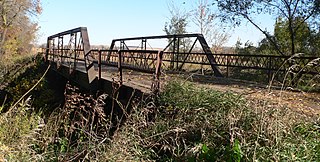
The Rattlesnake Creek Bridge brings a Cuming County, Nebraska county road over Rattlesnake Creek, 2.8 miles northwest of Bancroft. It was built in 1903 and was listed on the National Register of Historic Places in 1992.
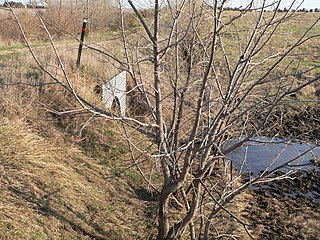
The Bridge designated NEHBS No. AP00-252 near Royal, Nebraska built in 1911 was listed on the National Register of Historic Places in 1992. It brought a township road over an unnamed stream, about 6.8 miles (10.9 km) northeast of Royal. The bridge was fabricated by the Lackawanna Steel Co. and built by the Western Bridge & Construction Co. of Omaha, Nebraska at cost of $1,149. It was a Kingpost pony truss bridge with span length of 30 feet (9.1 m), total length of 32 feet (9.8 m), and roadway width of 16 feet (4.9 m).

The West Sixth Street Bridge is a historic stone arch bridge in downtown Austin, Texas. Built in 1887, the bridge is one of the state's oldest masonry arch bridges. It is located at the site of the first bridge in Austin, carrying Sixth Street across Shoal Creek to link the western and central parts of the old city. The bridge was added to the National Register of Historic Places in 2014.

The West Fifth Street Bridge is a historic cantilever concrete girder bridge in downtown Austin, Texas. Built in 1931, the bridge carries Fifth Street across Shoal Creek to link central Austin with neighborhoods that were then the city's western suburbs. It is one of only a handful of curved cantilever girder bridges in Texas, built as part of the city's 1928 master plan for urban development and beautification. The bridge was added to the National Register of Historic Places in 2019.