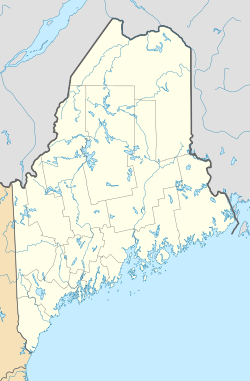
Mount Desert Island in Hancock County, Maine, is the largest island off the coast of Maine. With an area of 108 square miles (280 km2) it is the 52nd-largest island in the United States, the sixth-largest island in the contiguous United States, and the second-largest island on the Eastern Seaboard, behind Long Island and ahead of Martha's Vineyard. According to the 2010 census, the island has a year-round population of 10,615. In 2017, an estimated 3.5 million tourists visited Acadia National Park on MDI. The island is home to numerous well-known summer colonies such as Northeast Harbor and Bar Harbor.

Cadillac Mountain is located on Mount Desert Island, within Acadia National Park, in the U.S. state of Maine. With an elevation of 1,530 feet, its summit is the highest point in Hancock County and the highest within 25 miles (40 km) of the Atlantic shoreline of the North American continent between the Cape Breton Highlands, Nova Scotia, and peaks in Mexico. It is known as the first place in the continental U.S. to see the sunrise, although that is only true for a portion of the year.
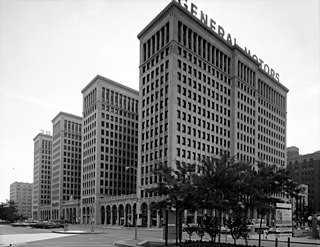
Cadillac Place, formerly the General Motors Building, is a landmark high-rise office complex located at 3044 West Grand Boulevard in the New Center area of Detroit, Michigan. It was renamed for the French founder of Detroit, Antoine Laumet de La Mothe, sieur de Cadillac. It is a National Historic Landmark in Michigan, listed in 1985.

Pennellville Historic District is a residential district located in Brunswick, Maine. To locals, the neighborhood is known simply as "Pennellville."

Hilton is a historic home located on the campus of The Community College of Baltimore County in Catonsville, Baltimore County, Maryland. It is an early-20th-century Georgian Revival–style mansion created from a stone farmhouse built about 1825, overlooking the Patapsco River valley. The reconstruction was designed by Baltimore architect Edward L. Palmer Jr. in 1917. The main house is five bays in length, two and a half stories above a high ground floor, with a gambrel roof. The house has a 2+1⁄2-story wing, five bays in length, with a gabled roof, extending from the east end; and a two-story, one-bay west wing. The roof is covered with Vermont slate. The house features a small enclosed porch of the Tuscan order that was probably originally considered a porte cochere.
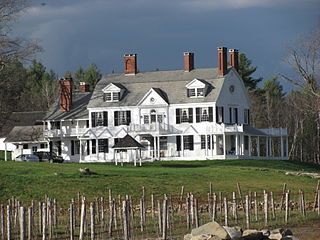
Brook Farm is a historic country estate farm at 4203 Twenty Mile Stream Road in Cavendish, Vermont. It includes one of the state's grandest Colonial Revival mansion houses, and surviving outbuildings of a model farm of the turn of the 20th century. It was listed on the National Register of Historic Places in 1993. The property is now home to the Brook Farm Vineyard.

The Proprietors Meeting House and Parish House, known for many years as the Universalist Church of Scarborough and South Buxton, is a historic church complex at the junction of Maine State Route 22 and Old County Road in the village of South Buxton, on the Scarborough side of the town line with Buxton, Maine. The church, built about 1839, is a fine local example of transitional Federal-Gothic Revival architecture, and the adjacent parish house, built in 1914, is a good local example of the Bungalow style. The property, purchased for use of the Maine Hindu Temple in 2012, was listed on the National Register of Historic Places in 2001. The Hindu Temple has since moved out and the property is now vacant.

The John B. Russwurm House is an historic house at 238 Ocean Avenue in the Back Cove neighborhood of Portland, Maine. Built about 1810, it was the residence of American abolitionist and Liberian colonist John Brown Russwurm. The house was listed on the National Register of Historic Places in 1983.

The Emily Means House is a historic house on Birch Island in South Bristol, Maine. Built in 1914, it is a distinctive local example of Mediterranean Revival architecture, designed by New York architect Samuel Very. It was built for Emily Means, a nationally known horticulturalist. It was listed on the National Register of Historic Places in 1985.
Oak Grove is a historic plantation house located near Eastville, Northampton County, Virginia. The original section of the manor house was built about 1750, and is a 1+1⁄2-story, gambrel-roofed colonial-period structure. It has a two-story Federal style wing added about 1811, and a two-story Greek Revival style wing added about 1840. The house was remodeled and enlarged in the 1940s. Also on the property are the contributing five early outbuildings, three 20th century farm buildings, and a well tended formal garden designed by the Richmond landscape architect Charles Gillette.
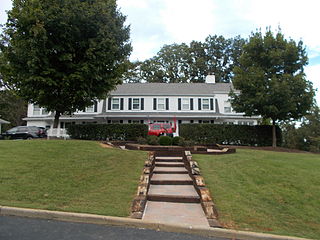
Commanding General's Quarters, Quantico Marine Base, also known as Building Number 1 and Quarters 1, is a historic home located at Marine Corps Base Quantico, Quantico, Prince William County, Virginia. It was built in 1920, and is a large, two-story, concrete-block-and-frame, Dutch Colonial Revival style house. The main block consists of a two-story, five-bay, symmetrical, gambrel-roofed central block with lower level walls covered with stucco. It has flanking wings consisting of a service wing and wing with a porch and second story addition. Also on the property is a contributing two-car, hipped roof, stucco-covered garage. The house is a contributing resource with the Quantico Marine Base Historic District.

The Frank J. Cobbs House is a private house located at 407 E. Chapin Street in Cadillac, Michigan. It was designated a Michigan State Historic Site in 1985 and listed on the National Register of Historic Places in 1988.

The Webster Estate is a historic summer estate in Holderness, New Hampshire. Located near Carns Cove on Squam Lake off New Hampshire Route 113, the estate belongs to the locally prominent Webster family. It includes a number of houses: the Homestead, which was built for the family patriarch, Frank Webster, in 1899, and the 1903 Laurence Webster House. It was one of the largest summer estates on Squam Lake at the time. A 16.4-acre (6.6 ha) remnant of the original 5,000-acre (2,000 ha) estate was listed on the National Register of Historic Places in 1989.
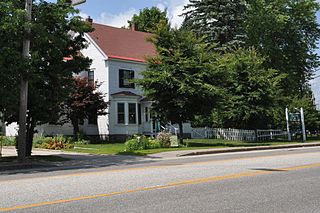
The McLaughlin House and Garden are a historic house museum and associated specimen garden at 97 Main Street in South Paris, Maine. The property includes a traditional New England connected farmstead with house, ell, and barn, all of which date to the mid-19th century, and a landscaped garden area developed beginning in the 1930s by Bernard McLaughlin that now houses more than 500 varieties of flowers. It is one of a small number of such specimen gardens in the state, and was listed on the National Register of Historic Places in 2000. The property is now owned by a local nonprofit organization, and is open to the public free of charge between May and October.
The Farm House is a historic summer estate at 15 Highbrook Road in Bar Harbor, Maine. The estate includes a 19th-century farmhouse which was extensively altered in the 1920s to Colonial Revival designs by Arthur McFarland, who also designed a caretaker's cottage on the property. The property also includes a series of garden spaces designed by Beatrix Farrand. This work was done for Mildred McCormick, an heir to the fortune of Cyrus McCormick, inventor of the combine harvester. The estate was listed on the National Register of Historic Places in 2007.
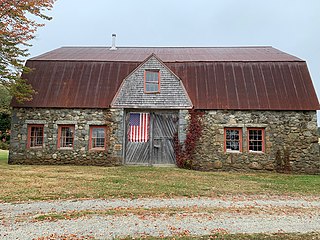
Stone Barn Farm is one of a small number of surviving farm properties on Mount Desert Island off the coast of Maine, United States. Located at the junction of Crooked Road and Norway Drive, the farm has a distinctive stone barn, built in 1907, along with a c. 1850 Greek Revival farm house and carriage barn. The property was listed on the National Register of Historic Places in 2001, and is subject to a conservation easement held by the Maine Coast Heritage Trust.

The Isaac W. Dyer Estate is a historic property at 180 Fort Hill Road in Gorham, Maine. The property consists of an 1850s Greek Revival house, and a collection of farm-related outbuildings and landscaping added in the early 20th century as part of a transformation of the property into gentleman's farm by Isaac Watson Dyer, a prominent Portland lawyer. The property was listed on the National Register of Historic Places in 1998.
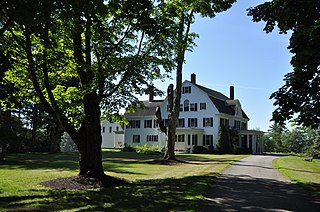
The Dr. F.W. Jackson House is a historic house on Maine State Route 32 in the village center of Jefferson, Maine. Built 1903–05, it is one of the rural community's largest and most elegant examples of Colonial Revival architecture. It was listed on the National Register of Historic Places in 1980.
Grouselands, also known more recently as the Waterman Farm, is a historic farm and country estate on McDowell Road in Danville, Vermont. The main house is a distinctive and rare example of Shingle style architecture in northern Vermont, and is the product of a major redesign of an Italianate farmhouse built in the 1860s. The house and immediate surrounding outbuildings were listed on the National Register of Historic Places in 1983.

The Lovira Hart, Jr., and Esther Maria Parker Farm is a historic farmstead located at 9491 West Frankenmuth Road in Tuscola Township, Michigan. It was settled in 1836 and has been continuously owned by the same family since that time. It was listed on the National Register of Historic Places in 2004.