
Charles A. Lindbergh State Park is a 569-acre (2.3 km2) Minnesota state park on the outskirts of Little Falls. The park was once the farm of Congressman Charles August Lindbergh and his son Charles Lindbergh, the famous aviator. Their restored 1906 house and two other farm buildings are within the park boundaries. The house, a National Historic Landmark, and an adjacent museum are operated by the Minnesota Historical Society, known as the Charles Lindbergh House and Museum. Three buildings and three structures built by the Works Progress Administration in the 1930s were named to the National Register of Historic Places. These buildings include a picnic shelter and a water tower, built in the Rustic Style from local stone and logs, and have remained relatively unchanged since construction. Although the property includes shoreline on the Mississippi River, the Lindbergh family requested that the park not include intensive use areas for swimming or camping, so development was kept to a minimum.

The W.H. Bickel Estate is a 2+1⁄2-story stone mansion built between 1928 and 1930 on the outskirts of Parkersburg, West Virginia. The 1,800-square-foot (170 m2) building has a rectangular main section and a wing to the East. The main house is rich with woodwork, including intricately inlaid walnut and maple floors with geometric patterns, wood mantels, partial wainscoting on all three floors, 15 light French doors on the first floor, solid maple arched doors on the second floor, built-in china cabinets, crown molding in all main rooms, and original finish wood casement windows with roll down screens and brass hardware. There are five gas fireplaces with marble or stone hearths in the main house and two staircases, including a circular walnut and maple main staircase. The ceilings are coved on the second and third floors, and the third floor contains a ballroom or “dance hall” stretching twenty eight feet.

The Ogle County Courthouse is a National Register of Historic Places listing in the Ogle County, Illinois, county seat of Oregon. The building stands on a public square in the city's downtown commercial district. The current structure was completed in 1891 and was preceded by two other buildings, one of which was destroyed by a group of outlaws. Following the destruction of the courthouse, the county was without a judicial building for a period during the 1840s. The Ogle County Courthouse was designed by Chicago architect George O. Garnsey in the Romanesque Revival style of architecture. The ridged roof is dominated by its wooden cupola which stands out at a distance.

The Converse Memorial Library – also known as Converse Memorial Building – is a historically significant building designed by noted American architect Henry Hobson Richardson. From 1885 to 1996, it housed the Malden Public Library, which now occupies a modern building adjacent to it. The former library is located at 36 Salem Street, Malden, Massachusetts.

The George Hummel House is a historic residence in the city of Cincinnati, Ohio, United States. Constructed in the early 1890s, it is built with numerous prominent components from different architectural styles, and it has been named a historic site.

The S. C. Mayer House is a historic house in the Over-the-Rhine neighborhood of Cincinnati, Ohio, United States. Constructed in the late 1880s, it has been recognized because of its mix of major architectural styles and its monolithic stone walls. Built by a leading local architect, it has been named a historic site.

The Richard H. Mitchell House is a historic residence in Cincinnati, Ohio, United States. Built of stone throughout, this large house was designed by prominent Cincinnati architect Samuel Hannaford. Converted into a school, the house has been named a historic site.
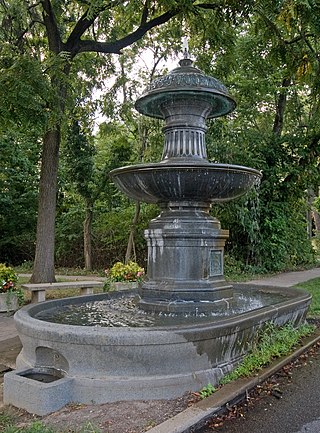
The Probasco Fountain is a large fountain in Cincinnati, Ohio, United States. Built of bronze on a base of granite, the fountain was constructed in 1887 according to a design by Samuel Hannaford.

The Bagley Memorial Fountain is a historic fountain in Downtown Detroit, Michigan. It has recently been moved from its long-time location in Campus Martius Park to a new location just down the street in Cadillac Square Park. The fountain was listed on the National Register of Historic Places and designated a Michigan State Historic Site in 1971. The John N. Bagley House (1889) at 2921 East Jefferson Avenue in Detroit was constructed for Governor Bagley's son, and is also listed on the National Register of Historic Places.

The John N. Bagley House, also known as Bagley Mansion, was built as a private residence in 1889. The mansion is located at 2921 East Jefferson Avenue in Detroit, Michigan. It was listed on the National Register of Historic Places in 1985. As of 2022, the house is used as a commercial office building, maintaining its historic features and character.

The Franklin H. Walker House was a private residence located at 2730 East Jefferson Avenue in Detroit, Michigan. It was also known as Doctor's Hospital. The house was listed on the National Register of Historic Places in 1985, but subsequently demolished in 1998. It was at the time the largest remaining house along Jefferson Avenue.
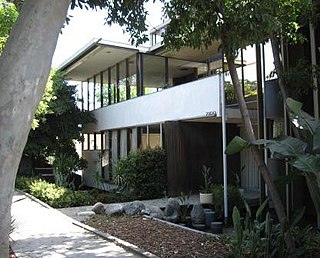
Neutra VDL Studio and Residences, the home of architect Richard Neutra, is located in Los Angeles, California. It is also known as the Neutra Research House, the Van der Leeuw House, the Richard and Dion Neutra VDL Research House II, or the Richard and Dion Neutra VDL Research Houses and Studio. It was designed by Richard Neutra and his son Dion Neutra. The house is currently owned by California State Polytechnic University, Pomona, and is maintained by its College of Environmental Design. The property was added to the National Register of Historic Places in 2009, and was designated as a National Historic Landmark in 2016.
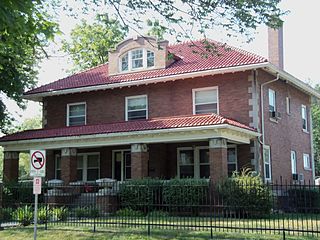
The Arthur Ebeling House is a historic building located on the west side of Davenport, Iowa, United States. The Colonial Revival house was designed by its original owner, Arthur Ebeling. It was built from 1912 to 1913 and it was listed on the National Register of Historic Places in 1984.

The John H. Suiter House is a historic building located in Le Claire, Iowa, United States. The house was built in 1855 and it has been listed on the National Register of Historic Places since 1979. The property is part of the Houses of Mississippi River Men Thematic Resource, which covers the homes of men from LeClaire who worked on the Mississippi River as riverboat captains, pilots, builders and owners.

The Darlington Memorial Fountain, also known as the Joseph Darlington Fountain, Nymph and Fawn, and Darlington Fountain, is a sculpture by C. Paul Jennewein atop a fountain in honor of Joseph James Darlington. It is located at Judiciary Park, where 5th Street, D Street, and Indiana Avenue NW intersect in the Judiciary Square neighborhood of Washington, D.C. The fountain is surrounded on three sides by government buildings, including the United States Court of Military Appeals, the H. Carl Moultrie Courthouse, and the former District of Columbia City Hall.

The Proctor-Clement House is a historic house at 85 Field Avenue in Rutland, Vermont. It was built in 1867 for Redfield Proctor, a prominent local lawyer and businessman who came to own the Vermont Marble Company and served as Governor of Vermont. A fine example of Italianate architecture, it now houses the Antique Mansion Bed and Breakfast. It was listed on the National Register of Historic Places in 1982.

The Langford and Lydia McMichael Sutherland Farmstead is a farm located at 797 Textile Road in Pittsfield Charter Township, Michigan. It was listed on the National Register of Historic Places in 2006. It is now the Sutherland-Wilson Farm Historic Site.
The Juan Garcia House, on Tularosa St. in La Luz, New Mexico, was built around 1870. It was listed on the National Register of Historic Places in 1980.

The Medgar and Myrlie Evers Home National Monument, also known as Medgar Evers House, is a historic house museum at 2332 Margaret Walker Alexander Drive within the Medgar Evers Historic District in Jackson, Mississippi, United States. Built in 1956, it was the home of African American civil rights activist Medgar Evers (1925–1963) at the time of his assassination. It was designated a National Historic Landmark in 2017. The John D. Dingell, Jr. Conservation, Management, and Recreation Act, signed March 12, 2019, by President Donald Trump, authorized it as a national monument; it was established on December 10, 2020, after the National Park Service (NPS) acquired it from Tougaloo College.

The so-called Queen Anne House, on Kearny St. in La Luz, New Mexico, was built around 1900. It was listed on the National Register of Historic Places in 1980.


