Olvera Street, commonly known by its Spanish name Calle Olvera, is a historic pedestrian street in El Pueblo de Los Ángeles, the historic center of Los Angeles. The street is located off of the Plaza de Los Ángeles, the oldest plaza in California, which served as the center of the city life through the Spanish and Mexican eras into the early American era, following the Conquest of California.
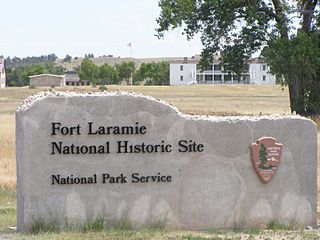
Fort Laramie was a significant 19th-century trading post, diplomatic site, and military installation located at the confluence of the Laramie and the North Platte Rivers. They joined in the upper Platte River Valley in the eastern part of the present-day U.S. state of Wyoming. The fort was founded as a private trading-post in the 1830s to service the overland fur trade; in 1849, it was purchased by the United States Army. The site was located east of the long climb leading to the best and lowest crossing-point over the Rocky Mountains at South Pass and became a popular stopping-point for migrants on the Oregon Trail. Along with Bent's Fort on the Arkansas River, the trading post and its supporting industries and businesses were the most significant economic hub of commerce in the region.
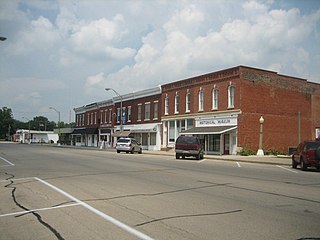
The Main Street Historic District in Tampico, Illinois, United States is a historic district notable as home to the birthplace of Ronald Reagan. The district includes the late 19th century collection of buildings that comprise Tampico's central business district; among them are two apartments that the Reagan family occupied in the early 1900s. The buildings in the district went through several periods of rebuilding during the 1870s due to major fires and a tornado. The district boundaries encompass the 100 block of Main Street and exclude properties that do not date from the historic period.

El Pueblo de Los Ángeles Historical Monument, also known as Los Angeles Plaza Historic District and formerly known as El Pueblo de Los Ángeles State Historic Park, is a historic district taking in the oldest section of Los Angeles, known for many years as El Pueblo de Nuestra Señora la Reina de los Ángeles del Río de Porciúncula. The district, centered on the old plaza, was the city's center under Spanish (1781–1821), Mexican (1821–1847), and United States rule through most of the 19th century. The 44-acre park area was designated a state historic monument in 1953 and listed on the National Register of Historic Places in 1972.

The Ygnacio Palomares Adobe, also known as Adobe de Palomares, is a one-story adobe brick structure in Pomona, California, built between 1850 and 1855 as a residence for Don Ygnacio Palomares. It was abandoned in the 1880s and was left to the elements until it was acquired by the City of Pomona in the 1930s. In 1939, the adobe was restored in a joint project of the City of Pomona, the Historical Society of Pomona Valley and the Works Project Administration. Since 1940, it has been open to the public as a museum on life in the Spanish and Mexican ranchos. It was listed on the National Register of Historic Places in 1971. Of the more than 400 sites in Los Angeles County that have been listed on the National Register, fewer than ten received the distinction prior to the Ygnacio Palomares Adobe.

Boggsville is an extinct town located in Bent County, Colorado, United States. The town was located near the Purgatoire River about 3 miles (4.8 km) above the Purgatoire's confluence with the Arkansas River. It was established in 1866. The surviving structures are among the earliest examples of Territorial architecture in Colorado. Boggsville was the last home of frontiersman Kit Carson before his death in 1868 at Fort Lyon. The U.S. Post Office at Las Animas now serves Boggsville postal addresses.
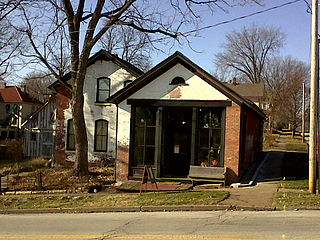
The Christian Jipp Home & Grocery is a historic building located in the Hamburg Historic District in Davenport, Iowa, United States. The district was added to the National Register of Historic Places in 1983. The house and grocery was individually listed on the Davenport Register of Historic Properties in 2005.
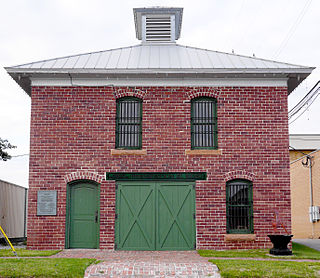
The Canadian County Jail and Stable comprises two buildings constructed at different times. The jail is a building located at 318 North Evans in El Reno, Oklahoma. It is the abandoned site of the county jail of Canadian County, and sits west of the current county jail on the same block.

The Brinley Avenue Historic District is a historic district in downtown Yuma, Arizona, that runs along Madison Avenue from 1st to 3rd Streets and along Second Street from Main Street to 1st Avenue. The district connected Yuma's historic commercial center along Main Street with its government center on 2nd Avenue and was actively developed from 1900 to 1925. The district was added to the National Register of Historic Places in 1982 and is also included in the larger Yuma Crossing National Heritage Area.

The Progressive Market is a historic commercial building at 63 South Main Street in White River Junction, Vermont. Built in 1922, it is an example of an increasingly rare type of building in Vermont, the neighborhood market. The store was operated for many years by Italian immigrants and Italian Americans, serving a local community in the area south of downtown White River Junction. The building, largely vernacular in form, was listed on the National Register of Historic Places in 1995. it appears to no longer house a retail establishment.

The Bowery Street Grocery Store, also known as Helmer's Grocery and as the New Pioneer Food Cooperative, is a historic building located on the east side of Iowa City, Iowa, United States. The building's construction is consistent with those built in the mid-19th century. The single-story wood-frame structure with the false front was a popular commercial style building that was built in Iowa from that time period. Although the exterior structure has not changed significantly since it was first built, the interior has been renovated heavily. The only original interior feature that remains is the shelving against the building's west wall.

Doyle Settlement was a ranch and settlement in Pueblo, Pueblo County, Colorado. It was listed on the National Register of Historic Places on April 4, 1980.

The Nathaniel W. Duke House, at 1409 Craig St. in Pueblo, Colorado, was built in 1889. It was listed on the National Register of Historic Places in 1985.

The Hi Wo Company Grocery is a building in Benson, Arizona. While it opened in 1896, its actual date of construction is unknown; it was one of the first commercial buildings in Benson. The store remained in operation until 1989, operated by descendants of Hi Wo, the first owner, an immigrant from China.