The National Register of Historic Places (NRHP) is the United States federal government's official list of sites, buildings, structures, districts, and objects deemed worthy of preservation for their historical significance or "great artistic value".
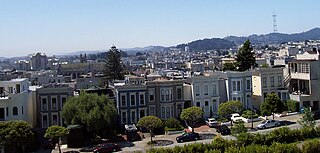
The Western Addition is a district in San Francisco, California, United States.

The Hotel Green, also known as Castle Green, was a hotel in Pasadena, California. It was built in 1893 by George Gill Green, and later expanded by him with two additional buildings in 1898 and 1903, creating a complex of three structures. The Hotel Green was the home of the Valley Hunt Club and the Tournament of Roses association.

Architectural Resources Group is a firm founded in 1980 by Bruce Judd and Steve Farneth in San Francisco, California. It began by providing professional services in the fields of architecture and urban planning with particular expertise in historic preservation. In 2000, David Wessel, a Principal of ARG, founded a separate conservation-contracting division, ARG Conservation Services which operates under the same roof as ARG. By 2005, the firm had expanded to a full-service architecture firm with 50+ employees. ARG also opened offices in Pasadena serving Southern California, and Portland, Oregon, serving the Pacific Northwest.

Myron Hubbard Hunt was an American architect whose numerous projects include many noted landmarks in Southern California and Evanston, Illinois. Hunt was elected a Fellow in the American Institute of Architects in 1908.

The Sheridan Inn is a historic hotel in Sheridan, Wyoming. Designed by the architect Thomas R. Kimball of Omaha, Nebraska in 1893, it was constructed by the Chicago, Burlington, and Quincy Railroad as part of its development program in Wyoming associated with extension of the railway. Equipped with the first bathtubs and electric lights in that part of Wyoming, the inn was considered the "finest hotel" between Chicago and San Francisco. It was declared a National Historic Landmark in 1964.

The Pasadena Civic Center District is the civic center of and a historic district in Pasadena, California, United States. The district is roughly bounded by Walnut and Green Streets and Raymond and Euclid Avenues.

The Dearborn Inn, A Marriott Hotel is a historic hotel in the suburban city of Dearborn, Michigan in Metro Detroit. It opened in 1931 and closed in February 2023 for renovations. It was conceived by Henry Ford, who saw a need for food and accommodations for visitors flying into the nearby Ford Airport, making it one of the first airport hotels. It is located at 20301 Oakwood Boulevard near The Henry Ford Museum of American Innovation and the world headquarters building of Ford Motor Company. Albert Kahn designed the Dearborn Inn in the Georgian architectural style. The Dearborn Inn is owned by Ford Motor Land Development Corporation and managed by Marriott International.
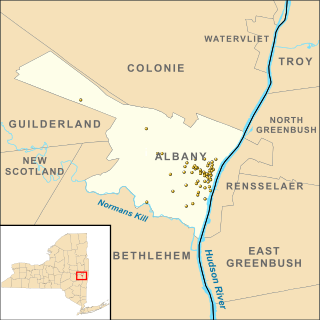
There are 77 properties listed on the National Register of Historic Places in Albany, New York, United States. Six are additionally designated as National Historic Landmarks (NHLs), the most of any city in the state after New York City. Another 14 are historic districts, for which 20 of the listings are also contributing properties. Two properties, both buildings, that had been listed in the past but have since been demolished have been delisted; one building that is also no longer extant remains listed.
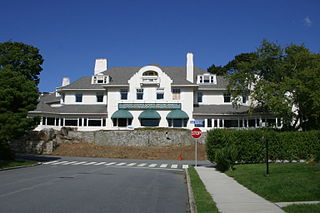
The Lighthouse Inn, originally known as Meadow Court, is a Colonial Revival hotel building at 6 Guthrie Place in New London, Connecticut. The Mission style main house was designed by William Ralph Emerson and built in 1902 as a country home for steel industry magnate Charles S. Guthrie. It is one of the few examples of this architectural style in the city, and became a popular dining and event venue after opening as an inn in 1927. The building and surviving estate remnants were listed on the National Register of Historic Places in 1996. It was listed for sale by the city in February 2014, with historic preservation restrictions.

The Stage House Inn is located at the intersection of Park Avenue and Front Street in the township of Scotch Plains in Union County, New Jersey, United States. The inn was built in 1737 and was added to the National Register of Historic Places on April 15, 1982, for its significance in architecture, commerce and politics/government.

Walker & Eisen (1919−1941) was an architectural partnership of architects Albert R. Walker and Percy A. Eisen in Los Angeles, California.

Chesterfield Inn, also known as Chesterfield Inn and Motor Lodge, was a historic hotel located at Myrtle Beach in Horry County, South Carolina. The Chesterfield Inn consisted of two three-story, rectangular buildings constructed in 1946 and 1965. The 1946 building was of frame construction with a brick veneer exterior, with an end to front gable roof, and a raised basement foundation. It was an unusual example of Colonial Revival style architecture in the Myrtle Beach area.

The Downtown Evanston Historic District in Evanston, Wyoming includes about sixty buildings in a compact downtown commercial district.

Robert Stanton (1900-1983) was an American architect. A resident of Carmel-by-the-Sea, California, he practiced primarily in the central California coastal region, and was responsible for a variety of eclectic buildings, most notably the Monterey County Court House and the King City Joint Union High School Auditorium, both listed on the National Register of Historic Places. He worked closely with sculptor Joseph Jacinto Mora on several of his projects.

First Baptist Church of Ventura is a historic church at 101 S. Laurel Street in Ventura, California. It was built in 1926 and renovated extensively into the Mayan Revival style in 1932. Declared a landmark by the City of Ventura In 1975, the building was added to the National Register of Historic Places in 2009. Since 1952, it has been home to the Ventura Center for Spiritual Living.

Michigan-Lee Apartments is a historic apartment building at 940–950 Michigan Avenue in Evanston, Illinois. The three-story brick building was built in 1928. Architect Frank W. Cauley, who also designed Evanston's Orrington Hotel, designed the building in the Georgian Revival style. The building features entrances flanked by columns, limestone quoins, and a parapet with decorative urns. A sunken courtyard occupies the center of the building; while courtyards were common in Evanston's apartments, the sunken design is unusual within the city.