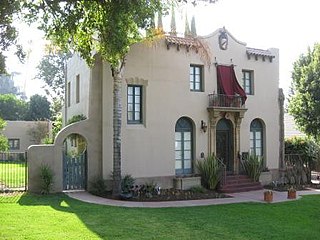
The Upton Sinclair House is an historic house at 464 N. Myrtle Avenue, Monrovia, California. Built in 1923, it was the home of American novelist Upton Sinclair (1878–1968) between 1942 and 1966, and is where he wrote many of his later works. It was listed on the National Register of Historic Places and was declared a National Historic Landmark in 1971. It is a private residence.

The Pioneer Building is a Richardsonian Romanesque stone, red brick, terra cotta, and cast iron building located on the northeast corner of First Avenue and James Street, in Seattle's Pioneer Square District. Completed in 1892, the Pioneer Building was designed by architect Elmer Fisher, who designed several of the historic district's new buildings following the Great Seattle Fire of 1889.

Pasadena City Hall is the historic city hall of Pasadena, California, United States. Completed in 1927, it combines elements of both Mediterranean Revival and Spanish Colonial Revival architecture, and is a significant architectural example of the City Beautiful movement of the 1920s.

The Pasadena Civic Center District is the civic center of and a historic district in Pasadena, California, United States. The district is roughly bounded by Walnut and Green Streets and Raymond and Euclid Avenues.

The Whitney Avenue Historic District is a historic district in the East Rock neighborhood of New Haven, Connecticut. It is a 203-acre (82 ha) district which included 1,084 contributing buildings when it was listed on the National Register of Historic Places in 1989.

This is intended to be a complete list of the properties and districts on the National Register of Historic Places in the city of Pasadena, California, United States. The locations of National Register properties and districts for which the latitude and longitude coordinates are included below, may be seen in an online map.

The Singer Building in Pasadena, California is a Spanish Colonial Revival building located at 520 E. Colorado Boulevard in Pasadena, California. Built in 1926, the building was designed by Everett Phipps Babcock and is his only surviving non-residential design. The Spanish Colonial Revival design of the building was popular in Pasadena in the 1920s. Prominent features of the building's design include a red tile roof, a stone frieze with a tiled pattern, and piers with decorative moldings. The building originally housed a Singer Sewing Machine Company showroom and has since been used for other commercial purposes.

The Greenwich Avenue Historic District is a historic district representing the commercial and civic historical development of the downtown area of the town of Greenwich, Connecticut. The district was listed on the National Register of Historic Places on August 31, 1989. Included in the district is the Greenwich Municipal Center Historic District, which was listed on the National Register the year before for the classical revival style municipal buildings in the core of Downtown. Most of the commercial buildings in the district fall into three broad styles, reflecting the period in which they were built: Italianate, Georgian Revival, and Commercial style. The district is linear and runs north–south along the entire length of Greenwich Avenue, the main thoroughfare of Downtown Greenwich, between U.S. Route 1 and the New Haven Line railroad tracks.
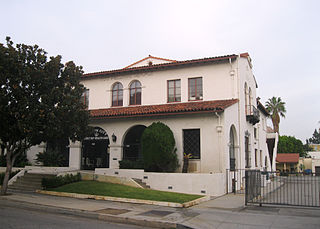
The Odd Fellows Temple in Pasadena, California is a historic building that was built in 1933 at 175 N. Los Robles Ave. The temple served as a meeting place for Odd Fellow Lodge No. 324, the Pasadena branch of the Independent Order of Odd Fellows established in 1885. Pasadena architect Kenneth Gordon designed the building; its design incorporates the Spanish Colonial Revival and Mediterranean Revival styles. The temple is the only Spanish Colonial Revival building in Pasadena which was built for a fraternal organization. It was listed on the National Register of Historic Places (NRHP) in 1985.
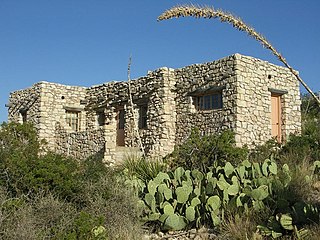
The Caverns Historic District comprises the central developed area of Carlsbad Caverns National Park. The complex was built between the early 1920s and 1942, initially in Pueblo Revival style, and later in New Mexico Territorial Revival style in the area around the natural entrance to Carlsbad Caverns. The earlier structures are built of local limestone, the later buildings in adobe. Thirteen buildings in the district are considered contributing structures. Buildings built between 1940 and 1942 were constructed with labor provided by the Civilian Conservation Corps.
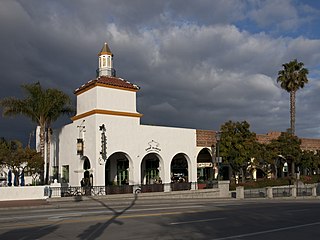
The Andalucia Building was built in 1911. It was listed on the National Register of Historic Places in 1999. The building is located on State Street, in the southeastern part of the historical center of Santa Barbara, California, immediately next to the Highway 101. The building is one of the few examples of Moorish architecture in Santa Barbara.
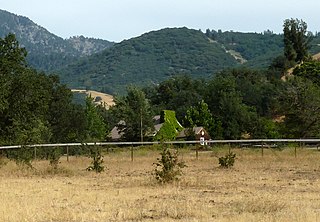
The Courtlandt Gross House is a historic house located at 18600 Courtlandt Court in Tehachapi, Kern County, California.
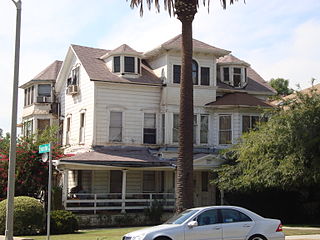
The Evanston Inn is a historic hotel located at 395 S Marengo Ave. in Pasadena, California. The inn was built in 1897 and served as a smaller and less lavish alternative to Pasadena's luxury hotels. The building was designed in a combination of the Queen Anne and Colonial Revival styles, and the original section of the building features decorative shingling. In 1898 and 1905, the inn constructed additional wings due to the growth in Pasadena tourism. The inn is now the only extant wood-frame hotel in Pasadena.

The Court at 497–503½ North Madison Avenue is a bungalow court in Pasadena, California.

Mission Court is a bungalow court located at 567 N. Oakland Ave. in Pasadena, California. The court consists of eight buildings containing fourteen residential units which surround a central courtyard. Built in 1913, the court was designed by architect J. F. Walker. The houses in the court were designed in the Mission Revival style; the court is the oldest Mission Revival bungalow court in Pasadena. The houses' designs feature broken parapets along the roofs and porches with either recessed arch entrances or tiled shed roofs. The courtyard includes two buttressed piers topped by lamps.

The San Bernardino County Court House, is a Classical Revival building located at 351 N. Arrowhead Ave. in San Bernardino, is the county courthouse for San Bernardino County, California. The courthouse was built in 1927 and has served as the center of county government since then. A 1937 welfare building, a 1940 county library, and a 1940 heating plant are also located on the courthouse grounds, which are extensively landscaped and include a fountain, sundial, plaque, and the remains of the former county courthouse.

The Civic Center Financial District is a historic district composed of five buildings near the intersection of Colorado Boulevard and Marengo Avenue in Pasadena, California. The Security Pacific Building and the Citizens Bank Building are located at the intersection itself and considered the centerpieces of the district, while the MacArthur, Mutual, and Crown Buildings are located on North Marengo. The buildings, which were built between 1905 and 1928, are all architecturally significant buildings used by financial institutions in the early 20th century.
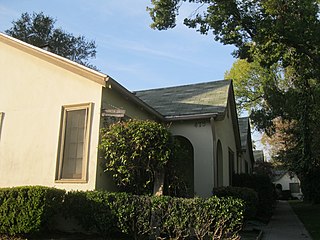
Washington Court is a bungalow court located at 475 E. Washington Blvd. in Pasadena, California. The court consists of six single-family homes arranged in an "L" shape; a common walkway and garden runs along the east side of the court, while a driveway on the west side accesses a rear garage. The homes are designed in the English Cottage Revival style and feature cross gabled roofs with wooden louvers at the gable ends, wooden trim and window moldings, and arched entrances with flared eaves. F. R. Finch commissioned the court in 1924; the homes cost $2,250 each to build.

The Home Laundry is a historic building at 432 S. Arroyo Parkway in Pasadena, California. The building was constructed in 1922 for the Home Laundry Company, a laundry service founded by Pasadena businessmen Daniel M. Linnard, Arnold J. Bertonneau, and Edward K. Hoak. All three were well known in Pasadena, and Linnard had a national reputation for his work in the hotel industry. The company's building represented a new type of building design in Pasadena, as the company's office space and industrial space were both visually separated and structurally integrated. In addition, the building has an uncommon Tudor Revival design created by the local architecture firm Marston, Van Pelt & Maybury. The building's design features ornamental half-timbering on the front façade, coursed brickwork, gabled dormers above the second-story windows, and stone quoins at the corners. The building is the only Tudor Revival commercial or industrial building in Pasadena.
The W.L. and Winnie (Woodfield) Belfrage Farmstead Historic District is a nationally recognized historic district located south of Sergeant Bluff, Iowa, United States. It was listed on the National Register of Historic Places in 2017. At the time of its nomination it contained six resources, which included four contributing buildings and two non-contributing buildings. The four contributing buildings are the dairy barn (1910), farmhouse (1920), brooder house, and the chicken coop. The two no-contributing buildings are the cattle shed (1960) and the garage/utility building (2006).