The Wilford Wood House is located on Pleasant Hill Road just east of the New York State Thruway in the Mountainville section of Cornwall, New York, United States. It is a white Colonial Revival farmhouse built in the late 19th century, a period when most large new houses in Cornwall were being built as boardinghouses to serve those who came to the area as a summer resort. The Wood house, too, would be used as a boardinghouse where guests could take in the mountain air and views of the surrounding mountains.
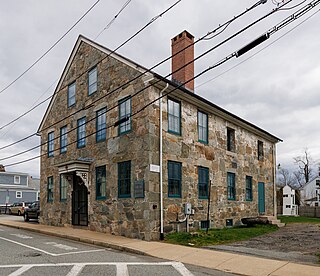
Bristol County Jail is a historic jail at 48 Court Street in Bristol, Rhode Island, and home to the Bristol Historical and Preservation Society.
The Mitchell – Foster – Young House is a historic house located just outside Oxford, Mississippi off the highway to New Albany. The house, thought to be one of the oldest standing farmhouses in the county, is listed on the National Register of Historic Places.

The Clover Hill Tavern with its guest house and slave quarters are structures within the Appomattox Court House National Historical Park in Appomattox County, Virginia. They were registered in the National Park Service's database of Official Structures on October 15, 1966.

Lewis Jones House, in Centerville, Indiana, also known as The Stephen and Betty Jones House, is a historic farmhouse in Centerville, Indiana, in the United States. It was built in 1840. It was listed on the National Register of Historic Places in 1984.
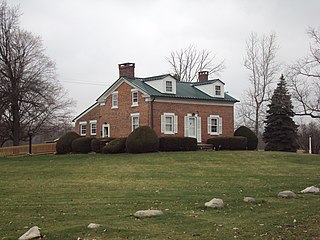
The Edward Loranger House is a private residence located at 7211 South Stoney Creek Road in Frenchtown Charter Township in Monroe County, Michigan. It was listed as a Michigan Historic Site on October 2, 1980 and added to the National Register of Historic Places on May 31, 1984. The house is significant as one of the oldest authentic structures in Michigan — having undergone very little modifications since it was first built.
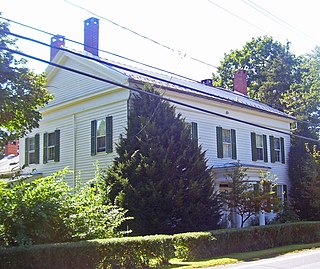
The Stephen Hogeboom House is located on NY 23B in Claverack, New York, United States. It is a frame Georgian-style house built in the late 18th century.

The Whitehall Mansion is a historic house at 42 Whitehall Avenue in the Stonington side of Mystic, Connecticut. Built about 1771 for a local physician and politician, it is a fine example of late Georgian architecture. It has been moved twice, both times short distances, and now serves as a bed and breakfast inn. The house was added to the National Register of Historic Places on April 12, 1979.

The Jacob P. Perry House is a historic home on Sickletown Road in Pearl River, New York, United States. It was constructed around the end of the 18th century, one of the last houses in Rockland County to have been built in the Dutch Colonial style more common before the Revolution.

The Edward Salyer House is located on South Middletown Road in Pearl River, New York, United States. It is a wood frame house built in the 1760s.

The Richard Austin House is located on Croton Avenue in the village of Ossining, New York, United States. It is a wood frame structure dating to the 1870s. In 1989 it was added to the National Register of Historic Places.
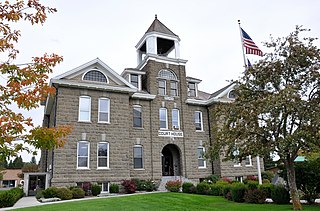
The Wallowa County Courthouse is the seat of government for Wallowa County in northeastern Oregon. The courthouse is located in Enterprise, Oregon. It was built in 1909–1910 using locally quarried stone. It is a massive High Victorian structure built of local Bowlby stone. The courthouse was listed on National Register of Historic Places in 2000. Today, the courthouse still houses Wallowa County government offices.

Crossroads Tavern, also known as Crossroads Inn, is a historic inn and tavern located at North Garden, Albemarle County, Virginia. It was built about 1820. In the mid nineteenth century, Clifton G. Sutherland, son of Joseph Sutherland, owned and ran the tavern which was located on the Staunton and James River Turnpike. It served as a tavern and overnight lodging for farmers and travelers using the turnpike. In 1889, Daniel B. Landes bought the land at the public auction of the estate of Clifton Sutherland. The property continued to be conveyed to various owners over the years. The Crossroads Tavern is an early nineteenth century two- to three-story, three-bay, double pile brick structure. The building sits on top of a brick and stone foundation, is roofed with tin and has pairs of interior brick chimneys on either gable end. The brick is laid in five course American bond with Flemish variant. Windows on the basement level at the rear of the house are barred; other basement windows are nine-over-six sash. Put-holes are found at the west end of the building, formerly providing sockets for scaffold boards should repairs be necessary. The front facade is dominated by a porch on the second story extending the entire width of the south and east facades. It is supported by five rounded brick columns and the tin roof above is supported by simple square wooden pillars connected by horizontal rails. Doors of the front of the basement level open respectively into kitchen and dining room and into a spirits cellar with its original barrel racks as well as a laundry fireplace. Floors on this level were originally dirt but dining room and kitchen floors have been cemented. The main entrance door on the second level, with its multi-panes lights, opens onto a central stair hall with two main rooms on either side. This stair hall has an ascending stair at its front and both ascending and descending stairs toward its center. Formerly the ascending stairs led to upstairs areas which did not connect. There is no ridge pole in the three attic rooms. The interiors of windows and doors on the main entrance side have extremely long wooden lintels. With few exceptions, the interior woodwork is original, including floors, chair rails, mantels and built in cupboards. Also on the property is a two-story contributing summer kitchen, brick up to the second story and frame above, and with an exterior brick chimney at the rear gable with fireplaces on both floors. It is operated as a bed and breakfast.

The Whidden-Ward House is a historic house at 411 High Street in Portsmouth, New Hampshire. Probably built in the late 1720s, it is a well-preserved example of Georgian architecture. The house was added to the National Register of Historic Places in 1972.

The Elkins Tavern is a historic house on Bayley-Hazen Road in Peacham, Vermont. Built in 1787 by one of Peacham's first settlers, it has one of the best-preserved 18th-century interiors in the state of Vermont. It was listed on the National Register of Historic Places in 1978.

Mathew H. Ritchey House, also known as Mansion House and Belle Starr House, is a historic home located in Newtonia, Newton County, Missouri. It was built about 1840, and is a two-story, brick dwelling with a two-story rear wing built using slave labor. The house rests on a sandstone block foundation and has a side-gabled roof. It features a one-story front portico and interior end chimneys. Also on the property is the contributing Ritchey family cemetery, outbuildings, and a well. During the American Civil War, the site saw fighting during both the First and Second Battles of Newtonia, which required its use as a hospital after the battles. It was listed on the National Register of Historic Places in 1978 and is a contributing property in the First Battle of Newtonia Historic District. The building was damaged by a tornado in 2008.

The Elijah Mills House is a United States historic house at 45 Deerfield Road in Windsor, Connecticut. Built in 1822, it is a well-preserved local example of a Federal period brick house. It was listed on the National Register of Historic Places in 1985.

The Moses Andrews House is a historic house museum at 424 West Main Street in Meriden, Connecticut. Built about 1760, it is one of a small number of surviving 18th-century houses in the city. It has been operated by the local historical society as a museum property since about 1940. It was listed on the National Register of Historic Places in 1978.

The Joseph Blakeslee House was a historic house at 1211 Barnes Road in Wallingford, Connecticut. Built in 1780, it was a good example of a late 18th-century Cape style residence. It was listed on the National Register of Historic Places in 1998. It collapsed and was demolished in 2008.

The Richard Mansfield House is a historic house at 35 Jewett Street in Ansonia, Connecticut. Built at the turn of the 17th-century, it is one of the community's oldest surviving buildings, and is noted for its association with a prominent early Episcopal minister. It was listed on the National Register of Historic Places in 1971.