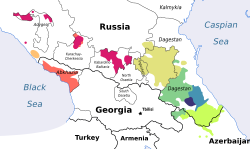
The Hatuqway dialect[a] is a dialect of Adyghe, spoken by the Hatuqway branch of the Circassian people.[1][2] Linguistically, it is classified as one of the "Steppe dialects", a subgroup of that also includes the Temirgoy, Abzakh and Bzhedug dialects, although it also shares many grammatical and phonological features with the "Coastal dialects" of Shapsug and Natukhaj.[1][2] Although a dialect of Western Circassian (Adyghe), it is considered the closest among the Western dialects to Eastern Circassian (Kabardian).[3]
Hatuqway is spoken only in the diaspora, especially in Turkey;[2] as a consequence of the Circassian genocide, there are no remaining speakers of the Hatuqway dialect in the Caucasus region. Consequently, Circassian dialectology studies rarely mention or analyze Hatuqway.[1][4]
Etymology
Sphinx gate in Hattusa
The Hatuqway dialect takes its name from the Hatuqway tribe, which is believed to derive from Prince Hatuqo (Adyghe: Хьатыкъо), who, according to traditional Circassian geneologies, was the founder of the Hatuqway principality, and a prince descended from King Inal.[5][6][7]
The name has been the subject of a folk etymology, which explains it as referring to the Hittites ('Son of Hittite'). A study about Circassians in Kayseri found that local Circassians frequently claimed descent from the Hittites.[8] The etymology of Hattusa, capital of the Hittite Empire, is explained with Circassian хьэтӏу (two dogs) + щхьэ (head), which supposedly refers to the two sphinx statues guarding the gate of Hattusa. Some connected the Circassians with the Hattians rather than Hittites;[9][10][11] and some authors explained the etymology of "Hatuqway" as "Hatti-Son".[12][13] The Adyghe Encyclopedia published in Russia compares Hattian mythology and Nart sagas, including stories found in the Hatuqway Nart corpus.[13] The Hittites spoke an Indo-European language, however the possibility of Hattians speaking a Northwest Caucasian language related to Circassian has been considered by linguists, although this is unconfirmed.[14][15][16][17]
Distribution and status
Historically, the Hatuqway dialect was spoken in the Hatuqway Principality, which was originally located near the Black Sea coast, as well as the southern banks of the Kuban, a little further down from where the Afips (Афыпс) river flows.[3][5] However, in the late 18th century, Hatuqway Principality was relocated west of the Temirgoys, in the territory situated between the Belaya (Шъхьагуащэ) and Pshish (Пщыщ) rivers.[3][1][5]
In the village of Khatukay in the Republic of Adygea, located in historical Hatuqway territory, Circassians are a minority and speak the standart Temirgoy dialect.
The Hatuqway dialect was recorded by Ottoman traveller Evliya Çelebi in the 17th century, who visited the Hatuqway region:[18]
This Circassian language, even now, cannot be written down; it is a language based on listening, produced from the throat, cheeks, and under the tongue, a sound that is like a sparrow's chirp and cannot be committed to paper. This humble servant of God, a traveler of the world and companion to man, the unpretentious Evliya, has traveled for 51 years, setting foot in 18 kingdoms across seven climes, and has written down 147 languages with my gem-scattering pen, including their eloquence, rhetoric, and poems, in order to converse with the people of every region. But I could not write down this Circassian language with its magpie-like sound. By the will of God, we will try to write this language as best as we can. They have a peculiar dialect, for they are not literate. That is why it cannot be committed to paper; it is a bird's language, and that is that.
—Evliya Çelebi, Seyahatname
Following the Circassian genocide and exile, the Hatuqway population was dispersed, the tribe effectively dissapeared from the map.[19] Currently, there are no remaining speakers of the Hatuqway dialect in the Caucasus region. Almost the entire Hatuqway tribe was exiled;[8] the few Hatuqway remaining in the Caucasus have assimilated into the Temirgoy dialect.[20] The dialect survives in the diaspora, specifically in Turkey. It is spoken in approximately 20 Circassian villages located in the Pınarbaşı district of the Kayseri province,[1] as well as in Bozüyük and Biga.[21][8]
Consequently, Circassian dialectology studies conducted within the Caucasus rarely mention or analyze Hatuqway.[4] Thus, the collection of data from the diaspora in Turkey is considered essential to filling the gaps in the study of this dialect.[1] Data on the Hatuqway dialect is largely drawn from acoustic analyses of diaspora communities.[2]
Classification
Circassian languages are divided into two groups: "West Circassian", known in English as "Adyghe", and "East Circassian", known in English as "Kabardian".[22] The two are closely related and mutually intelligible to some degree. Both Adyghe and Kabardian speakers refer to their language as "Adyghe" and consider the eastern and western language variants to be dialects of one Circassian Adyghe language, rather than two related languages.[23]
Hatuqway is classified as a dialect of West Circassian, or Adyghe.[1][8] Within the western group, Hatuqway is classified as one of the "Steppe dialects", a subgroup of that also includes the Temirgoy, Abzakh and Bzhedug dialects,[1] although it also shares many grammatical and phonological features with the "Coastal Dialects" of Shapsug and Natukhaj.[1][2] Thus, it can be considered an "in-between" dialect. Although a dialect of Western Circassian (Adyghe), it is considered the closest among the Western dialects to Eastern Circassian.[3] This may be due to frequent interaction with Kabardians in Kayseri, as Hatuqways are a minority among the majority Kabardians.
Phonology and Grammar
Proto-Circassian is reconstructed as having a four-way laryngeal contrast in its stop series: voiced, voiceless unaspirated, voiceless aspirated, and ejective. While most modern Circassian varieties have neutralized the distinction between voiceless unaspirated and voiceless aspirated stops, the Hatuqway dialect generally maintains the original four-way contrast.[2] Hatuqway occupies a "middle ground" compared to other dialects: while Shapsug and Temirgoy preserve a three-way posterior coronal contrast, and Besleney and Turkish Kabardian neutralize them to a single place, Hatuqway possesses two coronal places of articulation posterior to /s/. The specific realization of these two places varies by speaker, manifesting as contrasts such as /ʃ/ vs. /ɕ/, /ʃ/ vs. /ʂ/, or /ɕ/ vs. /ʂ/.[2]
The dialect features gerund forms ending in -рэ, such as кӏорэ ("going") or чъэрэ ("running").[20][24]
The Hatuqway dialect exhibits distinct phonetic shifts when compared to the West Circassian literary standard (based largely on the Temirgoy dialect). In the instrumental case the noun has the suffix -джэ (unlike other dialects that has the suffix -кӏэ:[1][20]
The Hatuqway dialect displays specific vowel shifts compared to the literary standard:[1]
Vowel Shifts
English
Hatuqway Adyghe
Literary Adyghe
Literary Kabardian
Word
гущаIэ
гущыIэ
псалъэ
Where
тэдэ
тыдэ
дэнэ
Swing
хъаерэн
хъэрен
хъыринэ
Small
жъий
жъый
жьей
A primary morphological distinction of Hatuqway is the future tense suffix. While the West Literary (Temirgoy) and Abzakh dialects use the suffix -щт, the Hatuqway dialect uses -т. This feature is shared with the Bzhedug dialect and some subgroups of Shapsug:[1][20][25]
Comparison of Future Tense Conjugation
English
Hatuqway Adyghe
Literary Adyghe
Shapsug Adyghe (Variant)
I will go
сыкIот
сыкIощт
сыкӏот
You will go
укIот
укIощт
укӏот
He/She will go
кIот
кIощт
рэкӏот
We will go
тыкIот
тыкIощт
тыкӏот
You (pl.) will go
шъукIот
шъукIощт
шъукӏот
They will go
кIотых
кIощтых
рэкӏотых
In the West Literary standard, the third-person plural possessive prefix is а-. However, the Hatuqway dialect uses я-, a feature it shares with the Shapsug dialect and the Kabardian (East Circassian) language:[1]
Comparison of Possessive Prefixes
English
Hatuqway Adyghe
Literary Adyghe
Literary Kabardian
The strongest of them
янахь лъэшыр
анахь лъэшыр
я нэхъ лъэщыр
The most beautiful of them
янахь дахэр
анахь дахэр
я нэхъ дахэр
The preverb къы- functions freely across all dialects, sub-dialects, and the Adyghe literary language: къы-одэӏу —- "he/she listens to you." However, in standart Adyghe, when this preverb meets a personal marker, the vowel component of the preverb къы- drops out (elision) in rapid speech. However, in the Hatuqway dialect, the vowel is typically retained. For example:[25]
Vowel Elision in the Preverb "къы-"
English
Hatuqway Adyghe
Literary Adyghe
He/She looked at you
къы-о-плъыгъ
къ-о-плъыгъ
He/She is waiting for you
къы-у-а-жэ
къ-о-жэ
In several instances, dialects and sub-dialects present different phonetic variants of the same preverbs:[25]
Phonetic Variants of Spatial Preverbs
English
Hatuqway Adyghe
Literary Adyghe
To step on someone/something
джъэхэ-хьан
жэхэ-хьан
To look at someone/something
джъэхэ-плъэн
жэхэ-плъэн
In the standart dialect, both presumptive mood expressing probability ("likely," "probably") and the obligatory mood expressing necessity ("must," "necessary") are the same. However in Hatuqway, they are distinguished:[25]
Distinctions Between Presumptive and Obligatory Moods
Dialect Group
Presumptive (Probability)
Obligatory (Necessity)
Literary Adyghe
кIогъэн фае "Probably went"
кIогъэн фае "Must go"
жъогъэн фае "Probably plowed"
жъогъэн фае "Need to plow"
Hatuqway
кIуагъэн фае "Probably went"
кIогъэн (кIуэгъэн) фае "Must go"
фэгъэсагъэн фае "Probably accustomed"
фэгъэсэгъэн фае "Necessary to accustom"
The morphological formants of the Hatuqway dialect largely coincide with those of the Bzhedug dialect. This is particularly evident in preverbs like къа-, фа-, and ха-, which utilize a different vowel sound than their Temirgoy counterparts:[25]
Vowel Change in Directional Preverbs
English
Hatuqway Adyghe
Literary Adyghe
Comes here
къа-кIо
къэ-кIо
Goes there
фа-кIо
фэ-кIо
A specific phonetic difference observed in Hatuqway is the inversion of the vowels ы and э in reflexive and spatial preverbs:[25]
Phonetic Inversion in Reflexive/Spatial Preverbs
English
Hatuqway Adyghe
Literary Adyghe
To tie something to oneself
зыхэ-шIэн
зэхэ-шIэн
To feel / To sense something
зэхэ-шIэн
зыхэ-шIэн
Vocabulary
The Hatuqway dialect shares a lot of its vocabulary with Bzhedug and Temirgoy, and also employs some unique words:
Vocabulary Comparison
English
Hatuqway Adyghe
Literary Adyghe
Literary Kabardian
To fall
ебэджын
ефэхын
ехуэхын
Mat
пIуаблэ
арджан
арджэн
Wide
шъуабгъо
шъуамбгъо
фабгъуэ
What
шъыд / дыра / да
сыд
сыт
There
хаддэ / ходдэ
адэ
модэ
Ball
Iэгуау
пIырагу
топ
Princess
гощэ
гуащэ
гуащэ
Tea
псыплъыжь
чай
шей
Coffee
псышӏуцӏэ
къэхьыо
къэхьэуэ
Potato
къантIруф
картоф
кӏэртӏоф
Money
нэгъэцӏыу
ахъщэ
ахъшэ
Despite being a Western dialect, it also shares some vocabulary with Kabardian:
The Hatuqway dialect is one of the dialects which play a role in the preservation of the Nart sagas.[27] Many Nart sagas have been recorded in the Hatuqway dialect. These are some excerpts:[28]
Akuanda was the daughter of the Nart Chelekhset. According to what is recounted, Chelekhset was killed by Sosruko.
That's what happened. I did not see it myself, but as the story is told, Sosruko and Shebatnyqo had come to court the beautiful Akuanda. When the two horsemen arrived near their dwelling, the old man caught sight of them.
Notes
↑Also known as Hatukay, Hatıkuay, Hatkoy, Hatuqay; Adyghe: Хьатикъое, Хьатыкъуай, Хьатыкъуайыбзэ
1234567Applebaum, Ayla (2013-01-01). "A Comparative Phonetic Study of the Circassian Languages1". Proceedings of the 37th Annual Meeting of the Berkeley Linguistics Society: Special Session on Languages of the Caucasus (2013), pp. 3-17 Editors: Chundra Cathcart, Shinae Kang, and Clare S. Sandy.
↑Ivanov, Vyacheslav V. (1985). "On the Relationship of Hattic to the Northwest Caucasian languages," in B.B. Piotrovskij, Vyacheslav V. Ivanov, and Vladislav G. Ardzinba (eds.), Anatoliya – Ancient Anatolia, Moscow: Nauka. pp 26–59 (in Russian)
↑John Colarusso (1997). Peoples of the Caucasus; in Introduction to the Worldmark Encyclopedia of Cultures and Daily Life; Pepper Pike, Ohio: Eastword Publications
↑Evliya Çelebi. Seyahatnâme(PDF) (in Turkish). Archived(PDF) from the original on March 20, 2023. Retrieved March 20, 2023.
This page is based on this Wikipedia article Text is available under the CC BY-SA 4.0 license; additional terms may apply. Images, videos and audio are available under their respective licenses.