| Adyghe | |
|---|---|
| West Circassian | |
| |
| Self-designation "Adyghe language" written in the Cyrillic, the ABX Latin and the now-defunct Perso-Arabic scripts. | |
| Pronunciation | [aːdɘɣaːbzə́] |
| Native to | |
| Ethnicity | |
Native speakers | 610,000 (2010–2020) [1] |
Northwest Caucasian
| |
Early forms | |
| Dialects | |
| Cyrillic (official) Latin (obsolete) Arabic (obsolete) Greek (obsolete) | |
| Official status | |
Official language in | |
Recognised minority language in | |
| Language codes | |
| ISO 639-2 | ady |
| ISO 639-3 | ady |
| Glottolog | adyg1241 |
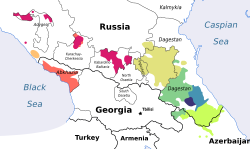
| Distribution of the Adyghe language in Adygea (2002) | |
| Northwest Caucasian languages in Turkey and the Caucasus | |
| Part of a series on the |
| Circassians Адыгэхэр |
|---|
| List of notable Circassians Circassian genocide |
| Circassian diaspora |
| Circassian tribes |
Surviving Destroyed or barely existing |
| Religion |
| Religion in Circassia |
| Languages and dialects |
|
| History |
Show
|
| Culture |
| Organizations |
| Political parties |
| Adyghe language |
|---|
Adyghe, [a] also known as West Circassian, [b] is a Northwest Caucasian language spoken by the western subgroups of Circassians. [3] [4] [5] Native to Circassia in the Caucasus, it is one of the two official languages of Adygea, the other being Russian. [6] It is spoken mainly in Turkey and Russia, as well as in Jordan, Syria, Iraq and Israel, where Circassians settled after the Circassian genocide by the Russian Empire. [7] Adyghe literary language (Adyghe: Литературабз) is largely based on the Temirgoy dialect, [8] which was chosen for its simplicity, [6] although there was significant input from Shapsug and Bzhedug dialects. [9]
Adyghe is closely related to the Kabardian or East Circassian language; [4] some reject the distinction between the two languages in favour of both being dialects of a unitary Circassian language. [4] [10] Despite phonological differences, Circassian languages are reciprocally intelligible, [10] with speakers being able to communicate. [6] [11] While the self-designation for both Adyghe and Kabardian language is Adyghe, in linguistic and administrative terms, "Adyghe" refers specifically to the language of the western tribes of Circassians, while "Kabardian" refers to the language of the two eastern tribes (Kabardians and Besleney). [6] Ubykh, Abkhaz and Abaza are more distantly related to Adyghe. [4]
Adyghe belongs to the Northwest Caucasian language family. Glottochronological studies suggest that the common Proto-Northwest Caucasian language split into the Circassian, Abkhaz, and Ubykh branches roughly 5,000 years ago. [9] For most of its history, Adyghe was an oral language. The folklore, particularly the Nart sagas, served as a repository for the language. [9] [12]
Besides native vocabulary, the Adyghe language has accepted loanwords from Turkic, Arabic, Persian, and Russian languages. [6] The appearance of Turkic loanwords in the Adyghe language can be dated to the 14th century due to interactions with the Golden Horde and Crimean Khanate. [13] Words such as chapych (kopeck) are pre-revolutionary loans from Russian, while internationalisms like revolutsiye (revolution) entered later. As a rule, the phonetic composition of borrowed words is adapted to the phonological system of the Adyghe language. [6]
Following the Circassian Genocide and expulsion in 1864, the majority of Adyghe speakers were scattered across the Ottoman Empire. [11] The language spoken in the diaspora has diverged from the literary forms in the Caucasus. Diaspora communities often use Arabic or Turkish loanwords where the literary language uses Russian ones. [6] [14]
Adyghe exhibits between 50 and 60 consonants depending on the dialect. All dialects possess a contrast between plain and labialized glottal stops. A very unusual minimal contrast, and possibly unique to the Abzakh dialect of Adyghe, is a three-way contrast between plain, labialized and palatalized glottal stops (although a palatalized glottal stop is also found in Hausa and a labialized one in Tlingit). The Shapsug (Black Sea) dialect of Adyghe contains a very uncommon sound: a voiceless bidental fricative [ h̪͆ ], which corresponds to the voiceless velar fricative [ x ] found in other varieties of Adyghe. This sound is only known to be used in the Black Sea dialect.
| Labial | Bidental | Alveolar | Post- alveolar | Alveolo- palatal | Retroflex | Velar | Uvular | Pharyngeal | Glottal | ||||||||||
|---|---|---|---|---|---|---|---|---|---|---|---|---|---|---|---|---|---|---|---|
| plain | lab. | plain | sib. | lab. | plain | lab. | plain | lab. | plain | lab. | plain | lab. | plain | lab. | |||||
| Nasal | m | n | |||||||||||||||||
| Plosive/ | ejective | pʼ | pʷʼ | tʼ | t͡sʼ | tʷʼ | t͡ʃʼ | t͡ʂʼ | kʼ | kʷʼ | |||||||||
| voiceless | p | t | t͡s | t͡sʷ | t͡ʃ | t͡ɕ 2 | t͡ɕʷ | t͡ʂ | k | kʷ | q | qʷ | ʔ | ʔʷ | |||||
| voiced | b | d | d͡z | d͡zʷ | d͡ʒ | d͡ʑ 2 | d͡ʑʷ | d͡ʐ | ɡ 1 | ɡʷ | |||||||||
| Fricative | ejective | ɬʼ | ʃʼ | ʃʷʼ | ɕʼ | ɕʷʼ | |||||||||||||
| voiceless | f | h̪͆ 2 | ɬ | s | ʃ | ʃʷ | ɕ | ɕʷ | ʂ | x | xʷ | χ | χʷ | ħ | |||||
| voiced | v 1 | ɮ | z | ʒ | ʒʷ | ʑ | ʑʷ | ʐ | ɣ | ʁ | ʁʷ | ||||||||
| Approximant | w | j | w | ||||||||||||||||
| Trill | r | ||||||||||||||||||
In contrast to its large inventory of consonants, Adyghe has only three phonemic vowels in a vertical vowel system. [19]
| Central | |
|---|---|
| Mid | ə |
| Near-open | ɐ |
| Open | aː |
Adyghe, like all Northwest Caucasian languages, has a basic subject–object–verb typology and is characterised by the ergative construction of sentences.
| А а [ aː ] | Б б [ b ] | В в [ v ] | Г г [ ɣ ] | Гу гу [ ɡʷ ] | Гъ гъ [ ʁ ] | Гъу гъу [ ʁʷ ] | Д д [ d ] |
| Дж дж [ d͡ʒ ] | Дз дз [ d͡z ] | Дзу дзу [ d͡ʐʷ ] | Е е [ja/aj] | Ё ё [jo] | Ж ж [ ʒ ] | Жъ жъ [ ʐ ] | Жъу жъу [ ʐʷ ] |
| Жь жь [ ʑ ] | З з [ z ] | И и [jə/əj] | Й й [ j ] | К к [ k ] | Ку ку [ kʷ ] | Къ къ [ q ] | Къу къу [ qʷ ] |
| Кӏ кӏ [ t͡ʃʼ ] | Кӏу кӏу [ kʷʼ ] | Л л [ ɮ ] or [ l ] | Лъ лъ [ ɬ ] | Лӏ лӏ [ ɬʼ ] | М м [ m ] | Н н [ n ] | О о [aw/wa] |
| П п [ p ] | Пӏ пӏ [ pʼ ] | Пӏу пӏу [ pʷʼ ] | Р р [ r ] | С с [ s ] | Т т [ t ] | Тӏ тӏ [ tʼ ] | Тӏу тӏу [ tʷʼ ] |
| У у [ w/əw ] | Ф ф [ f ] | Х х [ x ] | Ху ху [ xʷ ] | Хъ хъ [ χ ] | Хъу хъу [ χʷ ] | Хь хь [ ħ ] | Ц ц [ t͡s ] |
| Цу цу [ t͡ʂʷ ] | Цӏ цӏ [ t͡sʼ ] | Ч ч [ t͡ʃ ] | Чӏ чӏ [ t͡ʂʼ ] | Чъ чъ [ t͡ʂ ] | Ш ш [ ʃ ] | Шъ шъ [ ʂ ] | Шъу шъу [ ʂʷ ] |
| Шӏ шӏ [ ʃʼ ] | Шӏу шӏу [ ʂʷʼ ] | Щ щ [ ɕ ] | Ъ ъ [ ˠ ] | Ы ы [ ə ] | Ь ь [ ʲ ] | Э э [ a ] | Ю ю [ju] |
| Я я [jaː] | ӏ [ ʔ ] | ӏу [ ʔʷ ] |
The Adyghe alphabet contains some inconsistencies between visual representation and pronunciation which can be a point of confusion for learners. For example, while the letter Кӏ appears to represent [ kʼ ], it is actually pronounced as [ t͡ʃʼ ] (Чӏ). Conversely, Чӏ is pronounced as the retroflex [ t͡ʂʼ ] (Чӏъ). Additionally, Цу is pronounced as [ t͡ʂʷ ] (Чъу). The letter Г represents the fricative [ ɣ ] rather than the stop [ ɡ ], whereas the labialized Гу corresponds to the stop [ ɡʷ ].
| Гь гь [ ɡʲ ] | Джь джь [ ɡʲ ] | Кь кь [ kʲ ] | Кӏь кӏь [ kʲʼ ] | Сӏ сӏ [ sʼ ] | ӏь [ ʔʲ ] |
These letters are not part of the official alphabet, but they may appear in books that showcase the different dialects.
Widespread literacy in Adyghe did not exist until the modern era. The official alphabet for Adyghe is the Cyrillic script, which has been used since 1936.
In the 13th–15th centuries, as a result of the influence of Byzantine Empire and the Genoese Republic, Adyghe used Greek and, to a lesser extent, Italian (Latin) scripts. In the 14th century, along with Islam, the Arabic script was adopted for Adyghe. It was referred to as Ajam, a writing system for the native language based on the Perso-Arabic script. Since Adyghe has many more consonants than Arabic, the Ajam system required adding special diacritical marks or inventing new letters to represent sounds. [6]
In 1853, the Adyghe educator Umar Bersey published the first "Primer of the Circassian Language" based on the Arabic script. [6] [9] The Arabic script was used until 1927, when as a part of the Soviet "Latinisation" campaign, a Latin-based alphabet was adopted. It was developed by the linguist N.F. Yakovlev and the Adyghe scholar Daud Ashkhamaf. In the late 1930s, the script was converted to Cyrillic to align with Russian. [8]
| Date | Author / Creator | Script Base | Description & Historical Context |
|---|---|---|---|
| 17th Century | Evliya Çelebi | Arabic / Ottoman | Recorded Adyghe linguistic material in his travel notes. |
| c. 1820s (Early 19th Century) | Sheretluk Hadji-Notauk (Magomet Effendi) | Arabic | A Shapsug nobleman educated in the "Arab East", considered the founder of the Adyghe Enlightenment. He opened a school on the Bogundyr River and created one of the first Arabic-based Circassian grammars. However, he burned his manuscripts, "to preserve traditional oral culture against "civilizational" threats". |
| 1830s | Sultan Khan-Giray | Cyrillic | Adapted the Cyrillic alphabet for his ethnographic work "Notes on Circassia" to record Circassian legends. |
| 1840–1843 | Shora Nogmov (Нэгъумэ Шорэ) | Cyrillic / Arabic | A Kabardian noble who initially developed a Cyrillic alphabet (1840) before switching to Arabic/Persian (1843). |
| 1846 | Leonty Lyulye | Cyrillic | Published a dictionary using a modified Russian alphabet. Criticized by Pyotr Uslar for failing to reflect phonetics. |
| 1853 | Umar Bersey | Arabic | Published the "Primer of the Circassian Language" in Tiflis on March 14, 1853. This date is celebrated as the "Day of the Adyghe Language and Writing." |
| 1860s | Kazi Atazhukin & Pyotr Uslar | Cyrillic | Developed a Kabardian alphabet based on Cyrillic, believing the Russian script was politically and practically suitable for Caucasian languages. |
| 1897 | Tharxet Ahmet Cavit Pasha | Arabic | Created an alphabet later used in the newspaper Ghuaze (The Guide), published by the Circassian Union and Mutual Aid Society (1908–1923). |
| 1902–1912 | Various Diaspora Authors | Arabic / Latin | Various attempts in the Ottoman diaspora:
|
| 1918 | Seferbiy Siyukhov (S. Siyukhov) / Ahmed Bekukh | Arabic | Siyukhov prepared an alphabet for the Adyghe (West) dialect, officially adopted for teaching and publishing. It remained in use until 1927. |
| 1918–1929 | Blanau Batok | Latin / Arabic | Published a Latin primer (Çerkes Alfab) in Constantinople (1919) and an Arabic primer (Elifba El-Şerkesiyye) in Damascus (1929). |
| 1923 | N. F. Yakovlev | Cyrillic | A Cyrillic project proposed by Yakovlev prior to the shift toward Latinization. |
| 1927 | N. F. Yakovlev & D. A. Ashkhamaf | Latin (Adyghe) | Officially adopted for the West Circassian (Adyghe) language by the Regional Department of Public Education. It established the Temirgoy dialect as the literary standard. |
| 1936 | T'ut'e Borikey | Cyrillic | Early transition to Cyrillic for Kabardian. |
| 1937–1938 | N. F. Yakovlev & D. A. Ashkhamaf | Cyrillic | Due to shifting Soviet nationality policies, scripts were converted to Cyrillic. The Adyghe alphabet followed the Kabardian one (1936) in 1938. It uses di- and trigraphs (e.g., 'къ', 'кI') and remains the basis for the modern script. |
| 1952 | K’ube Şaban | Latin | A Latin alphabet prepared in the diaspora. |
| 1989 | Official Standard | Cyrillic | Legislative consolidation of the alphabet (66 signs).
|
| 2012 | R.I. Dawur (Даур Р. И) | Tamga / Symbols | Prepared "Circassian Calligraphy" (*Черкесская Каллиграфия*), attempting to create a unique alphabet by converting ancient family symbols (Tamgas) into letters. |
| 2012 | Ali İhsan Tarı | Latin | Prepared by the founder of the Adyghe Language Association in Konya. |
| 2018 | Nezhdet Meshvez | Cyrillic (Modified) | An experimental textbook replacing most digraphs/trigraphs with diacritical marks to simplify learning. |
In the diaspora, a new Latin alphabet based on the Turkish alphabet was designed to better facilitate Adyghe and Kabardian education in Turkey. [22]
| Cyrillic | Arabic | Latin [23] [24] [25] | IPA | Pronunciation | Examples |
|---|---|---|---|---|---|
| А а | ا | A a | [ aː ] | ачъэ, ače, 'goat'апчъы, apčy, 'they count' | |
| Б б | ب | B b | [ b ] | баджэ, badźe, 'fox'бэ, be, 'a lot' | |
| В в [c] | ڤ | V v | [ v ] | жъвэ, z̄ve, 'oar', лавэ, lave, 'lava' | |
| Г г | ݝ | G g | [ ɣ ] | гыны, gyny, 'powder'чъыгы, čygy, 'tree' | |
| Гу гу | گو | Gw gw | [ ɡʷ ] | гу, gw, 'heart'гущыӏ, gwśyx̧, 'word' | |
| Гъ гъ | غ | Ǧ ǧ | [ ʁ ] | гъатхэ, ǧatxe, 'spring'гъэмаф, ǧemaf, 'summer' | |
| Гъу гъу | غو | Ǧw ǧw | [ ʁʷ ] | гъунэгъу, ǧwneǧw, 'neighbour'гъунджэ, ǧwndźe, 'mirror' | |
| Д д | د | D d | [ d ] | дыджы, dydźy, 'bitter'дахэ, daxe, 'pretty' | |
| Дж дж | ج | Dź dź | [ d͡ʒ ] | джан, dźan, 'shirt'лъэмыдж, łemydź, 'bridge' | |
| Дз дз | ذ | Dz dz | [ d͡z ] | дзыо, dzyo, 'bag'дзын, dzyn, 'to throw' | |
| Дзу дзу | ذو | Dzy dzy | [ d͡ʐʷ ] | хьандзу, handzw, 'rick'хьандзуачӏ, handzwaç̌, '[lower] rick' | |
| Е е | ئە / ەي | É é, Je je [d] | [ ɜj ][ jɜ ] | ешэн, ješen, 'to catch'еплъын, jepłyn, 'to look at' | |
| Ё ё [c] | – | Jo jo | [ jo ] | ёлк, jolk, 'Christmas tree' | |
| Ж ж | ڒ | Ž ž | [ ʒ ] | жэ, že, 'mouth'жакӏэ, žaḉe, 'beard' | |
| Жъ жъ | ظ | Z̄ z̄ | [ ʐ ] | жъы, z̄y, 'old'жъажъэ, z̄az̄e, 'slow' | |
| Жъу жъу | ظو | Z̄w z̄w | [ ʐʷ ] | жъун, z̄wn, 'to melt'жъуагъо, z̄waǧo, 'star' | |
| Жь жь | ژ | Ź ź | [ ʑ ] | жьыбгъэ, źybǧe, 'wind'жьао, źao, 'shadow' | |
| З з | ز | Z z | [ z ] | занкӏэ, zanḉe, 'straight'зандэ, zande, 'steep' | |
| И и | ئي / ي | I i | [ ɘj ][ jɘ ] | ихьан, ihan, 'to enter'икӏыпӏ, iḉyṗ, 'exit' | |
| Й й | ي | J j | [ j ] | йод, jod, 'iodine'бай, baj, 'rich' | |
| К к [c] | ك | K k | [ k ] | кнопк, knopk, 'button'команд, komand, 'team; command' | |
| Ку ку | کو | Kw kw | [ kʷ ] | кушъэ, kws̄e, 'cradle'ку, kw, 'cart' | |
| Къ къ | ق | Q q | [ q ] | къалэ, qale, 'city'къэкӏон, qeḉon, 'to come' | |
| Къу къу | قو | Qw qw | [ qʷ ] | къухьэ, qwhe, 'ship'къушъхьэ, qws̄he, 'mountain' | |
| Кӏ кӏ | ڃ | Ķ ķ, Ḉ ḉ | [ kʼ ][ t͡ʃʼ ] [e] | кӏымаф, ḉymaf, 'winter'кӏыхьэ, ḉyhe, 'long'кӏэ, ķe, 'tail'шкӏэ, šķe, 'calf' | |
| Кӏу кӏу | ࢰو | Ķw ķw | [ kʷʼ ] | кӏон, ķon, 'to walk'кӏуакӏэ, ķwaḉe, 'gait' | |
| Л л | ل | L l | [ l ][ ɮ ] | лагъэ, laǧe, 'painted'лы, ly, 'meat' | |
| Лъ лъ | ݪ | Ł ł | [ ɬ ] | лъэбэкъу, łebeqw, 'step'лъащэ, łaśe, 'lame' | |
| Лӏ лӏ | ࢦ | Ļ ļ | [ ɬʼ ] | лӏы, ļy, 'man'лӏыгъэ, ļyǧe, 'bravery' | |
| М м | م | M m | [ m ] | мазэ, maze, 'moon'мэлы, mely, 'sheep' | |
| Н н | ن | N n | [ n ] | нэ, ne, 'eye'ны, ny, 'mother' | |
| О о | ئۆ / ۆ | O o | [ ɜw ][ wɜ ] | мощ, moś, 'that'коны, kony, 'bin'о, o, 'you'осы, osy, 'snow'ощхы, ośxy, 'rain' | |
| П п | پ | P p | [ p ] | пэ, pe, 'nose'сапэ, sape, 'dust' | |
| Пӏ пӏ | ࢠ | Ṗ ṗ | [ pʼ ] | пӏэ, ṗe, 'bed'пӏэшъхьагъ, ṗes̄haǧ, 'pillow' | |
| Пӏу пӏу | ࢠو | Ṗw ṗw | [ pʷʼ ] | пӏун, ṗwn, 'to rise; to adopt'пӏур, ṗwr, 'pupil; apprentice' | |
| Р р | ر | R r | [ r ] | рикӏэн, riḉen, 'to pour' Adyghe : риӏонrix̧on 'to tell' | |
| С с | س | S s | [ s ] | сэ, se, 'I, me'сэшхо, sešxo, 'sabre' | |
| Т т | ت | T t | [ t ] | тэтэжъ, tetez̄, 'grandfather'тэ, te, 'we, us' | |
| Тӏ тӏ | ط | Ţ ţ | [ tʼ ] | тӏы, ţy, 'ram'ятӏэ, jaţe, 'dirt' | |
| Тӏу тӏу | طو | Ţw ţw | [ tʷʼ ] | тӏурыс, ţwrys, 'old'тӏурытӏу, ţwryţw, 'pair' | |
| У у | و | U u, W w | [ ɘw ][ wɘ ] | ушхун, ušxwn, 'to straighten'убэн, uben, 'to tamp; to smoothen' | |
| Ф ф | ف | F f | [ f ] | фыжьы, fyźy, 'white'фэен, fejen, 'to want' | |
| Х х | ݗ | X x | [ x ] | хы, xy, 'sea; six'хасэ, xase, 'council' | |
| Хъ хъ | خ | Ḩ ḩ | [ χ ] | хъыен, ḩyjen, 'to move'пхъэн, pḩan, 'to sow' | |
| Хъу хъу | خو | Ḩw ḩw | [ χʷ ] | хъун, ḩwn, 'to happen'хъурай, ḩwraj, 'circle' | |
| Хь хь | ح | H h | [ ħ ] | хьэ, he, 'dog'хьаку, hakw, 'oven' | |
| Ц ц | ث | C c | [ t͡s ] | цагэ, cage, 'rib'цы, cy, 'body hair' | |
| Цу цу | ثو | Cw cw | [ t͡ʂʷ ] | цуакъэ, cwaqe, 'shoe'цу, cw, 'ox' | |
| Цӏ цӏ | ڗ | Ç ç | [ t͡sʼ ] | цӏынэ, çyne, 'wet'цӏыфы, çyfy, 'person' | |
| Ч ч | چ | Ć ć | [ t͡ʃ ] | чэфы, ćefy, 'cheerful'чэты, ćety, 'chicken' | |
| Чъ чъ | | Č č | [ t͡ʂ ] | чъыгай, čygaj, 'oak'чъыӏэčyx̧e 'cold' | |
| Чӏ чӏ | | Ç̌ ç̌ | [ t͡ʂʼ ] | чӏыпӏэ, ç̌yṗe, 'area'чӏыфэ, ç̌yfe, 'debt' | |
| Ш ш | | Š š | [ ʃ ] | шы, šy, 'brother'шыблэ, šyble, 'thunder' | |
| Шъ шъ | ص | S̄ s̄ | [ ʂ ] | шъэ, s̄e, 'hundred'шъабэ, s̄abe, 'soft' | |
| Шъу шъу | صو | S̄w s̄w | [ ʂʷ ] | шъугъуалэ, s̄wǧwale, 'envious'шъукъакӏу, s̄wqaķw, 'to come' | |
| Шӏ шӏ | ض | Ş̄ ş̄ | [ ʃʼ ] | шӏын, ş̄yn, 'to do'шӏэныгъ, ş̄enyǧ, 'knowledge' | |
| Шӏу шӏу | ضو | Ş̄w ş̄w | [ ʂʷʼ ] | шӏуцӏэ, ş̄wçe, 'black'шӏуфэс, ş̄wfes, 'greetings' | |
| Щ щ | ش | Ś ś | [ ɕ ] | щагу, śagw, 'yard'щатэ, śate, 'sour cream' | |
| (Ъ ъ) | – | – | – | ||
| Ы ы | ئہـ / ہ | Y y | [ ɘ ] | ыкӏи, yḉi, 'and also'зы, zy, 'one' | |
| (Ь ь) | – | – | [ ◌ʲ ] | ||
| Э э | ئە / ە | E e | [ ɜ ] | ӏэтажx̧etaž 'floor'нэнэжъ, nenez̄, 'grandmother' | |
| Ю ю | یو | Ju ju | [ ju ] | Юсыф, Jusyf, 'Joseph'Юныс, Junys, 'Jonah' | |
| Я я | یا | Ja ja | [ jaː ] | яй, jaj, 'theirs'ябгэ, jabge, 'evil' | |
| Ӏ ӏ | ئ | X̧ x̧ | [ ʔ ] | ӏэx̧e 'hand'кӏасэ, ḉase, 'like' | |
| Ӏу ӏу | ؤ | X̧w x̧w | [ ʔʷ ] | ӏукӏэнx̧wḉen 'to meet'ӏусынx̧wsyn 'to be sitting near'ӏуданx̧wdan 'thread' |
The vowels are written ⟨ы⟩[ə], ⟨э⟩[ɐ] and ⟨а⟩[aː]. Other letters represent diphthongs: ⟨я⟩ represents [jaː], ⟨и⟩[jə] or [əj], ⟨о⟩[wɐ] or [ɐw], ⟨у⟩ represent [wə] or [əw], and ⟨е⟩ represents [jɐ] or [ɐj].
The language of Adyghe is officially written in the Cyrillic script, and is also unofficially written in the Latin script. Before 1927, Adyghe was written in a version of the Perso-Arabic script; after the Soviet Latinisation campaign, an older variant of the Latin alphabet had been in use in the Soviet Union until 1938, when all Soviet languages transitioned into the Cyrillic alphabet.
Prior to the mid-19th century, Adyghe had no writing system. Starting from 1853, the process of creating an orthography for Adyghe was started. In Tbilisi in 1853, a document titled "Primer of the Circassian Language" (Archive) was published, in which an Perso-Arabic-based orthography influenced by the Ottoman Turkish alphabet was developed. This document became the first ever publication in Adyghe. In this document, several new letters were introduced to represent the consonants that exist in Adyghe language. This proposed orthography, although with many shortcomings, received widespread approval and usage. And thus, Perso-Arabic script became the accepted orthography for Adyghe. [26]
Over the following decades, several authors attempted to further improve the Adyghe Arabic orthography. The most successful attempt was the alphabet created by Akhmetov Bekukh. In this version, letters were designated for vowel sounds, and the orthography was transformed from an "Impure abjads to a true alphabet. In 1918, on the initiative of the Kuban Revolutionary Committee, a primer was published in Yekaterinodar. This official endorsement resulted in a literary boom in Adyghe and the publication of various newspapers, textbooks and other literature, including the Adyghe Maq , the main Adyghe language newspaper established in 1923. [26]
During the abovementioned decades, parallel with this process, the Perso-Arabic orthography had also been standardized for the sister Circassian language of Kabardian. Although very similar in many aspects, there were minor variations, in which letters were included based on each respective phonology, and there were minor differences in presentation of a few consonants as well. [26] [27]
Below table shows the Adyghe Perso-Arabic alphabet as it was officially adopted between 1918 and 1927. [26] [28]
| Forms | IPA | Adyghe Cyrillic equivalent | Adyghe Latin equivalent (1927–1938) | Unicode | Notes | |||
|---|---|---|---|---|---|---|---|---|
| Isolated | Final | Medial | Initial | |||||
| ا | ـا | ـا | آ | [ aː ] | А а | ᴀ | U+0622 U+0627 | |
| ئ | ـئ | ـئـ | ئـ | [ ʔ ] | Ӏ ӏ | h | U+0626 |
|
| ؤ | ـؤ | - | - | [ ʔʷ ] | Ӏу ӏу | hv | U+0624 | |
| ە | ـە | - | ئە | [ a ] | Э э Е е1 | e | U+06D5 |
|
| ہ | ـہ | ـہـ | ئہـ | [ ə ] | Ы ы | ə | U+06C1 and U+200D 1 |
|
| ب | ـب | ـبـ | بـ | [ b ] | Б б | ʙ | U+0628 | |
| ت | ـت | ـتـ | تـ | [ t ] | Т т | t | U+062A | |
| ث | ـث | ـثـ | ثـ | [ t͡s ] | Ц ц | c | U+062B | |
| پ | ـپ | ـپـ | پـ | [ p ] | П п | ᴘ | U+067E | |
| ࢠ | ـࢠ | ـࢠـ | ࢠـ | [ pʼ ] | Пӏ пӏ | | U+08A0 | |
| ن | ـن | ـنـ | نـ | [ n ] | Н н | n | U+0646 | |
| ح | ـح | ـحـ | حـ | [ ħ ] | Хь хь | ɦ | U+062D | |
| ج | ـج | ـجـ | جـ | [ d͡ʒ ] | Дж дж | ǥ | U+062C | |
| خ | ـخ | ـخـ | خـ | [ χ ] | Хъ хъ | | U+062E | |
| ݗ | ـݗ | ـݗـ | ݗـ | [ x ] | Х х | x | U+0757 | |
| ڃ | ـڃ | ـڃـ | ڃـ | [ kʼ ][ tʃʼ ] | Кӏ кӏ1 | ⱪ | U+0683 |
|
| چ | ـچ | ـچـ | چـ | [ t͡ʃ ] | Ч ч | ꝁ | U+0686 | |
| | | | | [ t͡ʂ ] | Чъ чъ | đ | - 1 | |
| | | | | [ t͡ʃʼ ] | ЧI чI | | - 1 | |
| د | ـد | - | - | [ d ] | Д д | d | U+062F | |
| ذ | ـذ | - | - | [ d͡z ] | Дз дз | ᴣ | U+0630 | |
| ر | ـر | - | - | [ r ] | Р р | r | U+0631 | |
| ز | ـز | - | - | [ z ] | З з | z | U+0632 | |
| ژ | ـژ | - | - | [ ʑ ] | Жь жь | | U+0698 | |
| ڗ | ـڗ | - | - | [ t͡sʼ ] | Цӏ цӏ | | U+0697 | |
| ڒ | ـڒ | - | - | [ ʒ ] | Ж ж | | U+0692 | |
| س | ـس | ـسـ | سـ | [ s ] | С с | s | U+0633 | |
| | | | | [ ʃ ] | Ш ш | ħ | - 1 | |
| ش | ـش | ـشـ | شـ | [ ɕ ] | Щ щ | ʃ | U+0634 | |
| ص | ـص | ـصـ | صـ | [ ʂ ] | Шъ шъ | š | U+0635 | |
| ض | ـض | ـضـ | ضـ | [ ʃʼ ] | Шӏ шӏ | | U+0636 | |
| ط | ـط | ـطـ | طـ | [ tʼ ] | Тӏ тӏ | | U+0637 | |
| ظ | ـظ | ـظـ | ظـ | [ ʐ ] | Жъ жъ | ⱬ | U+0638 | |
| غ | ـغ | ـغـ | غـ | [ ʁ ] | Гъ гъ | | U+063A | |
| ݝ | ـݝ | ـݝـ | ݝـ | [ ɣ ] | Г г1 | | U+075D |
|
| ف | ـف | ـفـ | فـ | [ f ] | Ф ф | f | U+0641 | |
| ق | ـق | ـقـ | قـ | [ q ] | Къ къ | q | U+0642 | |
| ڤ | ـڤ | ـڤـ | ڤـ | [ v ] | В в | w | U+06A4 | |
| ک | ـک | ـکـ | کـ | [ k ] | К к | k | U+0643 | |
| گ | ـگ | ـگـ | گـ | [ g ] ([ gʷ ])1 | Г г (Гу гу) | g | U+06AF |
|
| ࢰ | ـࢰ | ـࢰـ | ࢰـ | [ kʼ ] ([ kʷʼ ])1 | Кӏ кӏ (Кӏу кӏу) | ⱪ | U+08B0 |
|
| ل | ـل | ـلـ | لـ | [ l ]/[ ɮ ] | Л л | l | U+0644 | |
| ݪ | ـݪ | ـݪـ | ݪـ | [ ɬ ] | Лъ лъ | | U+076A | |
| ࢦ | ـࢦ | ـࢦـ | ࢦـ | [ ɬʼ ] | Лӏ лӏ | | U+08A6 | |
| م | ـم | ـمـ | مـ | [ m ] | М м | m | U+0645 | |
| و | ـو | - | ئو / و | [ ɘw ][ wɘ ] | У у | v | U+0648 | |
| ی | ـی | ـیـ | ئیـ / یـ | [ i ] / [ j ] | И и Й й | i / j | U+06CC | |
| ۆ | ـۆ | - | ئۆ | [ ɜw ][ wɜ ] | О о | o | U+06C6 | |
The Adyghe orthography was officially switched to the Latin alphabet in 1927. The Adyghe Latin alphabet was compiled and finalized a year prior, in 1926. This alphabet was the sole official script in the Soviet Union. The Adyghe Latin alphabet consisted of 50 letters, many of them newly created, some even borrowed from Cyrillic. Another interesting feature of this iteration of the Adyghe Latin alphabet was that there was no distinction between lower case and upper case letters. Each letter only had one single case. [26]
Below table shows Adyghe Latin alphabet as it was officially adopted between 1927 and 1938. [26]
| Letter | ᴀ | ʙ | c | | d | ᴣ | e | ə | f | |
|---|---|---|---|---|---|---|---|---|---|---|
| IPA | [ aː ] | [ b ] | [ t͡s ] | [ t͡sʼ ] | [ d ] | [ d͡z ] | [ e ] | [ ə ] | [ f ] | |
| Letter | g | ǥ | ɦ | i | y | k | ꝁ | ʀ | ⱪ | l |
| IPA | [ ɡ ] | [ d͡ʒ ] | [ ħ ] | [ i ] | [ j ] | [ k ] | [ t͡ʃ ] | [ ʲ ] | [ kʼ ] | [ l ] |
| Letter | | | m | n | o | ᴘ | | q | r | s |
| IPA | [ ɬ ] | [ ɬʼ ] | [ m ] | [ n ] | [ o ] | [ p ] | [ pʼ ] | [ q ] | [ r ] | [ s ] |
| Letter | š | ʖ | ʃ | ħ | t | ƀ | u | v | x | |
| IPA | [ ʂ ] | [ ʃʼ ] | [ ɕ ] | [ ʃ ] | [ t ] | [ tʼ ] | [ u ] | [ w ] | [ x ] | [ χ ] |
| Letter | z | ⱬ | | | г | г̌ | đ | | h | w |
| IPA | [ z ] | [ ʐ ] | [ ʑ ] | [ ʒ ] | [ ʁ ] | [ ɣ ] | [ t͡ʂ ] | [ t͡ʃʼ ] | [ ʔ ] | [ v ] |
In 2012, the Circassian Language Association (Adyghe: Адыге Бзэ Хасэ, ABX; Turkish : Adıge Dil Derneği) in Turkey has issued a call for the Circassian people for the creation of a standard Latin script to be used by all Circassian people on the globe. [22] Their main motivation for the creation of this alphabet was that the majority of Circassian people live in Turkey and use the Latin alphabet in their daily life because they know Turkish. However, when trying to teach the language to the younger generation, teaching them a new alphabet takes time and makes the process more laborsome. ABX has created a Latin script based on the Turkish alphabet and chose the Abzakh dialect as their base because it is the dialect with the most speakers in Turkey. However, the alphabet employed by the Circassian Language Association has been criticized by others. Some suggested that they created the alphabet without a good understanding of the Circassian phonology and have not even considered former Latin alphabets used to write Circassian [29] and that the use of the Latin script would sever the ties with the homeland. [30] Despite the criticism, the CLA has obtained a €40,000 funding from the European Union for the recording of the Circassian language with a Latin script and the preparation of multi-media learning materials for the language, [31] and the materials created by ABX were accepted by the Ministry of National Education to be taught in Secondary Schools. [32] This decision was protested and legally objected by the Federation of Caucasian Associations (Turkish: Kafkas Dernekleri Federasyonu; KAFFED) who created the materials for Circassian and Abaza languages with the Cyrillic script; [33] however, the court ruled in favour of the Latin alphabet created by the CLA and continued the use of their alphabet in Circassian courses. [34] Some glyphs in the Temirgoy-based Cyrillic alphabet have no equivalent in the Abzakh-based Latin alphabet because of dialectal differences. The most notable of these differences is the lack of differentiation between post-alveolar, alveolo-palatal and retroflex sounds. Though there are some additional letters in the alphabet for Kabardian, the materials in the CLA website are primarily in Adyghe. [35]
| Latin | Aa | Bb | Cc | Ćć (1) | Çç (2) | Dd | Ee | Éé (3) | Ff |
|---|---|---|---|---|---|---|---|---|---|
| Cyrillic | А а | Б б | Дж дж | ЧI чI | Ч ч | Д д | Э э | Е е | Ф ф |
| IPA | [ aː ] | [ b ] | [ d͡ʒ ] | [ t͡ʃʼ ] | [ t͡ʃ ] | [ d͡z ] | [ ɜ ] | [ e ] | [ f ] |
| Latin | Gg | Ǵǵ | Ğğ | Hh | Ḣḣ | Iı | İi (3) | Jj | Kk |
| Cyrillic | Г г | Г г | Гъ гъ | Хь хь | Хъ хъ | Ы ы | И и | Ж ж | Къ къ |
| IPA | [ ɡ ] | [ ɣ ] | [ ʁ ] | [ ħ ] | [ χ ] | [ ə ] | [ i ] | [ ʒ ] | [ q ] |
| Latin | Ḱḱ | Ll | Ĺĺ | Mm | Nn | Oo (4) | Öö (4) | Pp | Ṕṕ |
| Cyrillic | К к | Л л | Лъ лъ | М м | Н н | О о | П п | Пӏ пӏ | |
| IPA | [ k ] | [ l ] | [ ɬ ] | [ m ] | [ n ] | [ o ] | [ p ] | [ pʼ ] | |
| Latin | Qq (1) | Rr | Ss | Śś | Šš | Şş | Tt | Ṫṫ | Uu (4) |
| Cyrillic | Кӏ кӏ | Р р | С с | Ц ц | Цӏ цӏ | Ш ш | Т т | Тӏ тӏ | У у |
| IPA | [ kʼ ] | [ r ] | [ s ] | [ t͡s ] | [ t͡sʼ ] | [ ʃ ] | [ t ] | [ tʼ ] | [ u ] |
| Latin | Üü (4) | Ww | Xx | Yy | Zz | Źź | ` (5) | Áá* | |
| Cyrillic | У у | Х х | Й й | З з | Дз дз | Ӏ ӏ | |||
| IPA | [ w ] | [ x ] | [ j ] | [ z ] | [ ɣ ] | (varies) | [ aː ] |
1) Ć is the equivalent of both Кӏ and Чӏ and shows the ejective potalveolar affricate. Qq, on the other hand, only corresponds to Кӏ and shows an ejective velar plosive.
2) Ç normally stands for Ч but when it is followed by Ü and Ö, it is equivalent to Цу in the Cyrillic script.
3) É and İ are not direct equivalents of Е and И. The Cyrillic letters denote the [jɜ] and [jə] sounds at the beginning of syllables and [e] and [i] sounds at the end. The Latin letters are only used for the sounds [e] and [i]. The diphthongs are written as "Ye" and "Yi", respectively.
4) Circassian languages do not have phonemic rounded vowels but the labialized consonants affect the vowels around them to create allophonic rounded vowels. [36] The letters O, Ö, U and Ü are used to show these allophonic rounded vowels. O/Ö and U/Ü works similar to the vowel use О and У in the Adyghe Cyrillic alphabet with O/Ö showing labialized consonant+[ɜ] combinations and U/Ü the labialized consonant+[ə] combinations. However, Ö and Ü are used when these combinations occur next to postalveolar sounds (Ş, J, Ç). The diphthongal uses of О and У, i.e. [wɜ] and [wə], are written as "We" and "Wı". Another use of Ö and Ü is writing Turkish loanwords containing these letters.
5) Wıçüpe (уцупэ; the place of stopping) is written with a ` (accent grave) or ' (apostrophe) and has a complicated use. It is equivalent to Ӏ (palochka) in its use an ejective marker but not as the glottal stop. The glottal stop is not written as a letter but is implied through the use of consecutive vowels like in "mıerıs" (мыӀэрыс; apple). As many ejective sounds have their own letters (Ć, Ṕ, Q, Š, Ṫ), only some ejective sounds are written with the wıçüpe (ş`, ĺ`). Another use of wıçüpe is to show that an U at the end of a word represents a labialized consonant and not a labialized consonant + [ə] combination. For example, джэгу in Cyrillic is written cegu` to make sure that it is pronounced [d͡ʒɜgʷ] as a single syllable but wıçüpe is removed when the word takes a suffix and the allophonic [u] is audible, as in cegum [d͡ʒɜgum].
| Cyrillic | Latin [23] [24] | IPA | Translation |
|---|---|---|---|
| сэ | se | [sɐ] | I |
| пшъашъэ | ps̄as̄e | [p͡ʂaːʂɐ] | girl |
| тӏыс | ţys | [tʼəs] | to sit |
| тэдж | tedź | [tɐd͡ʒ] | to stand |
| Тэу ущыт? | Tew uśyt? | [tɐw‿wəʃət] | How are you? |
| Сышӏу. | Syş̄w. | [səʃʷʼ] | I'm fine. |
| шы | šy | [ʃə] | horse |
| щы | śy | [ɕə] | three |
| жъуагъо | z̄waǧo | [ʐʷaːʁʷɐ] | star |
| тыгъэ | tyǧe | [təʁɐ] | sun |
| мазэ | maze | [maːzɐ] | moon |
| цуакъэ | cwaqe | [t͡sʷaːqɐ] | shoe |
| шъукъеблагъ | s̄wqéblaǧ | [ʂʷəqɐjblaːʁ] | welcome |
| лъэхъуамбэ | łeḩwambe | [ɬɐχʷaːmbɐ] | toe |
| хьамлыу | hamlyw | [ħaːmləw] | worm |
| кӏэнкӏэ | ḉenḉe | [kʼɐŋkʼɐ] | egg |
| хьампӏырашъу | hamṗyras̄w | [ħaːmpʼəraːʂʷ] | butterfly |
| мэшӏоку | meş̄okw | [mɐʃʷʼɐkʷ] | train |
| пхъэтӏэкӏу | pḩeţeķw | [p͡χɐtʼɐkʷʼ] | chair |
| тхьалъыкӏо | thałyḉo | [t͡ħaːɬəkʷʼɐ] | prophet |
| къамзэгу | qamzegw | [qaːmzɐɡʷ] | ant |
| псычэт | psyćet | [p͡sət͡ʃɐt] | duck |
| Cyrillic | Latin | IPA | Translation | Etymology |
|---|---|---|---|---|
| республикэ | réspublike | [rʲespublʲikɐ] | republic | From Latin rēs pūblica ('public concern') via Russian республика. |
| компутер | komputér | [komputʲer] | computer | From Latin computāre ('to settle together') via Russian компьютер. |
| математикэ | matématike | [maːtʲemaːtʲikɐ] | mathematics | From Ancient Greek μάθημαmáthēma ('study, knowledge') via Russian математика. |
| спорт | sport | [sport] | sports | From English sport via Russian спорт. |
| быракъ | byraq | [bəraːq] | flag | Ultimately from Proto-Turkic *badrak ('spear; stick'). |
| къартӏоф | qārţof | [qaːrtʷʼɐf] | potato | From German Kartoffel ('potato') via Russian картофель. |
| томат | tomat | [tomaːt] | tomato | From Spanish tomate, which in turn derives from Nahuan tomatl, via Russian томат. |
| орэндж | orendź | [wɐrɐnd͡ʒ] | orange | From Persian نارنگ nârang or نارنج nâranj. |
| нэмаз | nemaz | [nɐmaːz] | salah (Islamic praying) | From Persian نماز namâz. |
| къалэ | qale | [qaːlɐ] | city | Akkadian kalakku ('fort'). |
| дунай | dunaj | [dəwnaːj] | earth | From Arabic دنيا dunyā ('world'). |
Adyghe is taught outside Circassia in Prince Hamza Ibn Al-Hussein Secondary School, a school for Jordanian Adyghes in Jordan's capital city of Amman. This school, established by the Jordanian Adyghes with support from the late king Hussein of Jordan, is one of the first schools for the Adyghe communities outside Circassia. It has around 750 Jordanian Adyghe students, and aims to preserve the Adyghe language and traditions among future generations. [37] [ better source needed ]
Adyghe is spoken by Circassians in Iraq and by Circassians in Israel, where it is taught in schools in their villages. It is also spoken by many Circassians in Syria, although the majority of Syrian Circassians speak Kabardian.[ citation needed ]
There are many books written in or translated into Adyghe. An Adyghe translation of the Quran by Iskhak Mashbash is available. [38] The New Testament and many books of the Old Testament have been published in Adyghe by the Institute for Bible Translation in Moscow.
According to the UNESCO 2009 map entitled "UNESCO Map of the World's Languages in Danger", the status of the Adyghe language in 2009, along with all its dialects (Adyghe, Western Circassian tribes; and Kabard-Cherkess, Eastern Circassian tribes), is classified as vulnerable. [39]
| Al-Fatiha in Adyghe | Transliteration [23] [24] | English translation | Arabic original |
|---|---|---|---|
1. Алахьэу гукӏэгъушӏэу, гукӏэгъу зыхэлъым ыцӏэкӏэ! | 1. Alahew gwḉeǧwş̄ew, gwḉeǧw zyzełym yçeḉe! | 1. In the name of Allah, the Entirely Merciful, the Especially Merciful! | ١-بِسْمِ اللَّهِ الرَّحْمَٰنِ الرَّحِيمِ |
| John 1:1–5 in Adyghe | Transliteration [23] [24] | English translation |
|---|---|---|
Ублапӏэм ыдэжь Гущыӏэр щыӏагъ. Ар Тхьэм ыдэжь щыӏагъ, а Гущыӏэри Тхьэу арыгъэ. Ублапӏэм щегъэжьагъэу а Гущыӏэр Тхьэм ыдэжь щыӏагъ. Тхьэм а Гущыӏэм зэкӏэри къыригъэгъэхъугъ. Тхьэм къыгъэхъугъэ пстэуми ащыщэу а Гущыӏэм къыримыгъгъэхъугъэ зи щыӏэп. Мыкӏодыжьын щыӏэныгъэ а Гущыӏэм хэлъыгъ, а щыӏэныгъэри цӏыфхэм нэфынэ афэхъугъ. Нэфынэр шӏункӏыгъэм щэнэфы, шӏункӏыгъэри нэфынэм текӏуагъэп. | Ublaṗem ydeź Gwśyx̧er śyx̧aǧ. Ar Them ydeź śyx̧aǧ, a Gwśyx̧eri Thew aryǧe. Ublaṗem śéǧeźaɡ̌ew a Gwśyx̧er Them ydeź śyx̧aǧ. Them a Gwśyx̧em zeḉeri qyriǧeǧeḩwǧ. Them qyǧeḩwǧe pstewmi aśyśew a Gwśyx̧em qyrimyǧǧeḩwǧe zi śyx̧ep. Myḉodyźyn śyx̧enyǧe a Gwśyx̧em xełyǧ, a śyx̧enyǧeri çyfxem nefyne afeḩwǧ. Nefyner ş̄wnḉyǧem śenefy, ş̄wnḉyǧeri nefynem téķwaǧep. | In the beginning was the Word, and the Word was with God, and the Word was a god. This one was in the beginning With God. All things came into existence through him, and apart from him not even one thing came into existence. What has come into existence by means of him was life, and the life was the light of men. And the light is shining in the darkness, but the darkness has not overpowered it. |
| UDHR in Adyghe [40] | Transliteration [23] [24] | IPA | English translation |
|---|---|---|---|
| Цӏыф пстэури шъхьэфитэу, ялъытэныгъэрэ яфэшъуашэхэмрэкӏэ зэфэдэу къалъфы. Акъылрэ зэхэшӏыкӏ гъуазэрэ яӏэшъы, зыр зым зэкъош зэхашӏэ азфагу дэлъэу зэфыщытынхэ фае. | Çyf pstewri s̄hefitew, jałytenyǧere jafes̄wašexemreḉe zefedew qałfy. Aqylre zexeş̄yḉ ǧwazere jax̧es̄y, zyr zym zeqoš zexaş̄e azfagw dełew zefyśytynxe faje. | [t͡sʼəf pstawərəj ʂ͡ħafəjtawə jaːɬətanəʁara jaːfaʂʷaːʃaxamrat͡ʃʼa zafadawə qaːɬfə aqəɮra zaxaʃʼət͡ʃʼ ʁʷaːzara jaːʔaʃə zər zəm zaqʷaʃ azfaːgʷ daɬawə zafəɕətənxa faːja] | All human beings are born free and equal in dignity and rights. They are endowed with reason and conscience and should act towards one another in a spirit of brotherhood. |
{{cite book}}: CS1 maint: location missing publisher (link){{cite book}}: CS1 maint: location missing publisher (link)